

10 Mark (Albert Schweitzer) – German Democratic Republic
Non-circulating coins
Commemoration: 100th Anniversary of Birth of Schweitzer
Germany
Context
Year: 1975
Country: Germany 
Issuer: German Democratic Republic 
Period:
(1949—1990)
Currency:
(1948—1990)
Demonetization: 30 June 1990
Total mintage: 102,140
Material
References
KM: #Click to copy to clipboard56
Numista: #43334
Value
Exchange value: 10 DDM
Bullion value: $30.41
Inflation-adjusted value: 34.03 DDM
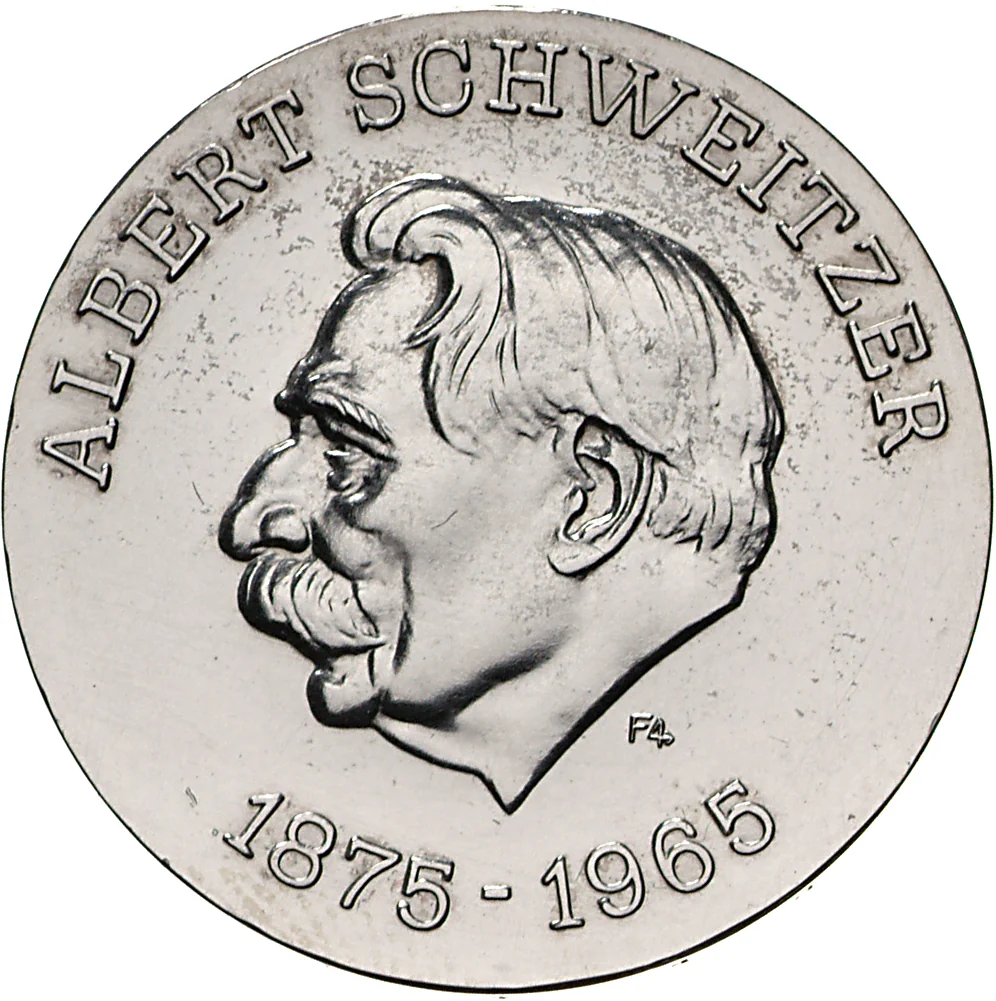
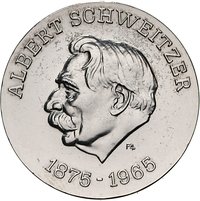
Obverse
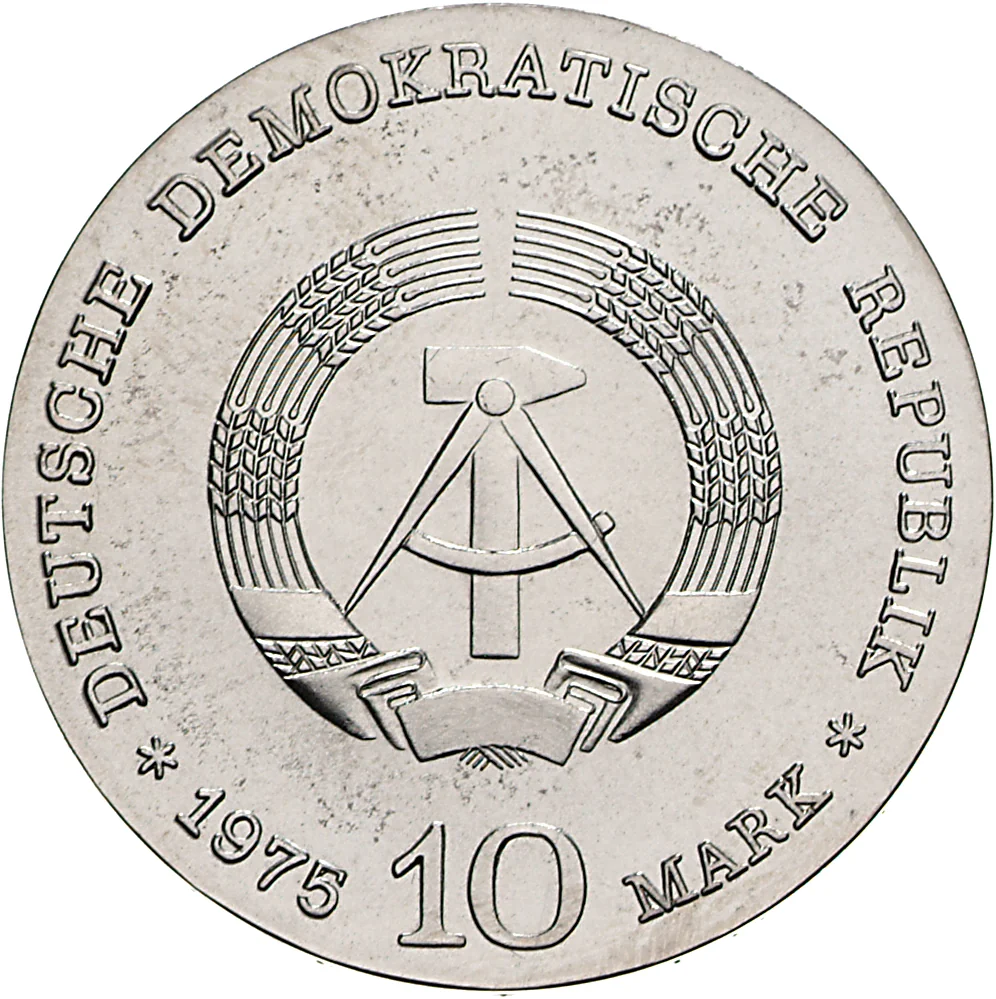
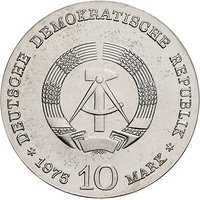
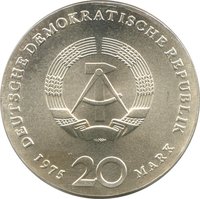
Reverse
Description:
Portrait of Albert Schweitzer in profile.
Inscription:
ALBERT SCHWEIZER
1875 - 1965
F4
1875 - 1965
F4
Script: Latin
Engravers: Axel Bertram, Wilfried Fitzenreiter
Edge
Smooth with inscription
Legend:
10 MARK * 10 MARK * 10 MARK *
Categories
| Event> Birth anniversary |
Mintings
| Year | Mint Mark | Mintage | Quality | Collection |
|---|---|---|---|---|
| 1975 | — | 101,100 | ||
| 1975 | — | 1,040 | Proof |
Historical background
In 1975, the currency situation in the German Democratic Republic (GDR) was defined by a strict dual-currency system that mirrored the country's divided economic reality. The official state currency was the GDR Mark (Mark der DDR), also known as the "Ostmark." It was a non-convertible currency, meaning it could not be legally exchanged for Western currencies on international markets and its value was artificially set by the state. Its primary function was within the domestic planned economy, where it was used for salaries and the purchase of domestically produced goods and services, which were often subject to shortages and a lack of variety.
Alongside the Ostmark, a parallel currency system existed involving the West German Deutsche Mark (DM). The DM circulated unofficially but was ubiquitously accepted in Intershops—state-run retail stores that sold high-quality imported goods, luxury items, and scarce products unavailable in regular GDR stores. Access to these shops was legally restricted to those possessing Western currency, creating a two-tiered society where citizens with relatives in the West or access to hard currency enjoyed a significantly higher standard of living. This system drained hard currency from the population into state coffers, which the SED regime desperately needed to service its foreign debt and import critical technology.
The year 1975 fell within an era of relative economic stabilization under Honecker's "Unity of Economic and Social Policy," which aimed to improve consumer supply and social benefits. However, this policy was financed by mounting foreign debt, largely in Western currencies. The fundamental instability of the Ostmark and the state's dependence on the DM highlighted the contradictions of the GDR's planned economy. It demonstrated the weakness of its currency on the world stage and the powerful magnetic pull of the West German economy, undermining the regime's ideological claims of economic parity and self-sufficiency.
Alongside the Ostmark, a parallel currency system existed involving the West German Deutsche Mark (DM). The DM circulated unofficially but was ubiquitously accepted in Intershops—state-run retail stores that sold high-quality imported goods, luxury items, and scarce products unavailable in regular GDR stores. Access to these shops was legally restricted to those possessing Western currency, creating a two-tiered society where citizens with relatives in the West or access to hard currency enjoyed a significantly higher standard of living. This system drained hard currency from the population into state coffers, which the SED regime desperately needed to service its foreign debt and import critical technology.
The year 1975 fell within an era of relative economic stabilization under Honecker's "Unity of Economic and Social Policy," which aimed to improve consumer supply and social benefits. However, this policy was financed by mounting foreign debt, largely in Western currencies. The fundamental instability of the Ostmark and the state's dependence on the DM highlighted the contradictions of the GDR's planned economy. It demonstrated the weakness of its currency on the world stage and the powerful magnetic pull of the West German economy, undermining the regime's ideological claims of economic parity and self-sufficiency.
🌟 Limited