

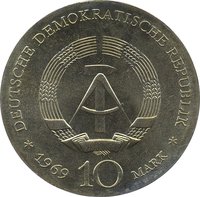
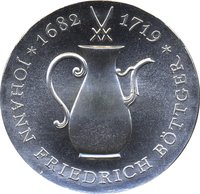
10 Mark (Johann Friedrich Böttger) – German Democratic Republic
Non-circulating coins
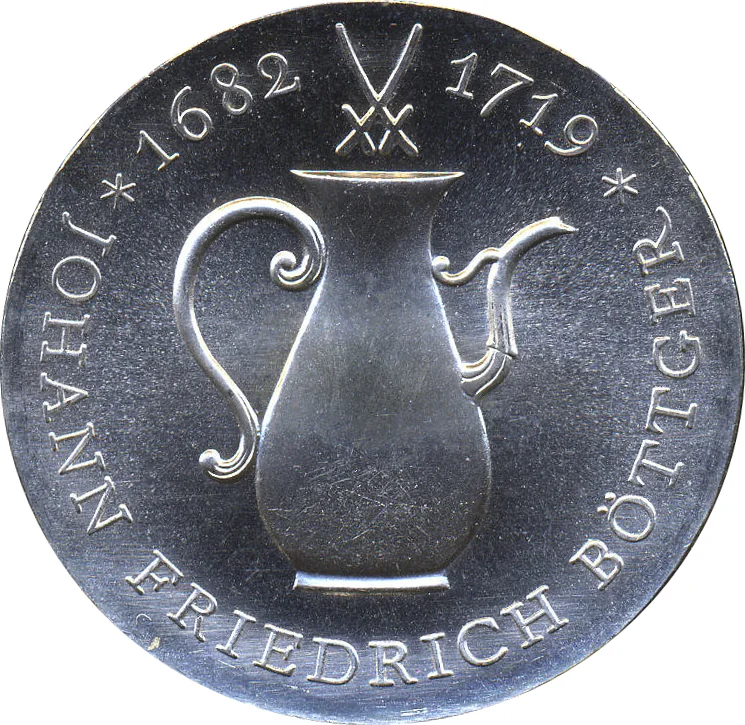
Commemoration: 250th Anniversary of Death of Johann Friedrich Böttger
Germany
Context
Year: 1969
Country: Germany 
Issuer: German Democratic Republic 
Period:
(1949—1990)
Currency:
(1948—1990)
Demonetization: 30 June 1990
Total mintage: 100,313
Material
References
KM: #Click to copy to clipboard24
Numista: #43330
Value
Exchange value: 10 DDM
Bullion value: $29.91
Inflation-adjusted value: 45.61 DDM
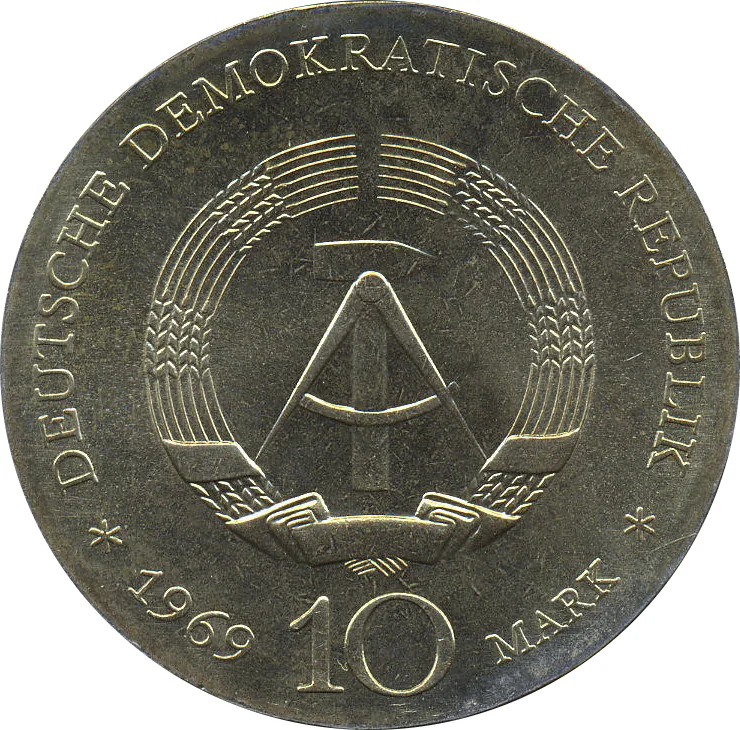
Obverse
Inscription:
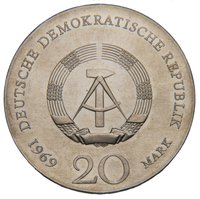
* DEUTSCHE DEMOKRATISCHE REPUBLIK *
1969 10 MARK
1969 10 MARK
Translation:
* GERMAN DEMOCRATIC REPUBLIC *
1969 10 MARK
1969 10 MARK
Script: Latin
Language: German
Engraver: Axel Bertram
Reverse
Edge
Smooth with inscription
Legend:
10 MARK * 10 MARK * 10 MARK *
Mintings
| Year | Mint Mark | Mintage | Quality | Collection |
|---|---|---|---|---|
| 1969 | A | 100,313 |
Historical background
In 1969, the currency situation in the German Democratic Republic (GDR) was defined by the rigid separation of its official currency, the GDR Mark (Mark der DDR), from both the West German Deutsche Mark (DM) and international markets. The currency was a non-convertible "soft currency," meaning it could not be legally exchanged for Western hard currencies at will. Its value was administratively set by the state and bore little relation to its actual purchasing power or international worth. Internally, this system was underpinned by a vast apparatus of state planning and price controls, which maintained an illusion of stability but masked growing inefficiencies and a widening gap in the quality and availability of goods compared to the West.
The reality for East German citizens and the state itself, however, was a pervasive and corrosive dual-currency system. The much-desired West German Deutsche Mark functioned as a powerful shadow currency, accessible on the black market at a highly inflated exchange rate (often 1:4 or 1:5 against the GDR Mark). This "Forum Check" system, where Western currency could be used in special Intershops, created a two-tiered society. Those with access to DM through relatives in the West or on the black market could purchase high-quality imported goods, while those reliant solely on GDR Marks faced shortages and an inferior selection. This undermined the state's ideology and exposed the weakness of its planned economy.
For the SED regime, the currency situation in 1969 was a source of both economic vulnerability and political control. The state itself was chronically short of hard currency, needed to import critical technology and pay international debts, leading to a constant battle to extract DM from its population through coercive measures and special stores. Politically, the inability to stabilize the currency or close the glaring gap with the West was a major failing. While the Berlin Wall (built in 1961) stopped the physical hemorrhage of people, the currency divide continued to highlight the GDR's relative economic decline, setting the stage for the severe debt crises and further monetary isolation that would characterize the 1970s and 1980s.
The reality for East German citizens and the state itself, however, was a pervasive and corrosive dual-currency system. The much-desired West German Deutsche Mark functioned as a powerful shadow currency, accessible on the black market at a highly inflated exchange rate (often 1:4 or 1:5 against the GDR Mark). This "Forum Check" system, where Western currency could be used in special Intershops, created a two-tiered society. Those with access to DM through relatives in the West or on the black market could purchase high-quality imported goods, while those reliant solely on GDR Marks faced shortages and an inferior selection. This undermined the state's ideology and exposed the weakness of its planned economy.
For the SED regime, the currency situation in 1969 was a source of both economic vulnerability and political control. The state itself was chronically short of hard currency, needed to import critical technology and pay international debts, leading to a constant battle to extract DM from its population through coercive measures and special stores. Politically, the inability to stabilize the currency or close the glaring gap with the West was a major failing. While the Berlin Wall (built in 1961) stopped the physical hemorrhage of people, the currency divide continued to highlight the GDR's relative economic decline, setting the stage for the severe debt crises and further monetary isolation that would characterize the 1970s and 1980s.
🌟 Limited