

5 Mark (Ferdinand von Schill) – German Democratic Republic
Circulating commemorative coins
Commemoration: 200th Anniversary of Birth of Ferdinand von Schill
Germany
Context
Year: 1976
Country: Germany 
Issuer: German Democratic Republic 
Period:
(1949—1990)
Currency:
(1948—1990)
Demonetization: 30 June 1990
Total mintage: 100,216
Material
Diameter: 29 mm
Weight: 12.2 g
Shape: Round
Composition: Nickel brass
Magnetic: No
Technique: Milled
Alignment: Medal alignment
flip
References
KM: #Click to copy to clipboard60
Numista: #43322
Value
Exchange value: 5 DDM
Inflation-adjusted value: 16.07 DDM
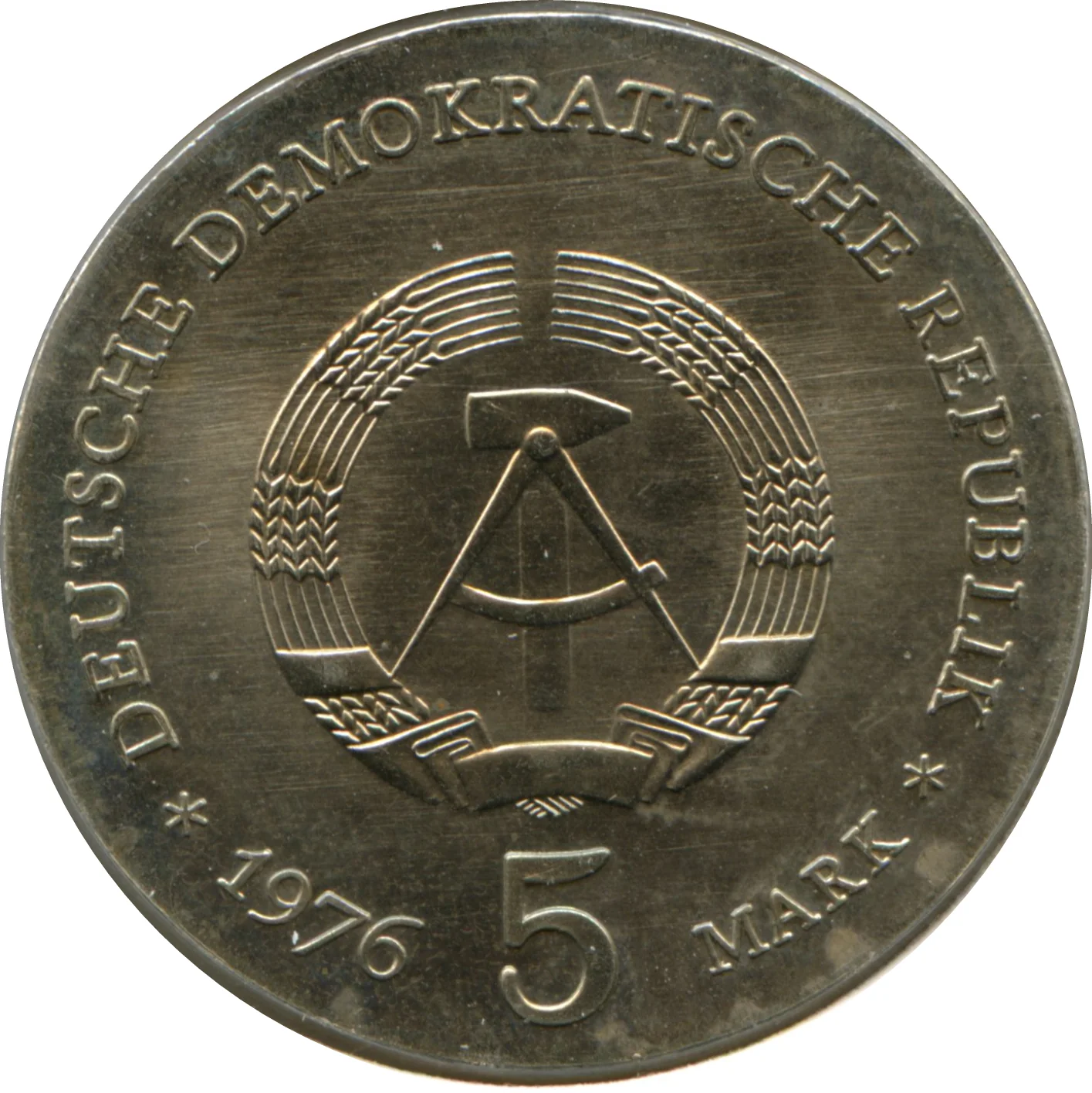
Obverse
Inscription:
* DEUTSCHE DEMOKRATISCHE REPUBLIK *
5 MARK
1976
5 MARK
1976
Translation:
GERMAN DEMOCRATIC REPUBLIC
5 MARK
1976
5 MARK
1976
Script: Latin
Language: German
Engraver: Axel Bertram
Reverse
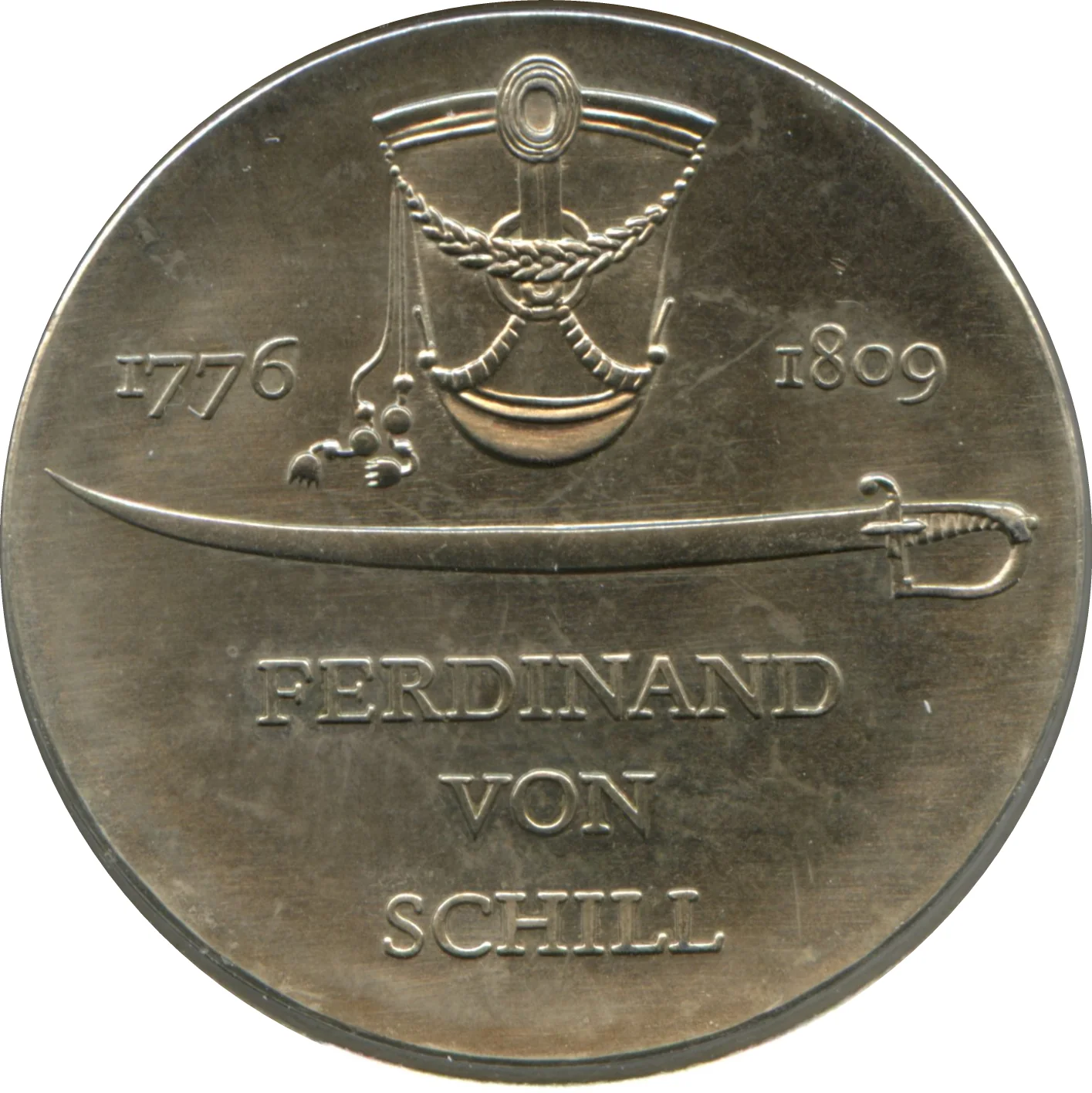
Description:
Shako hat and cavalry saber.
Inscription:
1776 1809
FERDINAND
VON
SCHILL
FERDINAND
VON
SCHILL
Script: Latin
Engraver: Axel Bertram
Edge
Smooth with inscription
Legend:
5 MARK * 5 MARK * 5 MARK * 5 MARK
Categories
| Event> Birth anniversary |
| Object> Cold weapons |
Mints
| Name | Mark |
|---|---|
| Berlin | A |
Mintings
| Year | Mint Mark | Mintage | Quality | Collection |
|---|---|---|---|---|
| 1976 | A | 100,216 |
Historical background
In 1976, the currency situation in the German Democratic Republic (GDR) was defined by the strict separation of its two distinct monetary systems: the internally used Mark der DDR (East Mark, M) and the externally targeted Forum Check. The East Mark was a non-convertible "soft currency," its value and utility artificially maintained by the state and disconnected from global markets. It was illegal for foreigners to possess, and its official exchange rate was set at parity with the West German Deutsche Mark (DM), a purely political fiction that bore no relation to its vastly weaker purchasing power or the black-market rate.
For essential hard currency, the state operated a parallel system. Western visitors were required to exchange a mandatory minimum of DM for Forum Checks, special vouchers valued at a 1:1 rate with the DM but only usable in exclusive Intershop and Delikat stores. These shops offered high-quality imported goods and luxury items unavailable for East Marks, creating a visible two-tier economy. This mechanism allowed the SED regime to confiscate desperately needed hard currency from Western tourists and from its own citizens, who often received DM gifts from relatives in the West, to service international debt and pay for critical imports.
This dual system underscored the broader economic contradictions of "real existing socialism" in the mid-1970s. While the GDR presented an image of stability and was considered the most prosperous Eastern Bloc economy, its currency regime revealed deep-seated weaknesses. The need to siphon off hard currency highlighted chronic shortages in the planned economy, productive inefficiencies, and a growing dependency on Western credit. The visible privilege of the Intershops, accessible only with Western money, also fostered public resentment, undermining the state's ideology of egalitarianism and exposing the gap between socialist rhetoric and material reality.
For essential hard currency, the state operated a parallel system. Western visitors were required to exchange a mandatory minimum of DM for Forum Checks, special vouchers valued at a 1:1 rate with the DM but only usable in exclusive Intershop and Delikat stores. These shops offered high-quality imported goods and luxury items unavailable for East Marks, creating a visible two-tier economy. This mechanism allowed the SED regime to confiscate desperately needed hard currency from Western tourists and from its own citizens, who often received DM gifts from relatives in the West, to service international debt and pay for critical imports.
This dual system underscored the broader economic contradictions of "real existing socialism" in the mid-1970s. While the GDR presented an image of stability and was considered the most prosperous Eastern Bloc economy, its currency regime revealed deep-seated weaknesses. The need to siphon off hard currency highlighted chronic shortages in the planned economy, productive inefficiencies, and a growing dependency on Western credit. The visible privilege of the Intershops, accessible only with Western money, also fostered public resentment, undermining the state's ideology of egalitarianism and exposing the gap between socialist rhetoric and material reality.
🌟 Uncommon