

1 leu (Reign of Carol I) – Romania
Add to wishlist
Circulating commemorative coins
Commemoration: 40th Anniversary of the Reign of Carol I
Romania
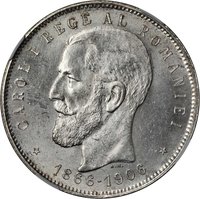
Obverse
Description:
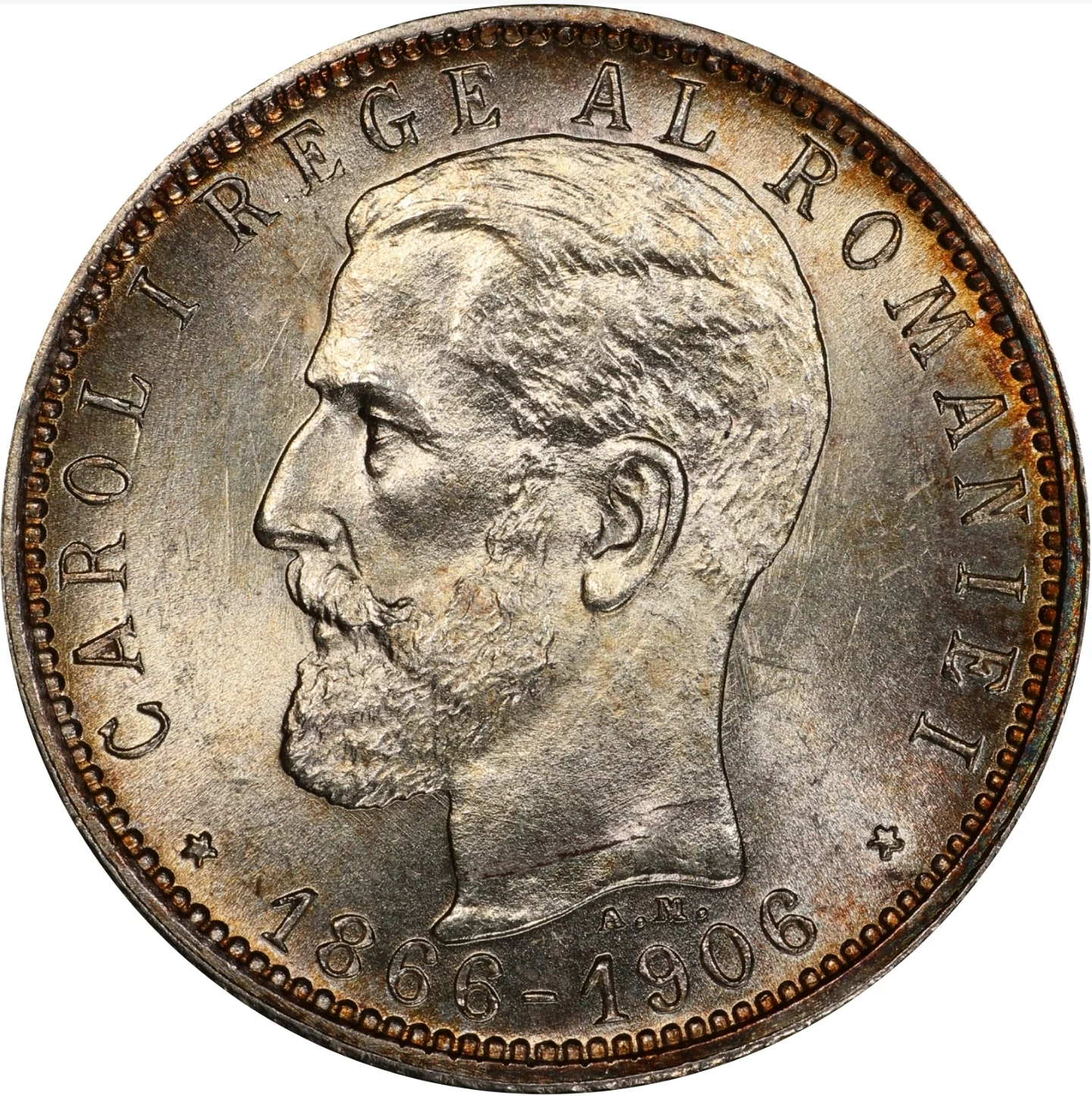
Left profile of King Carol I. Circular inscription: "CAROL I KING OF ROMANIA", years "1866 - 1906". Engraver's initials below neck. Outer beaded border.
Inscription:
CAROL I REGE AL ROMANIAEI
*1866-1906*
A.M.
*1866-1906*
A.M.
Translation:
Carol I King of Romania
*1866-1906*
A.M.
*1866-1906*
A.M.
Script: Latin
Engraver: Alphonse Michaux
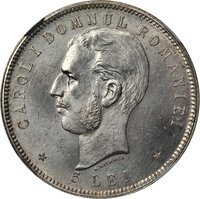
Reverse
Description:
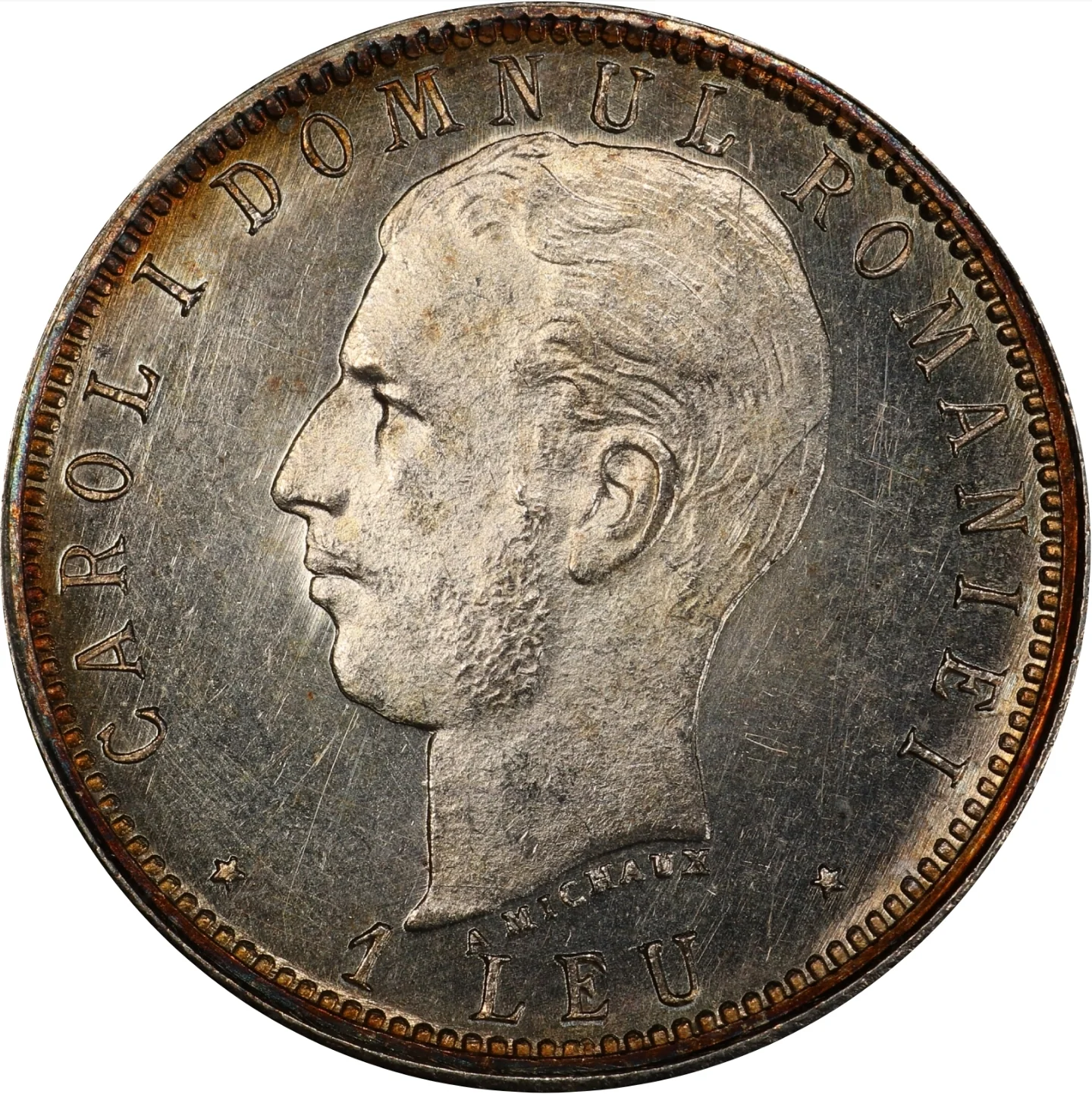
Prince Carol I facing left, with side whiskers. Circular legend: "CAROL I PRINCE OF ROMANIA", denomination "1 LEU". Engraver's name below neck. External grenetis.
Inscription:
CAROL I DOMNUL ROMANIEI
* 1 LEU *
A MICHAUX
* 1 LEU *
A MICHAUX
Translation:
CAROL I LORD OF ROMANIA
* 1 LEU *
MICHAUX
* 1 LEU *
MICHAUX
Script: Latin
Language: Romanian
Engraver: Alphonse Michaux
Edge
Reeded
Mints
| Name | Mark |
|---|---|
| Royal Mint of Belgium | — |
Mintings
| Year | Mint Mark | Mintage | Quality | Collection |
|---|---|---|---|---|
| 1906 | — | — | Proof | |
| 1906 | — | 2,500,000 |
Historical background
In 1906, Romania operated under a bimetallic currency system, though it was effectively transitioning towards a gold standard as part of a broader European trend and its own aspirations for economic modernization and international credibility. The official unit was the Romanian Leu (Lei), subdivided into 100 bani. By law, both gold and silver coins were legal tender, with the gold leu defined as 1/2900 of a kilogram of fine gold. However, the fixed ratio between gold and silver did not reflect global market values, leading to the practical disappearance of full-value gold coins from circulation, as they were often hoarded or exported.
The actual circulating medium was dominated by silver coins and, more problematically, a large volume of inconvertible paper money issued by the Banca Națională a României (National Bank of Romania). These banknotes, first issued during the Russo-Turkish War of 1877-78, were not freely redeemable for gold or silver, and their value fluctuated. This fiat system created periodic instability, exchange rate volatility, and inflationary pressures, which were concerns for both domestic commerce and foreign investors. The government and the National Bank were engaged in ongoing efforts to accumulate sufficient gold reserves to stabilize the leu and achieve full convertibility.
The currency situation was intrinsically linked to Romania's political ambitions. A stable, gold-backed leu was seen as essential for attracting foreign capital for infrastructure and industry, and for strengthening the country's sovereignty following its full independence in 1881. The drive for monetary reform culminated just a few years later, in 1890, when Romania formally adopted the gold standard, a move that was fully implemented and stabilized by the early 1900s. Therefore, by 1906, the system was in a relatively more stable phase, having recently solidified its gold-backed framework, which enhanced its financial standing in preparation for major future events like the 1906 Bucharest Jubilee Exhibition.
The actual circulating medium was dominated by silver coins and, more problematically, a large volume of inconvertible paper money issued by the Banca Națională a României (National Bank of Romania). These banknotes, first issued during the Russo-Turkish War of 1877-78, were not freely redeemable for gold or silver, and their value fluctuated. This fiat system created periodic instability, exchange rate volatility, and inflationary pressures, which were concerns for both domestic commerce and foreign investors. The government and the National Bank were engaged in ongoing efforts to accumulate sufficient gold reserves to stabilize the leu and achieve full convertibility.
The currency situation was intrinsically linked to Romania's political ambitions. A stable, gold-backed leu was seen as essential for attracting foreign capital for infrastructure and industry, and for strengthening the country's sovereignty following its full independence in 1881. The drive for monetary reform culminated just a few years later, in 1890, when Romania formally adopted the gold standard, a move that was fully implemented and stabilized by the early 1900s. Therefore, by 1906, the system was in a relatively more stable phase, having recently solidified its gold-backed framework, which enhanced its financial standing in preparation for major future events like the 1906 Bucharest Jubilee Exhibition.
🌱 Common