

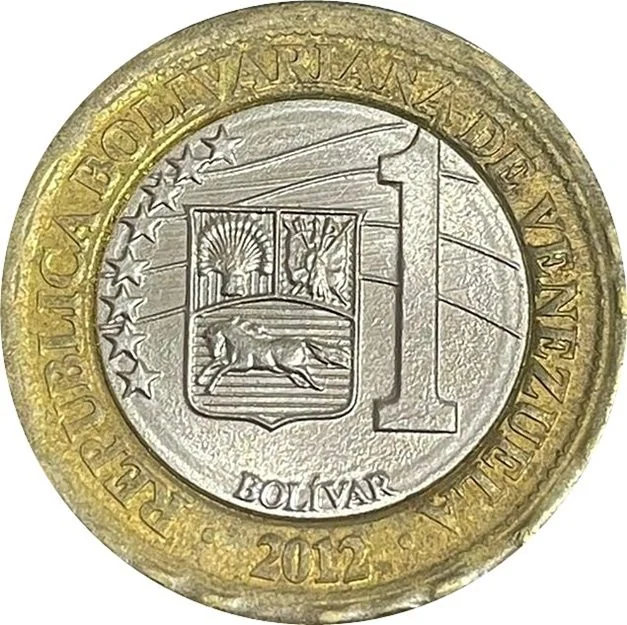
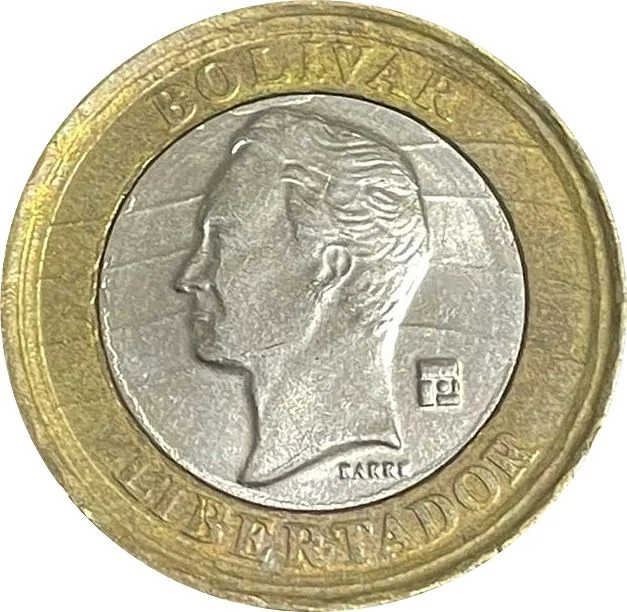
1 bolivar – Venezuela
Add to wishlist
Venezuela
Context
Year: 2012
Issuer: Venezuela
Period:
(since 1999)
Currency:
(2008—2018)
Demonetization: 3 December 2018
Material
References
Y: #
Numista: #431473
Value
Exchange value: 1 VEF
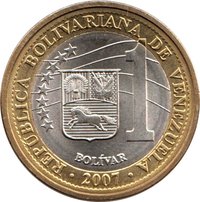
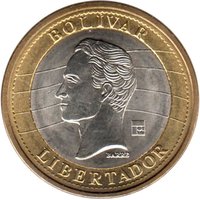
Obverse
Reverse
Edge
Smooth with inscription: value three times upright, three times inverted
Legend:
BCV1 1ΛƆB BCV1 1ΛƆB BCV1 1ΛƆB
Translation:
BONONIA DOCET BONONIA DOCET BONONIA DOCET
Language: Latin
Categories
| Animal> Horse |
| Person> Military leader |
| Person> Politician |
| Symbols> Coat of Arms |
Mints
| Name | Mark |
|---|---|
| Casa de la Moneda de Venezuela | — |
Mintings
| Year | Mint Mark | Mintage | Quality | Collection |
|---|---|---|---|---|
| 2012 | — | — |
Historical background
In 2012, Venezuela's currency situation was characterized by a heavily controlled and increasingly distorted multi-tier exchange rate system, a legacy of policies established by President Hugo Chávez. The government maintained an official fixed rate of 4.3 bolívares fuertes (VEF) to the US dollar, accessible only for imports deemed "essential" by the state, such as food and medicine. Alongside this, a second official rate of 5.3 VEF/$ was available through the Transaction System for Foreign Currency Denominated Securities (SITME). However, these rates were artificially strong and bore little relation to economic reality, creating a massive gap with the burgeoning black-market rate, which by year's end traded at over 15 VEF/$.
This complex system was underpinned by strict capital controls first implemented in 2003 to stem capital flight following a political crisis. While initially helping to stabilize reserves, the controls had fostered a lucrative arbitrage opportunity, where individuals and businesses with access to cheap official dollars could resell them or imported goods for immense profit. The government financed this subsidy through substantial oil revenues, which were near record highs in 2012, exceeding $100 per barrel. This high oil income temporarily masked the growing fiscal imbalances and the overvaluation of the currency, allowing the model to persist.
Despite the apparent stability provided by high oil prices, 2012 revealed the system's profound vulnerabilities. The widening gap between official and parallel rates encouraged massive corruption, drained international reserves, and created severe shortages of goods, as importers struggled to obtain dollars at the feasible rates. The death of President Chávez in March 2013 loomed, casting uncertainty over the future of these economic controls. Thus, while not yet in freefall, the currency regime in 2012 was a fragile house of cards, entirely dependent on unsustainable oil rents and setting the stage for the severe economic crisis that would deepen in the subsequent years.
This complex system was underpinned by strict capital controls first implemented in 2003 to stem capital flight following a political crisis. While initially helping to stabilize reserves, the controls had fostered a lucrative arbitrage opportunity, where individuals and businesses with access to cheap official dollars could resell them or imported goods for immense profit. The government financed this subsidy through substantial oil revenues, which were near record highs in 2012, exceeding $100 per barrel. This high oil income temporarily masked the growing fiscal imbalances and the overvaluation of the currency, allowing the model to persist.
Despite the apparent stability provided by high oil prices, 2012 revealed the system's profound vulnerabilities. The widening gap between official and parallel rates encouraged massive corruption, drained international reserves, and created severe shortages of goods, as importers struggled to obtain dollars at the feasible rates. The death of President Chávez in March 2013 loomed, casting uncertainty over the future of these economic controls. Thus, while not yet in freefall, the currency regime in 2012 was a fragile house of cards, entirely dependent on unsustainable oil rents and setting the stage for the severe economic crisis that would deepen in the subsequent years.
🌱 Common