

1 Sapeque – French Indochina
Context
Material
Diameter: 20 mm
Weight: 2 g
Shape: Round with a square hole
Composition: Bronze
Magnetic: No
Technique: Milled
Alignment: Coin alignment
flip
References
Numista: #429498
Value
Exchange value: 0.002 ICFP
Obverse
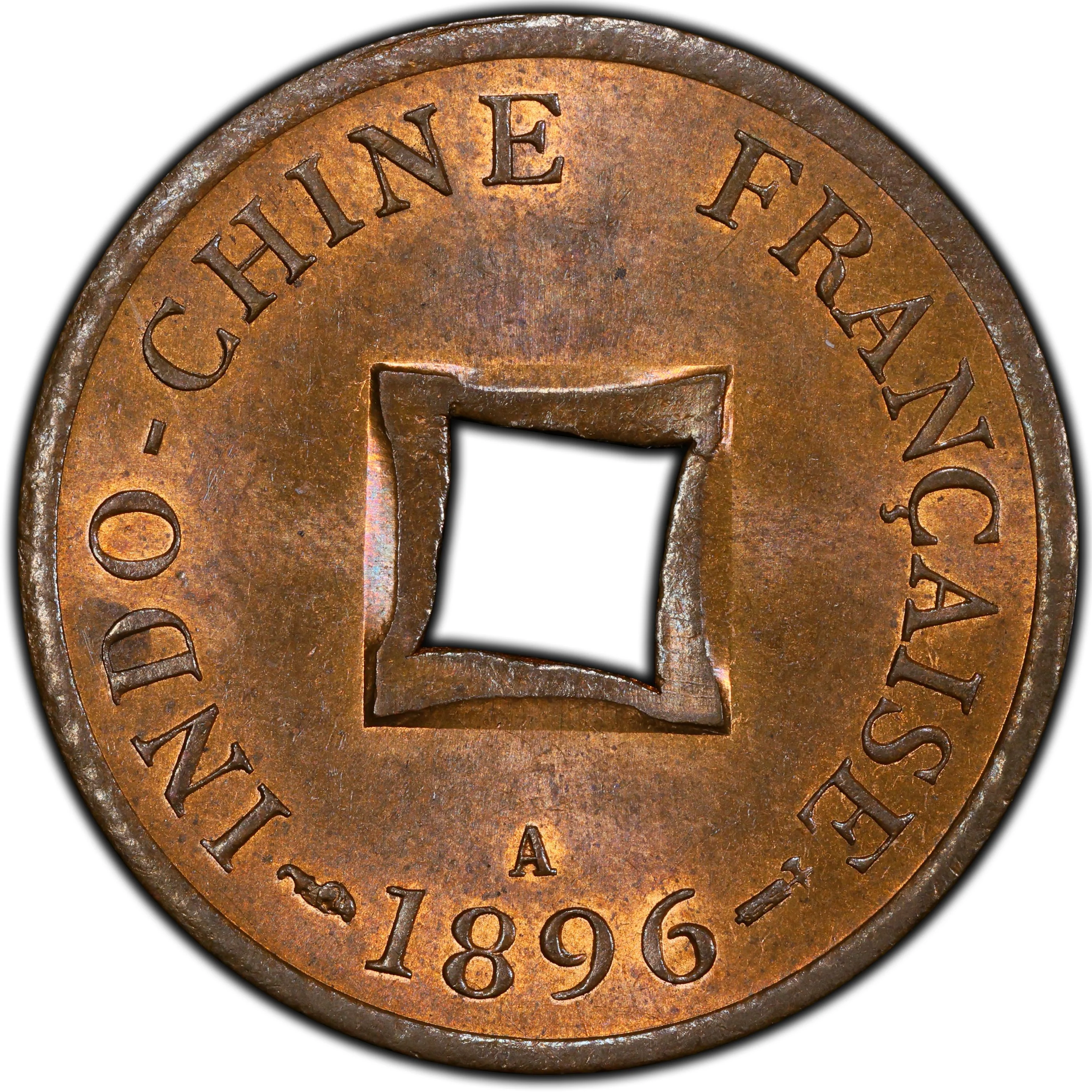
Description:
Lettering encircling square opening.
Inscription:
INDO-CHINE FRANÇAISE
A
1896
A
1896
Translation:
FRENCH INDO-CHINA
A
1896
A
1896
Script: Latin
Language: French
Engraver: Jean-Auguste Barre
Reverse
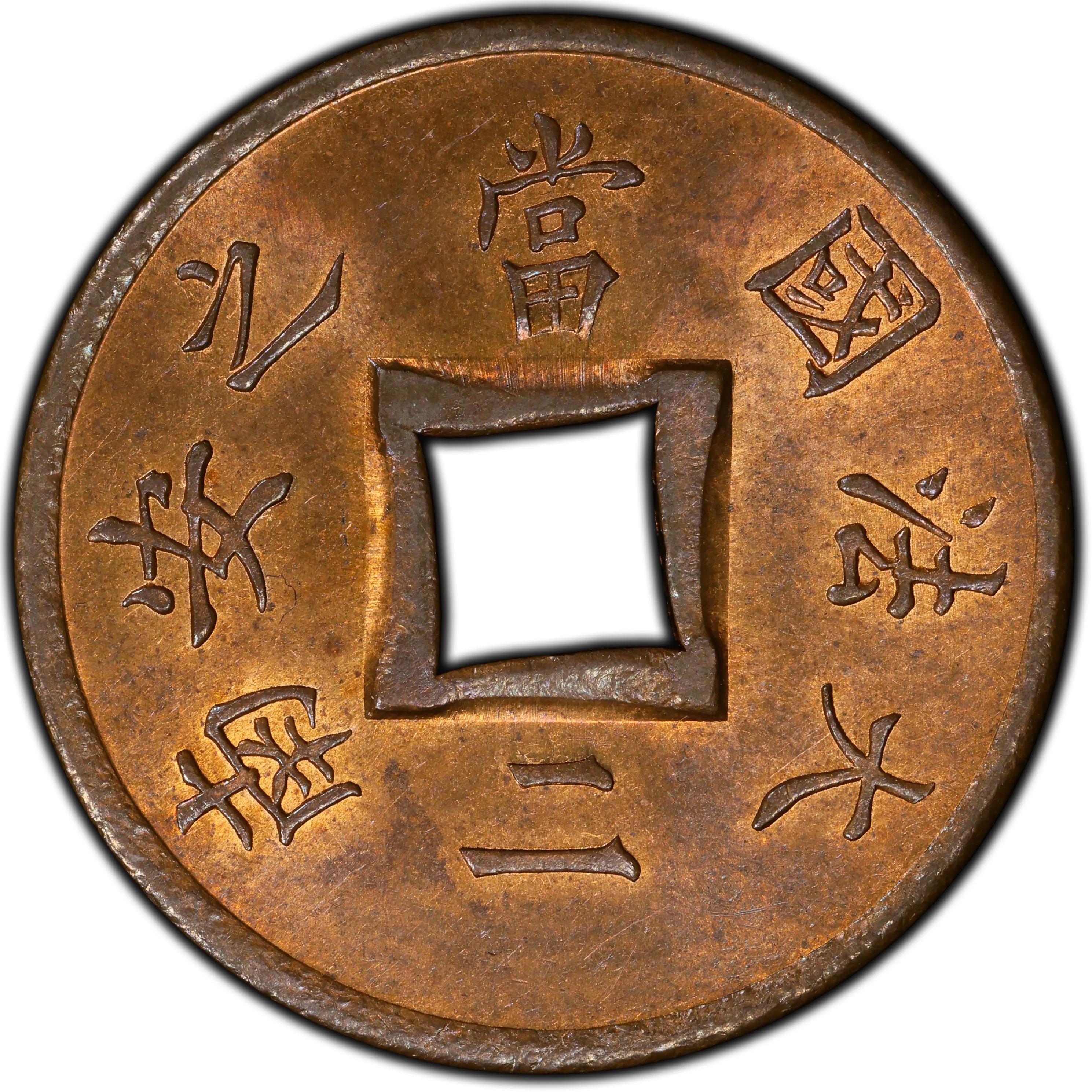
Description:
Chinese characters encircling a square opening.
Inscription:
南安之國法大
當二
當二
Translation:
State of Nan'an, Legal Tally
Value Two
Value Two
Script: Chinese
Language: Classical Chinese
Engraver: Jean-Auguste Barre
Edge
Plain
Mints
| Name | Mark |
|---|---|
| Monnaie de Paris | (A) |
Mintings
| Year | Mint Mark | Mintage | Quality | Collection |
|---|---|---|---|---|
| 1896 | A | — |
Historical background
In 1896, the currency situation in French Indochina was a complex and transitional system, reflecting the colony's recent political consolidation. The French had established the Union of Indochina (comprising Cochinchina, Annam, Tonkin, and Cambodia) just a decade prior, and were actively working to replace a multitude of existing currencies with a unified, French-controlled monetary system. The landscape was a patchwork of Mexican and Spanish silver piastres (still widely trusted in regional trade), Vietnamese zinc and copper cash coins, and French-issued silver piastres de commerce.
The cornerstone of French policy was the introduction of the Piastre de Commerce, a silver coin minted specifically for the colony. Legally set at a value equivalent to the Mexican silver dollar, its circulation was hampered by public skepticism and Gresham's Law, where overvalued or debased coinage drove "good" silver into hoarding or export. The colonial government had established the Bank of Indochina (Banque de l'Indochine) in 1875, granting it the exclusive right to issue banknotes. However, in 1896, these notes were still met with limited public acceptance, as the population, especially in rural areas, maintained a strong preference for tangible silver.
Consequently, the monetary economy was bifurcated. Major commercial transactions in port cities like Saigon and Haiphong were increasingly conducted in the French piastre or banknotes, while the vast interior and daily local markets still relied heavily on strings of zinc sapèque cash coins for small-scale trade. This period was thus characterized by an ongoing struggle by colonial authorities to impose a uniform, fiduciary currency and to centralize monetary sovereignty, a process that would take decades to fully realize across the region.
The cornerstone of French policy was the introduction of the Piastre de Commerce, a silver coin minted specifically for the colony. Legally set at a value equivalent to the Mexican silver dollar, its circulation was hampered by public skepticism and Gresham's Law, where overvalued or debased coinage drove "good" silver into hoarding or export. The colonial government had established the Bank of Indochina (Banque de l'Indochine) in 1875, granting it the exclusive right to issue banknotes. However, in 1896, these notes were still met with limited public acceptance, as the population, especially in rural areas, maintained a strong preference for tangible silver.
Consequently, the monetary economy was bifurcated. Major commercial transactions in port cities like Saigon and Haiphong were increasingly conducted in the French piastre or banknotes, while the vast interior and daily local markets still relied heavily on strings of zinc sapèque cash coins for small-scale trade. This period was thus characterized by an ongoing struggle by colonial authorities to impose a uniform, fiduciary currency and to centralize monetary sovereignty, a process that would take decades to fully realize across the region.
✨ Legendary