

10 francs – New Caledonia
Add to wishlist
France
Context
Years: 1972–2005
Country: France
Issuer: New Caledonia
Issuing organization: Overseas Institution of Issue
Period:
(since 1958)
Currency:
(since 1945)
Demonetization: 30 November 2022
Total mintage: 9,516,570
Material
References
KM: #
Numista: #1459
Value
Exchange value: 10 XPF
Inflation-adjusted value: 79.97 XPF
Obverse
Description:
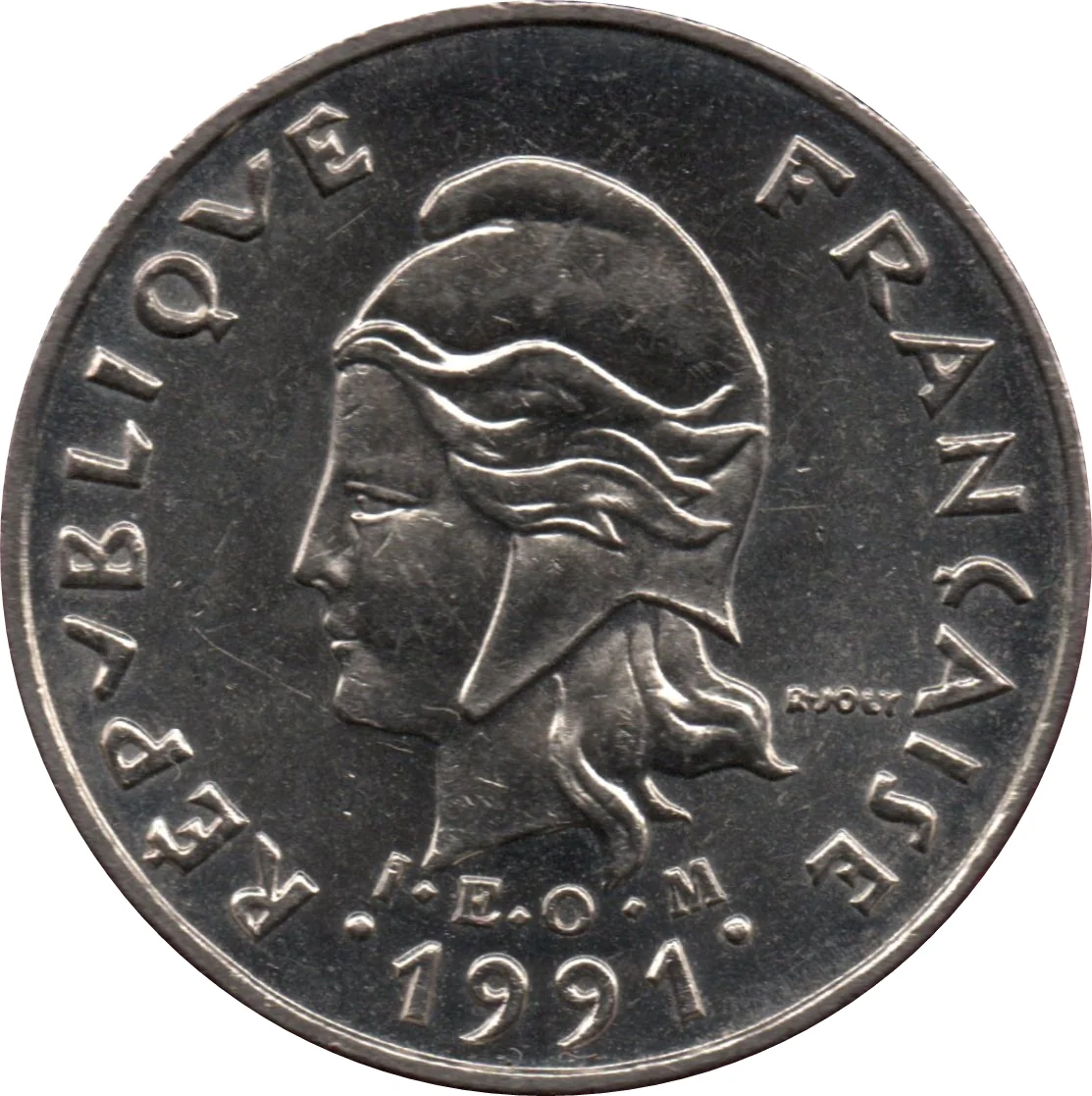
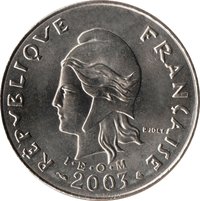
Marianne left, legend around, date below.
Inscription:
RÉPUBLIQUE FRANÇAISE
R·JOLY
I·E·O·M
1991
R·JOLY
I·E·O·M
1991
Translation:
FRENCH REPUBLIC
R·JOLY
I·E·O·M
1991
R·JOLY
I·E·O·M
1991
Script: Latin
Language: French
Engraver: Raymond Joly
Reverse
Description:
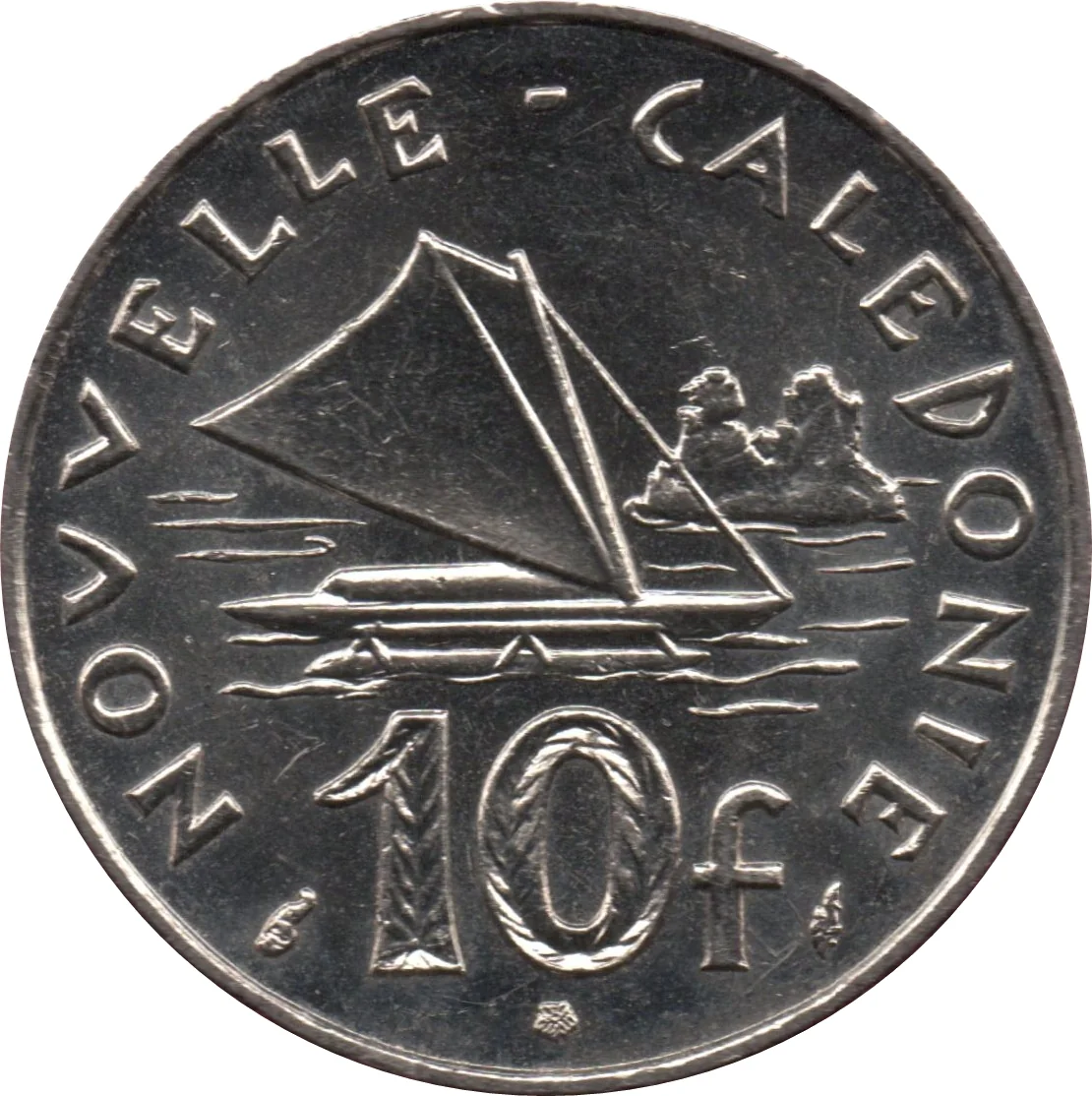
Sailing outrigger canoe from New Caledonia's Isle of Pines.
Inscription:
NOUVELLE - CALEDONIE
10f
10f
Translation:
NEW CALEDONIA
10 Francs
10 Francs
Script: Latin
Language: French
Engraver: Raymond Joly
Edge
Reeded
Categories
| Symbol> Allegory |
| Symbol> Phrygian cap |
| Transportation> Watercraft |
Mints
| Name | Mark |
|---|---|
| Monnaie de Paris | — |
Mintings
| Year | Mint Mark | Mintage | Quality | Collection |
|---|---|---|---|---|
| 1972 | — | 600,270 | ||
| 1973 | — | 400,100 | ||
| 1977 | — | 1,000,000 | ||
| 1983 | — | 800,200 | ||
| 1986 | — | 1,000,000 | ||
| 1989 | — | 500,000 | ||
| 1990 | — | 500,000 | ||
| 1991 | — | 500,000 | ||
| 1992 | — | 500,000 | ||
| 1995 | — | 200,000 | ||
| 1996 | — | 300,000 | ||
| 1997 | — | 300,000 | ||
| 1998 | — | 300,000 | ||
| 1999 | — | 500,000 | ||
| 2000 | — | 352,000 | ||
| 2001 | — | 100,000 | ||
| 2002 | — | 200,000 | ||
| 2003 | — | 800,000 | ||
| 2004 | — | 600,000 | ||
| 2005 | — | 64,000 |
Historical background
In 1972, New Caledonia's currency situation was defined by its status as a French overseas territory, operating fully within the French monetary system. The official currency was the CFP franc (Franc des Colonies Françaises du Pacifique), a currency created in 1945 and guaranteed by the French Treasury. Its value was pegged not to the metropolitan French franc at a fluctuating rate, but to a fixed benchmark: the French franc itself was still tied to the US dollar under the Bretton Woods system, so the CFP franc was indirectly anchored to the US dollar through this chain. This provided remarkable stability for the territory's economy, which was heavily dependent on nickel exports.
The year 1972 fell within the period of the "Nickel Boom," driven by high global demand. This economic surge created immense wealth for the mining industry and increased the flow of capital, all conducted in CFP francs. However, the currency's fixed parity and guaranteed convertibility primarily facilitated trade and financial integration with France, reinforcing the territory's economic dependence on the metropole. Local monetary policy was non-existent; it was entirely directed from Paris, reflecting the centralized colonial economic relationship.
This currency framework existed against a quiet but gathering political backdrop. While not yet a mass movement, indigenous Kanak political consciousness was growing, setting the stage for future debates about economic and political autonomy. In 1972, however, the question of a sovereign national currency was not yet a point of contention. The stability of the CFP franc was largely unquestioned in the business community, underpinning a booming export economy while symbolizing the deep and unchallenged administrative control France exerted over all aspects of New Caledonian life.
The year 1972 fell within the period of the "Nickel Boom," driven by high global demand. This economic surge created immense wealth for the mining industry and increased the flow of capital, all conducted in CFP francs. However, the currency's fixed parity and guaranteed convertibility primarily facilitated trade and financial integration with France, reinforcing the territory's economic dependence on the metropole. Local monetary policy was non-existent; it was entirely directed from Paris, reflecting the centralized colonial economic relationship.
This currency framework existed against a quiet but gathering political backdrop. While not yet a mass movement, indigenous Kanak political consciousness was growing, setting the stage for future debates about economic and political autonomy. In 1972, however, the question of a sovereign national currency was not yet a point of contention. The stability of the CFP franc was largely unquestioned in the business community, underpinning a booming export economy while symbolizing the deep and unchallenged administrative control France exerted over all aspects of New Caledonian life.
🌱 Very Common