

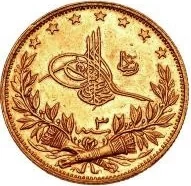
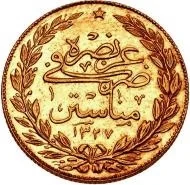
100 kurush – Ottoman Empire
Add to wishlist
Circulating commemorative coins
Commemoration: Manastir Mint Visit
Turkey
Context
Year: 1911
Islamic (Hijri) Year:: 1327
Country: Turkey
Issuer: Ottoman Empire
Ruler: Mehmed V Reşâd
Currency:
(1844—1923)
Demonetized: Yes
Total mintage: 750
Material
References
KM: #
Numista: #145856
Value
Bullion value: $1016.44
Obverse
Reverse
Edge
Mints
| Name | Mark |
|---|---|
| Manastır | — |
Mintings
| Year | Mint Mark | Mintage | Quality | Collection |
|---|---|---|---|---|
| 1911 | — | 750 |
Historical background
By 1911, the Ottoman Empire's currency system was a complex and fragile reflection of its broader political and economic decline. The empire operated on a bimetallic standard, but its primary unit was the gold-based Ottoman Lira (also called the Mecidiye), which was theoretically fixed in value to the British pound. However, the most common circulating currency was the silver Kuruş (piastre), with 100 kuruş equaling one lira. This created an unstable exchange rate between gold and silver on the international market, leading to frequent arbitrage and the flight of gold coins from circulation, which were often hoarded or exported.
The situation was exacerbated by chronic state debt and the empire's reliance on foreign loans. Since the Public Debt Administration (PDA) was established in 1881, a significant portion of Ottoman tax revenue was controlled by European creditors to service the massive external debt. This severely limited the state's financial autonomy and its ability to manage its currency effectively. Furthermore, a multitude of foreign currencies—including British sovereigns, French francs, and Austrian crowns—circulated freely within major commercial centers, undermining the sovereignty of the Ottoman monetary system and creating a de facto financial fragmentation.
Consequently, the Ottoman currency in 1911 suffered from a severe lack of public confidence, frequent devaluations, and inflationary pressures. The government's attempts to issue paper money (kaime) had historically led to disastrous hyperinflation, leaving a deep suspicion of banknotes. As the empire headed toward the Balkan Wars (1912-1913) and ultimately World War I, this precarious monetary foundation left it ill-equipped to handle the coming financial strains, setting the stage for the complete collapse of the Ottoman lira during the war years and its eventual replacement by the currencies of successor states.
The situation was exacerbated by chronic state debt and the empire's reliance on foreign loans. Since the Public Debt Administration (PDA) was established in 1881, a significant portion of Ottoman tax revenue was controlled by European creditors to service the massive external debt. This severely limited the state's financial autonomy and its ability to manage its currency effectively. Furthermore, a multitude of foreign currencies—including British sovereigns, French francs, and Austrian crowns—circulated freely within major commercial centers, undermining the sovereignty of the Ottoman monetary system and creating a de facto financial fragmentation.
Consequently, the Ottoman currency in 1911 suffered from a severe lack of public confidence, frequent devaluations, and inflationary pressures. The government's attempts to issue paper money (kaime) had historically led to disastrous hyperinflation, leaving a deep suspicion of banknotes. As the empire headed toward the Balkan Wars (1912-1913) and ultimately World War I, this precarious monetary foundation left it ill-equipped to handle the coming financial strains, setting the stage for the complete collapse of the Ottoman lira during the war years and its eventual replacement by the currencies of successor states.
✨ Legendary