

5 euro – Greece
Add to wishlist
Non-circulating coins
Commemoration: 200 year from the Battle of Samos
Greece
Context
Year: 2024
Issuer: Greece
Issuing organization: Bank of Greece
Period:
(since 1974)
Currency:
(since 2002)
Total mintage: 2,000
Material
References
KM: #
Numista: #427027
Value
Exchange value: 5 EUR
Inflation-adjusted value: 5.15 EUR
Obverse
Description:
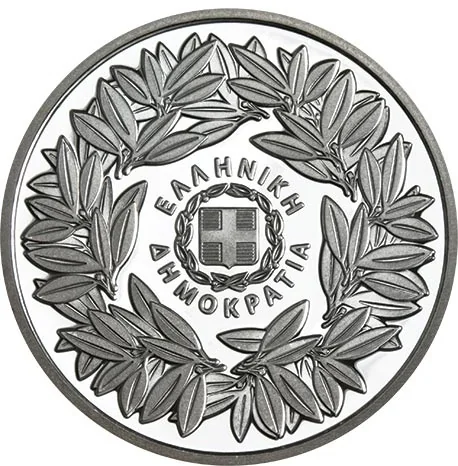
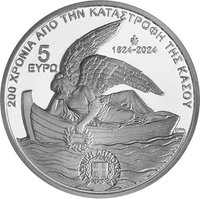
Greek coat of arms encircled by a wreath.
Inscription:
ΕΛΛΗΝΙΚΗ ΔΗΜΟΚΡΑΤΙΑ
Translation:
HELLENIC REPUBLIC
Script: Greek
Language: Greek
Designer: Geórgios Stamatópoulos
Reverse
Description:
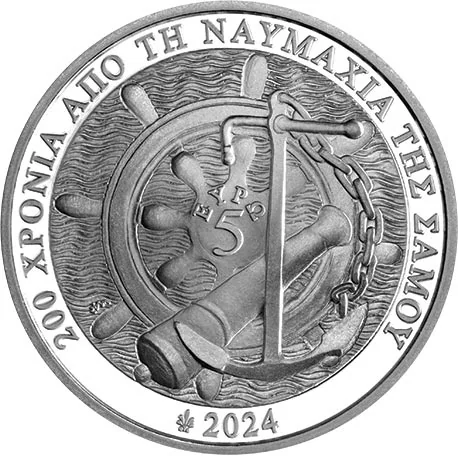
Ship's anchor, cannon, and tiller details.
Inscription:
200 ΧΡΟΝΙΑ ΑΠΟ ΤΗΝ NAYMAXIA ΤΗΣ ΣAMΟΥ
5 ΕΥΡΩ
2024
5 ΕΥΡΩ
2024
Translation:
200 YEARS FROM THE REVOLUTION OF SAMOS
5 EURO
2024
5 EURO
2024
Script: Greek
Language: Greek
Designer: Geórgios Stamatópoulos
Edge
Plain
Categories
| Object> Firearms |
| History> War |
| Transportation> Watercraft |
| Symbol> Anchor |
| Symbols> Coat of Arms |
| Symbol> Wreath |
Mints
| Name | Mark |
|---|---|
| National Mint of the Bank of Greece | — |
Mintings
| Year | Mint Mark | Mintage | Quality | Collection |
|---|---|---|---|---|
| 2024 | — | 2,000 | Proof |
Historical background
In 2024, Greece remains a full and integrated member of the Eurozone, using the euro (€) as its sole official currency. The acute financial crisis and the dramatic "Grexit" speculation of the previous decade have firmly receded. The country successfully exited its enhanced surveillance framework in 2022, marking the end of the era of strict bailout conditionality. While economic challenges persist, the debate is no longer about a return to the drachma but rather about achieving sustainable growth within the common currency area.
The current monetary situation is characterized by stability but also by the lasting effects of the crisis. The European Central Bank (ECB) sets monetary policy for Greece, which has benefited from historically low interest rates during the post-pandemic period, though it now contends with the ECB's tightening cycle to combat Eurozone-wide inflation. Greek banks have significantly reduced their non-performing loans, strengthening the financial system, yet credit expansion remains cautious. A key focus is on maintaining investor confidence to keep borrowing costs for the Greek state—which has seen its credit rating upgraded to investment grade by several agencies in late 2023—at manageable levels.
Looking ahead, the primary currency-related challenges for Greece are not about its form but its function within the national economy. The government's focus is on leveraging euro stability to attract investment, accelerate digital transactions, and further modernize the financial sector. Discussions at the European level, particularly regarding deeper Banking Union and Capital Markets Union integration, are highly relevant for Athens, as they promise to enhance the euro's effectiveness and reduce financial fragmentation. The overarching goal is to ensure that euro membership translates into tangible, equitable economic progress for the Greek population after years of austerity.
The current monetary situation is characterized by stability but also by the lasting effects of the crisis. The European Central Bank (ECB) sets monetary policy for Greece, which has benefited from historically low interest rates during the post-pandemic period, though it now contends with the ECB's tightening cycle to combat Eurozone-wide inflation. Greek banks have significantly reduced their non-performing loans, strengthening the financial system, yet credit expansion remains cautious. A key focus is on maintaining investor confidence to keep borrowing costs for the Greek state—which has seen its credit rating upgraded to investment grade by several agencies in late 2023—at manageable levels.
Looking ahead, the primary currency-related challenges for Greece are not about its form but its function within the national economy. The government's focus is on leveraging euro stability to attract investment, accelerate digital transactions, and further modernize the financial sector. Discussions at the European level, particularly regarding deeper Banking Union and Capital Markets Union integration, are highly relevant for Athens, as they promise to enhance the euro's effectiveness and reduce financial fragmentation. The overarching goal is to ensure that euro membership translates into tangible, equitable economic progress for the Greek population after years of austerity.
💎 Extremely Rare