

5 Lati (Bank of Latvia) – Latvia
Non-circulating coins
Commemoration: 90th Anniversary of the Bank of Latvia
Latvia
Context

Material
References
KM: #Click to copy to clipboard130
Numista: #42656
Value
Exchange value: 5 LVL
Bullion value: $65.41
Inflation-adjusted value: 7.54 LVL
Obverse
Description:
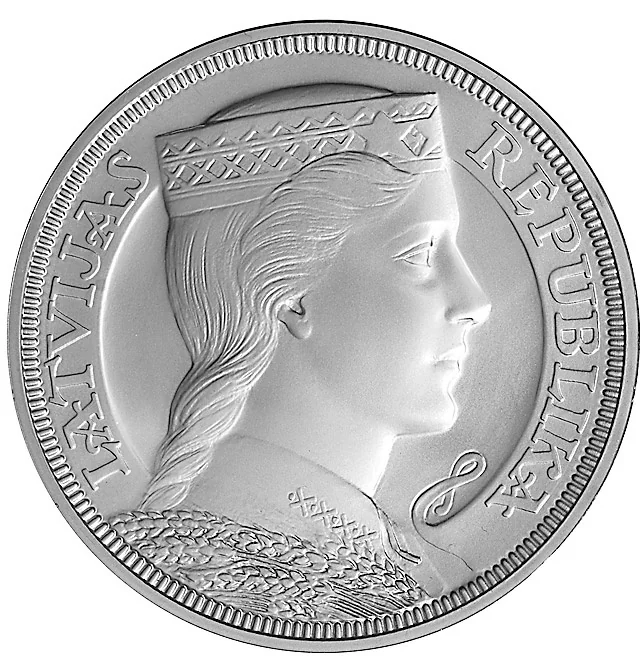
Maiden in folk costume holding grain. Inscription: LATVIJAS REPUBLIKA.
Inscription:
LATVIJAS REPUBLIKA
Translation:
Republic of Latvia
Script: Latin
Language: Latvian
Engraver: Rihards Zariņš
Reverse
Description:
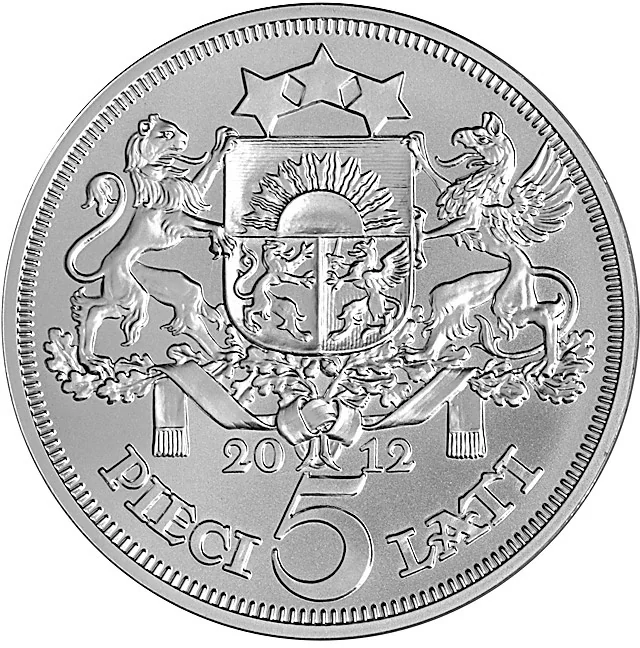
Latvia's coat of arms with denomination and issue year.
Inscription:
2012
5
PIECI LATI
5
PIECI LATI
Script: Latin
Engraver: Rihards Zariņš
Edge
Plain with inscriptions DIEVS, SVĒTĪ and LATVIJU, separated by three hexagonal stars.
Legend:
DIEVS ✶✶✶ SVĒTĪ ✶✶✶ LATVIJU ✶✶✶
Translation:
God bless Latvia.
Language: Latvian
Mints
| Name | Mark |
|---|---|
| Royal Mint | — |
Mintings
| Year | Mint Mark | Mintage | Quality | Collection |
|---|---|---|---|---|
| 2012 | — | 10,000 |
Historical background
In 2012, Latvia was in the final stages of a remarkable economic recovery, anchored by its steadfast commitment to its national currency, the lats (LVL), which was pegged to the euro. This peg had been a cornerstone of economic policy since the early 1990s, providing crucial stability. However, the period was defined by the aftermath of the devastating 2008-09 financial crisis, during which Latvia had undergone severe austerity measures and received an international bailout. By 2012, the economy was rebounding strongly, growing at one of the fastest rates in the EU, but the government's strategic focus was firmly set on joining the Eurozone to secure permanent monetary stability and deeper European integration.
The primary currency debate in 2012 revolved around the timeline and feasibility of adopting the euro, with the official target date set for January 1, 2014. To achieve this, Latvia needed to meet the EU's Maastricht convergence criteria, including benchmarks for inflation, budget deficits, debt levels, and exchange rate stability. A significant challenge emerged in early 2012 with a spike in inflation, partly driven by rising food and energy prices, which threatened to derail compliance with the strict inflation criterion. This caused domestic concern and public debate, as memories of the crisis were still fresh and many citizens were wary of switching to the euro, fearing it could lead to higher prices, similar to perceptions in other transitioning nations.
Despite these public reservations, the political and economic establishment was overwhelmingly in favor of euro adoption. The government, led by Prime Minister Valdis Dombrovskis, viewed it as the logical culmination of the lats' peg and a vital step to lock in financial stability, attract foreign investment, and reduce currency risk for its export-driven economy. By diligently maintaining the currency board arrangement and implementing prudent fiscal policies, Latvia successfully navigated the inflation hurdle and, in June 2013, received the European Commission's formal approval to join the euro. Thus, the currency situation in 2012 was a period of disciplined convergence, where Latvia successfully managed its peg while navigating the final technical and political hurdles on its path to replacing the lats with the euro.
The primary currency debate in 2012 revolved around the timeline and feasibility of adopting the euro, with the official target date set for January 1, 2014. To achieve this, Latvia needed to meet the EU's Maastricht convergence criteria, including benchmarks for inflation, budget deficits, debt levels, and exchange rate stability. A significant challenge emerged in early 2012 with a spike in inflation, partly driven by rising food and energy prices, which threatened to derail compliance with the strict inflation criterion. This caused domestic concern and public debate, as memories of the crisis were still fresh and many citizens were wary of switching to the euro, fearing it could lead to higher prices, similar to perceptions in other transitioning nations.
Despite these public reservations, the political and economic establishment was overwhelmingly in favor of euro adoption. The government, led by Prime Minister Valdis Dombrovskis, viewed it as the logical culmination of the lats' peg and a vital step to lock in financial stability, attract foreign investment, and reduce currency risk for its export-driven economy. By diligently maintaining the currency board arrangement and implementing prudent fiscal policies, Latvia successfully navigated the inflation hurdle and, in June 2013, received the European Commission's formal approval to join the euro. Thus, the currency situation in 2012 was a period of disciplined convergence, where Latvia successfully managed its peg while navigating the final technical and political hurdles on its path to replacing the lats with the euro.

💎 Very Rare