

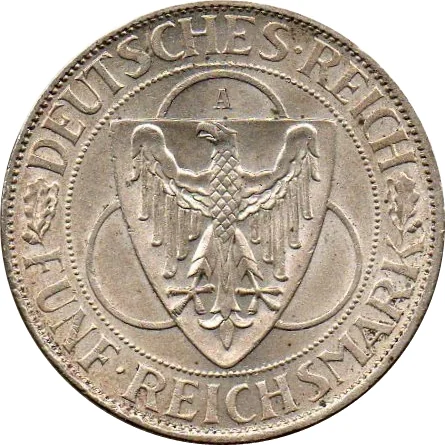
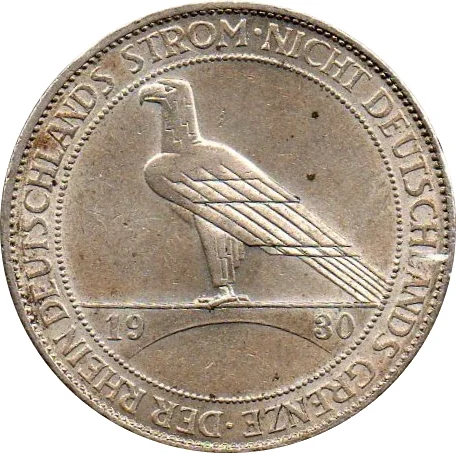
5 marks – Germany
Add to wishlist
Circulating commemorative coins
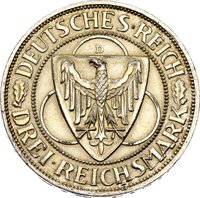
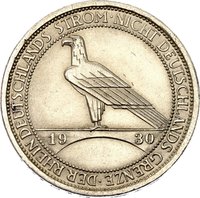
Commemoration: Liberation of Rhineland
Germany
Obverse
Reverse
Edge
Reeded
Mints
| Name | Mark |
|---|---|
| Berlin | A |
| Munich | D |
| Muldenhütten | E |
| Staatliche Münze Baden-Württemberg | F |
| Staatliche Münze Baden-Württemberg | G |
| Hamburgische Münze | J |
Mintings
Historical background
By 1930, Germany's currency situation was defined not by hyperinflation—that catastrophic episode had ended in 1924 with the introduction of the stable Rentenmark—but by a severe deflationary crisis under the burden of the Young Plan. The Weimar Republic’s public finances were strangled by enormous war reparations mandated by the Treaty of Versailles, which consumed a vast portion of government revenue. To manage these payments and stimulate the economy, Germany had become heavily reliant on short-term loans from American banks. The Wall Street Crash of 1929 abruptly ended this flow of foreign capital, triggering a desperate scramble for liquidity.
The government, led by Chancellor Heinrich Brüning, responded with a policy of brutal austerity to balance the budget and prove Germany could not afford its reparations. This "deflationary policy" involved drastic cuts to public spending, wages, and social benefits, while raising taxes. The result was a sharp contraction of the money supply within the economy. Prices and wages fell, but debt burdens became crushingly heavier in real terms. Unemployment skyrocketed, surpassing three million by 1930 and continuing to climb, plunging much of the population into poverty and eroding faith in democratic institutions.
This economic despair created a fertile political crisis. The deflationary spiral devastated the middle class and working poor, who felt betrayed by the traditional parties. Extremist groups on both the left and right gained massive support by blaming the crisis on the reparations regime, the Weimar "system," and often, virulently, on Jewish financiers. The political fragmentation led to frequent elections and unstable governments, setting the stage for the Nazi Party's electoral breakthrough in September 1930, where they became the second-largest party in the Reichstag by harnessing the widespread economic anger and fear. Thus, the currency and fiscal crisis of 1930 directly undermined the social and political stability of the Weimar Republic.
The government, led by Chancellor Heinrich Brüning, responded with a policy of brutal austerity to balance the budget and prove Germany could not afford its reparations. This "deflationary policy" involved drastic cuts to public spending, wages, and social benefits, while raising taxes. The result was a sharp contraction of the money supply within the economy. Prices and wages fell, but debt burdens became crushingly heavier in real terms. Unemployment skyrocketed, surpassing three million by 1930 and continuing to climb, plunging much of the population into poverty and eroding faith in democratic institutions.
This economic despair created a fertile political crisis. The deflationary spiral devastated the middle class and working poor, who felt betrayed by the traditional parties. Extremist groups on both the left and right gained massive support by blaming the crisis on the reparations regime, the Weimar "system," and often, virulently, on Jewish financiers. The political fragmentation led to frequent elections and unstable governments, setting the stage for the Nazi Party's electoral breakthrough in September 1930, where they became the second-largest party in the Reichstag by harnessing the widespread economic anger and fear. Thus, the currency and fiscal crisis of 1930 directly undermined the social and political stability of the Weimar Republic.
⭐ Rare