

10 Bolivars – Venezuela
Non-circulating coins
Commemoration: Centennial of Simon Bolivar in coins.
Venezuela
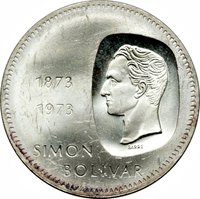
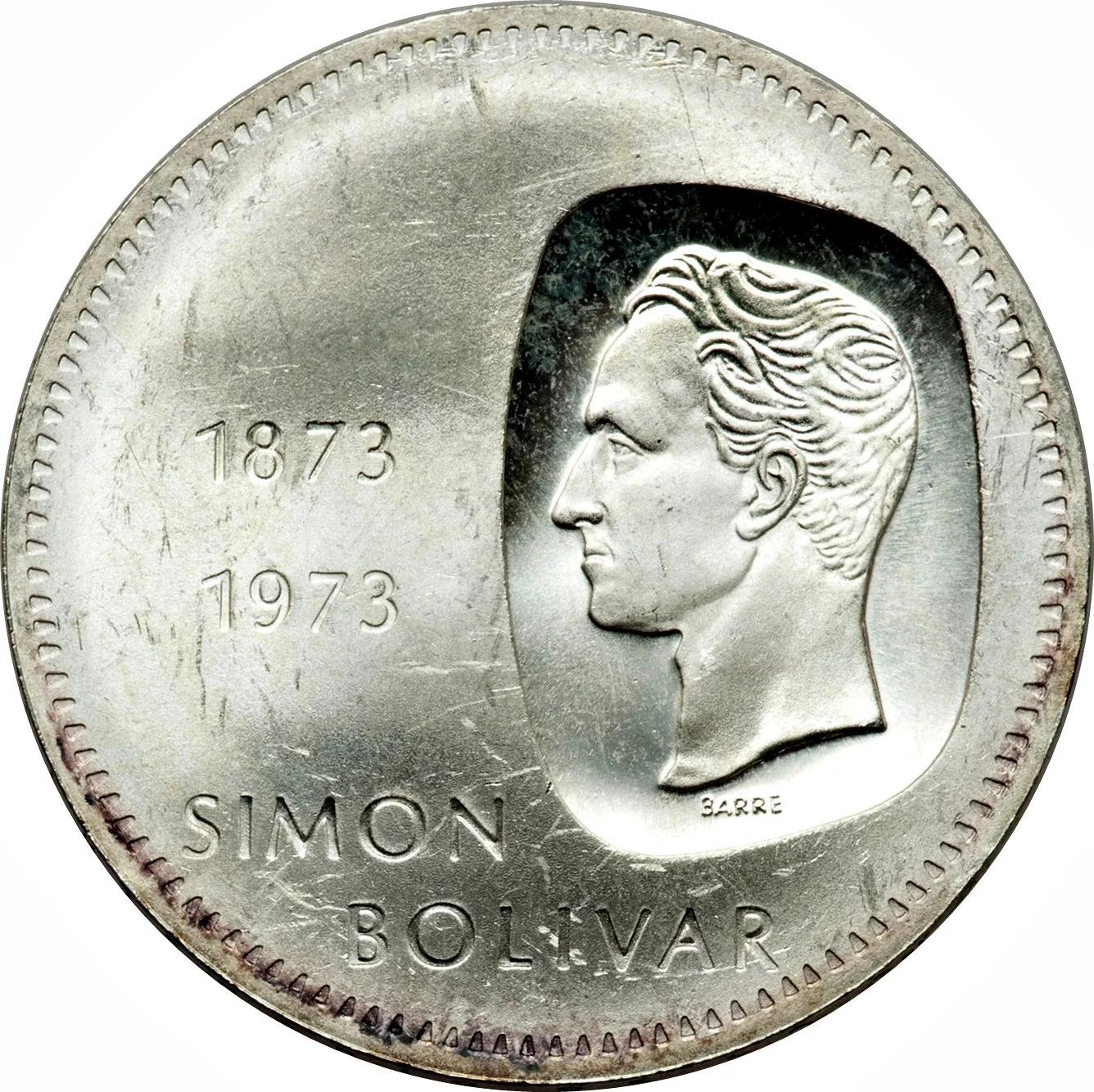
Obverse
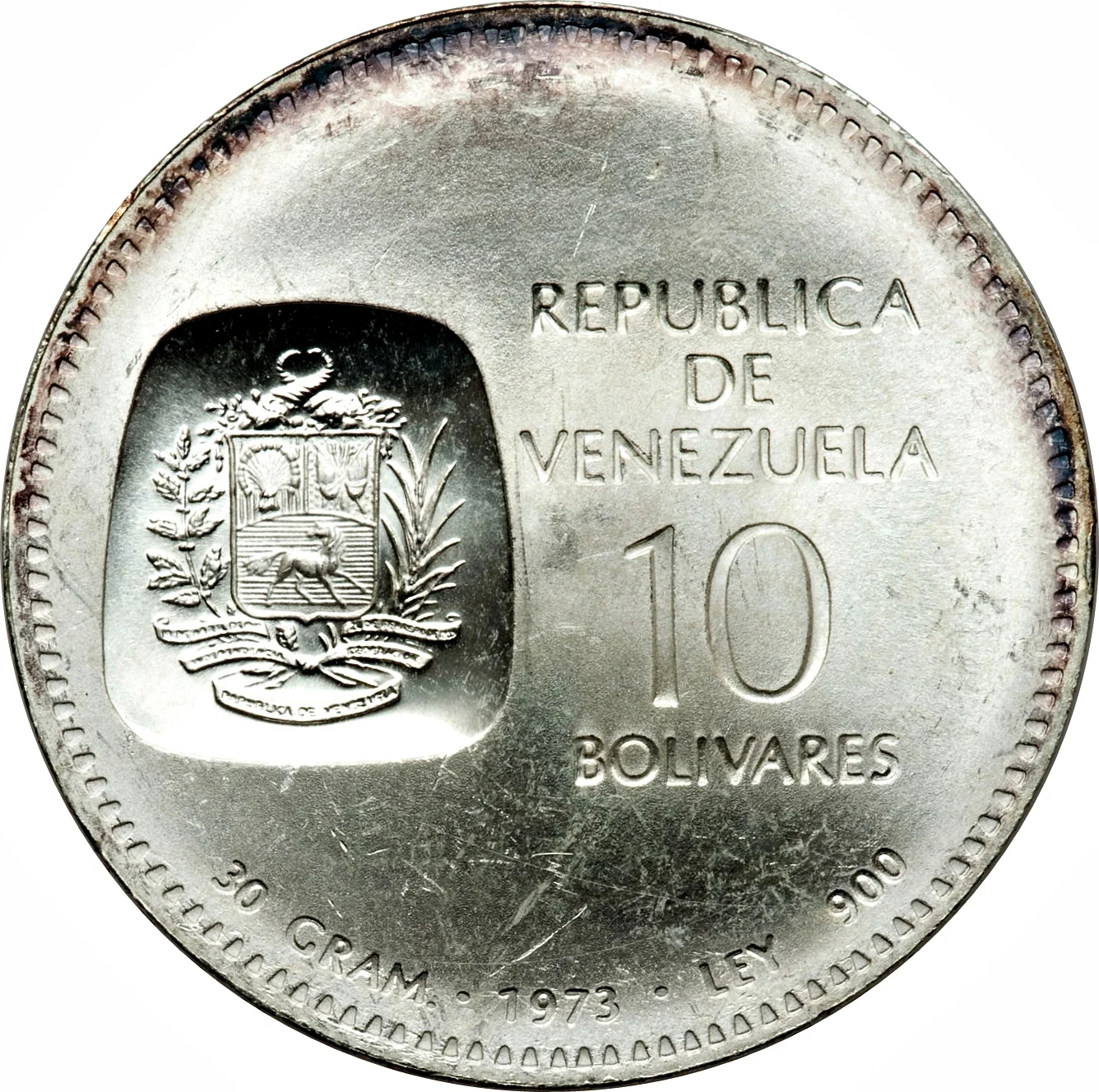
Reverse
Description:
Left-facing bust in stamp style, right. Dates left, name bottom. Engraver's name at bust base.
Inscription:
1873
1973
SIMON
BOLÍVAR
BARRE
1973
SIMON
BOLÍVAR
BARRE
Translation:
One thousand eight hundred seventy-three
One thousand nine hundred seventy-three
SIMON
BOLIVAR
BARRE
One thousand nine hundred seventy-three
SIMON
BOLIVAR
BARRE
Script: Latin
Engraver: Désiré-Albert Barre
Edge
Smooth with inscription
Legend:
CENTENARIO DE LA EFIGIE DEL LIBERTADOR EN LA MONEDA
Categories
| Person> Military leader |
| Person> Politician |
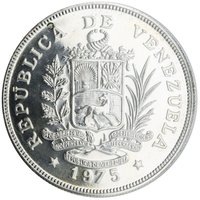
| Symbols> Coat of Arms |
| Symbol> Cornucopia |
| Animal> Horse |
Mints
| Name | Mark |
|---|---|
| Royal Canadian Mint of Ottawa | — |
Mintings
| Year | Mint Mark | Mintage | Quality | Collection |
|---|---|---|---|---|
| 1973 | — | 2,000,000 | ||
| 1973 | — | 200 | Proof |
Historical background
In 1973, Venezuela's currency, the bolívar, was a symbol of exceptional economic strength and stability, firmly pegged to the US dollar at a fixed and favorable rate of 4.30 bolívares per dollar. This stability was a direct result of the nation's booming oil economy, which was supercharged that year by the Arab Oil Embargo. As global oil prices quadrupled, Venezuela—a founding member of OPEC and a major exporter—experienced a massive influx of petrodollars, transforming its foreign reserves and government revenues almost overnight. The bolívar was considered so robust that it was colloquially called "the Venezuela dollar," widely accepted in international transactions and a point of national pride.
This monetary strength was underpinned by conservative fiscal management and the monetary authority's strict adherence to the gold standard, which it maintained longer than most countries. The Central Bank of Venezuela held substantial reserves in gold and foreign currency, fully backing the bolívar's value. Economically, the strong currency made imports cheap, fueling a consumer boom and rapid modernization, while also allowing the government to finance ambitious public works and social programs without borrowing externally. Inflation was low, and the country enjoyed one of the highest per capita incomes in Latin America.
However, this prosperous picture contained the seeds of future vulnerability. The economy became overwhelmingly dependent on oil revenues, which comprised over 90% of export earnings. The fixed exchange rate and influx of dollars began to distort the economy, discouraging non-oil exports and domestic production in a phenomenon known as "Dutch Disease." While 1973 itself was a zenith of monetary prestige, the policies of the era—centered on a rigid peg and a monolithic, state-centric oil economy—ultimately laid the groundwork for the severe currency crises that would plague Venezuela decades later when oil prices eventually faltered.
This monetary strength was underpinned by conservative fiscal management and the monetary authority's strict adherence to the gold standard, which it maintained longer than most countries. The Central Bank of Venezuela held substantial reserves in gold and foreign currency, fully backing the bolívar's value. Economically, the strong currency made imports cheap, fueling a consumer boom and rapid modernization, while also allowing the government to finance ambitious public works and social programs without borrowing externally. Inflation was low, and the country enjoyed one of the highest per capita incomes in Latin America.
However, this prosperous picture contained the seeds of future vulnerability. The economy became overwhelmingly dependent on oil revenues, which comprised over 90% of export earnings. The fixed exchange rate and influx of dollars began to distort the economy, discouraging non-oil exports and domestic production in a phenomenon known as "Dutch Disease." While 1973 itself was a zenith of monetary prestige, the policies of the era—centered on a rigid peg and a monolithic, state-centric oil economy—ultimately laid the groundwork for the severe currency crises that would plague Venezuela decades later when oil prices eventually faltered.
🌱 Fairly Common