

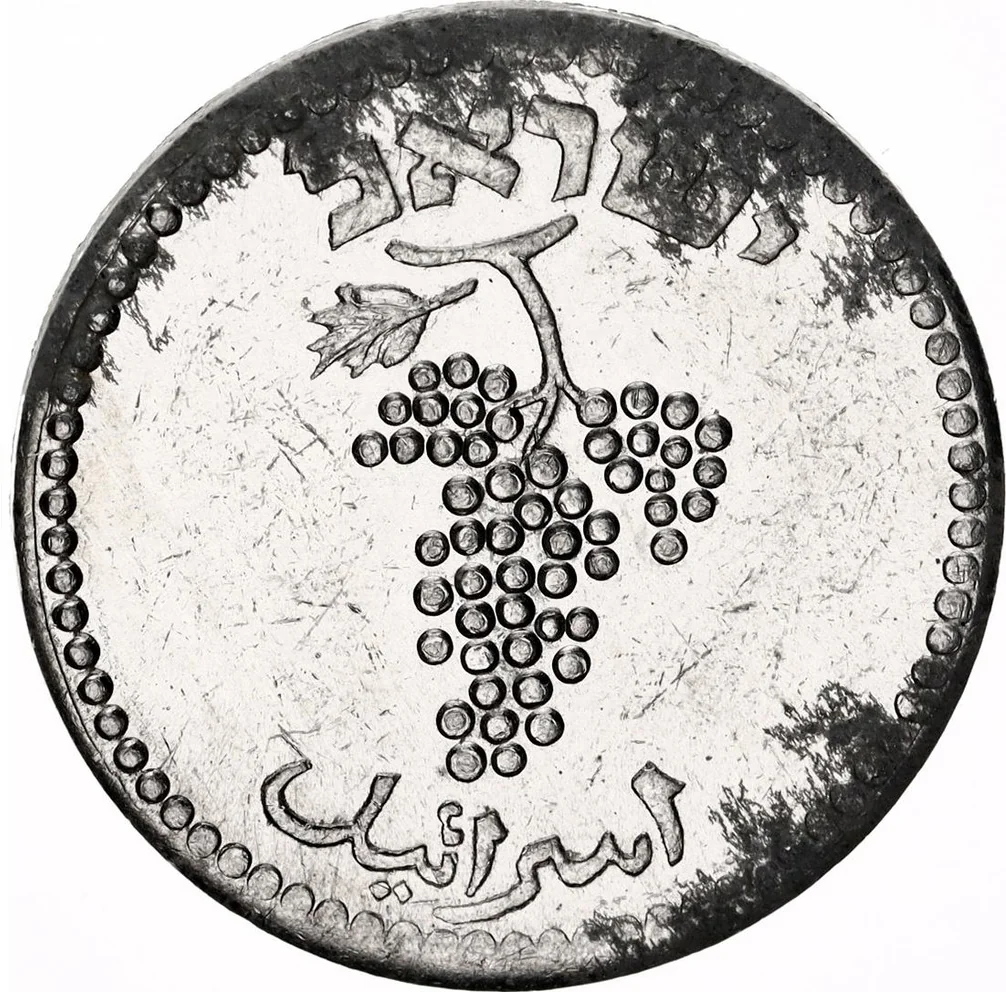
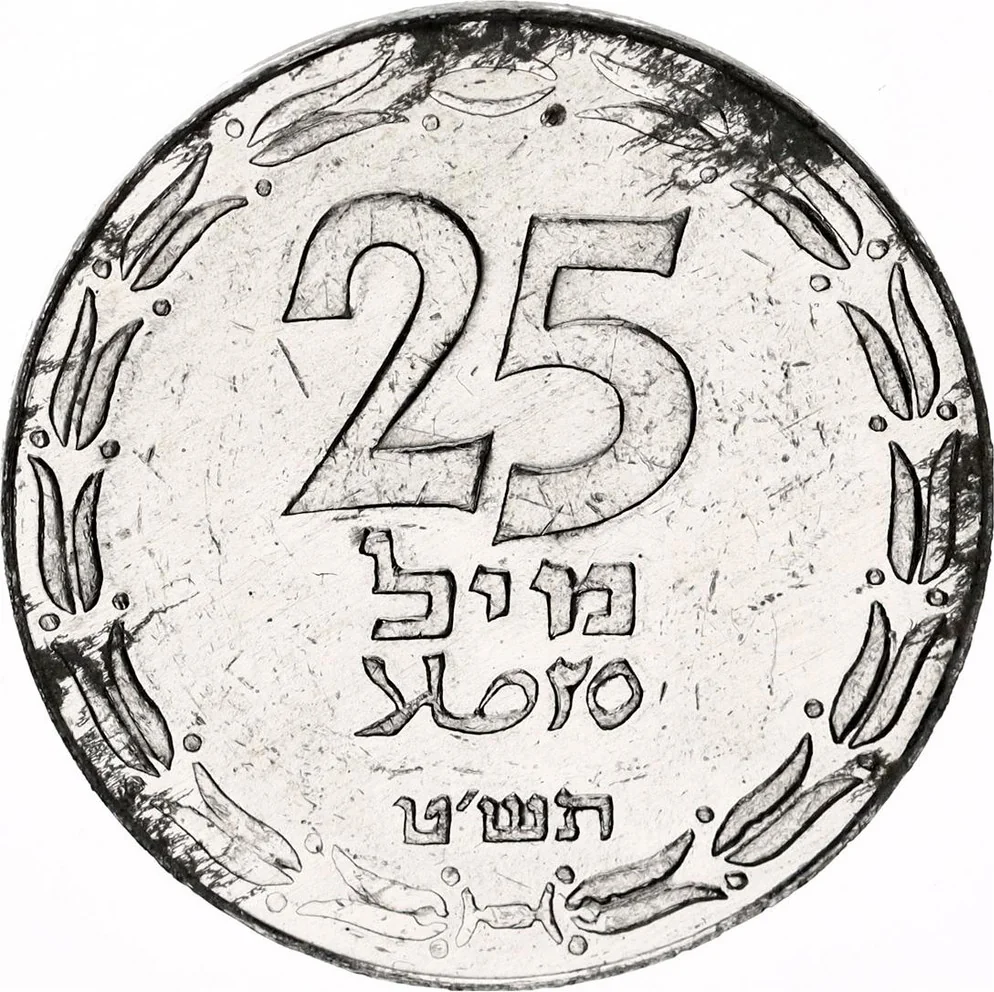
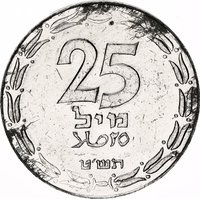
Obverse
Reverse
Edge
Plain
Mints
| Name | Mark |
|---|---|
| Jerusalem | — |
| Michsaf Cutlery Factory | — |
Mintings
| Year | Mint Mark | Mintage | Quality | Collection |
|---|---|---|---|---|
| 1948 | — | 42,650 | ||
| 1949 | — | — |
Historical background
In 1948, the nascent State of Israel inherited a complex and unstable currency situation from the British Mandate period. The official currency was the Palestinian pound, issued by the Palestine Currency Board in London, which was pegged to and fully backed by the British pound sterling. This system provided stability but was a clear symbol of colonial dependence. As the British withdrew and war broke out, the new Israeli government faced an urgent need to establish monetary sovereignty and fund its survival, leading to a period of parallel currencies and rapid monetary expansion.
To meet immediate financial demands, the provisional government authorized the Anglo-Palestine Bank (soon to become Bank Leumi) to issue a new currency. On August 17, 1948, the "lira" (commonly called the Israeli pound or lira) was introduced as legal tender, initially circulating alongside the existing Palestinian pounds and a flood of low-denomination "military scrip" used to pay soldiers and suppliers. This was not a formal, controlled conversion but a forced circulation, effectively demonetizing the Palestinian pound over time. The government mandated its acceptance and set exchange rates, but the launch was chaotic, contributing to public uncertainty and inflationary pressures.
The foundational monetary policy of 1948 was overwhelmingly expansionary, focused on financing the War of Independence rather than ensuring stability. The government ran massive deficits, financed largely by borrowing from the banking system, which led to the new currency being printed without sufficient reserves. Consequently, even in its first year, the Israeli lira began a steep devaluation against foreign currencies, and inflation started to accelerate. This established a pattern of fiscal-driven inflation and weak currency that would define the Israeli economy for decades, making the 1948 currency transition less a clean break and more the first step in a prolonged struggle for economic independence and stability.
To meet immediate financial demands, the provisional government authorized the Anglo-Palestine Bank (soon to become Bank Leumi) to issue a new currency. On August 17, 1948, the "lira" (commonly called the Israeli pound or lira) was introduced as legal tender, initially circulating alongside the existing Palestinian pounds and a flood of low-denomination "military scrip" used to pay soldiers and suppliers. This was not a formal, controlled conversion but a forced circulation, effectively demonetizing the Palestinian pound over time. The government mandated its acceptance and set exchange rates, but the launch was chaotic, contributing to public uncertainty and inflationary pressures.
The foundational monetary policy of 1948 was overwhelmingly expansionary, focused on financing the War of Independence rather than ensuring stability. The government ran massive deficits, financed largely by borrowing from the banking system, which led to the new currency being printed without sufficient reserves. Consequently, even in its first year, the Israeli lira began a steep devaluation against foreign currencies, and inflation started to accelerate. This established a pattern of fiscal-driven inflation and weak currency that would define the Israeli economy for decades, making the 1948 currency transition less a clean break and more the first step in a prolonged struggle for economic independence and stability.
🌱 Fairly Common