

100 euro (The Bratislava Coronations) – Slovakia
Add to wishlist
Non-circulating coins
Commemoration: The Bratislava Coronations - 300th Anniversary of the Coronation of Charles III
Slovakia
Context
Material
References
KM: #
Numista: #42248
Value
Exchange value: 100 EUR
Bullion value: $1310.06
Inflation-adjusted value: 154.56 EUR
Obverse
Description:
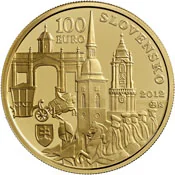
The coin's obverse shows the coronation procession alongside Bratislava landmarks: the Vienna Gate of Bratislava Castle, the steeple of St Martin's Cathedral, and the Old Town Hall tower. On the left are the Slovak national emblem and the denomination "100 EURO." Along the right edge are "SLOVENSKO" and the year "2012," below which are the Kremnica Mint mark and the designer Karol Ličko's initials.
Inscription:
100 EURO
SLOVENSKO
2012
SLOVENSKO
2012
Translation:
SLOVAKIA
100 EURO
2012
100 EURO
2012
Script: Latin
Engraver: Karol Ličko
Reverse
Description:
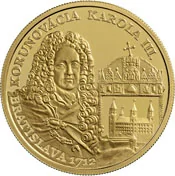
The reverse features King Charles III, the Hungarian crown, and a period view of Bratislava castle, with the inscriptions "KORUNOVÁCIA KAROLA III", "BRATISLAVA", and the year "1712".
Inscription:
KORUNOVÁCIA KAROLA III.
BRATISLAVA 2012
BRATISLAVA 2012
Translation:
Coronation of Charles III
Bratislava 2012
Bratislava 2012
Script: Latin
Language: Slovak
Engraver: Karol Ličko
Edge
Reeded
Categories
| Building> Governmental building |
| Event> Coronation |
| Person> Monarch |
Mints
| Name | Mark |
|---|---|
| Kremnica | (MK) |
Mintings
| Year | Mint Mark | Mintage | Quality | Collection |
|---|---|---|---|---|
| 2012 | MK | 5,200 | Proof |
Historical background
In 2012, Slovakia was a consolidated member of the Eurozone, having adopted the euro as its official currency on January 1, 2009. This move replaced the Slovak koruna (SKK) and was seen as a significant milestone, solidifying the country's integration into the core of the European Union's economic and political structures. By 2012, the euro was well-established in daily use, and the initial transition period was long over, with prices fully denominated in the single currency. Slovakia's entry had been notably smooth, meeting the Maastricht convergence criteria and benefiting from strong economic growth in the preceding years.
However, the broader Eurozone context in 2012 was one of profound crisis, which shaped Slovakia's currency and economic situation. The sovereign debt crisis, particularly acute in Greece, Ireland, Portugal, and Spain, threatened the stability of the euro itself. For Slovakia, a key moment had occurred in late 2011 when its parliament voted to approve the expansion of the Eurozone bailout fund, the European Financial Stability Facility (EFSF). This was a politically contentious decision that contributed to the fall of the government of Iveta Radičová, highlighting domestic tensions between the obligations of Eurozone membership and national fiscal sovereignty.
Domestically, the euro provided Slovakia with a shield against currency volatility during the turbulent global period, but it also meant the country had relinquished independent monetary policy tools. The European Central Bank's (ECB) policies, such as the announcement of the Outright Monetary Transactions (OMT) program in mid-2012, were crucial for calming markets but were set for the entire currency bloc, not tailored to Slovakia's specific needs. Economically, Slovakia's export-oriented industry, particularly its large automotive sector, benefited from the certainty of a common currency with its main trading partners in Europe, though it also faced the challenge of maintaining competitiveness without the ability to devalue a national currency. Thus, in 2012, Slovakia's currency situation was one of stable domestic use but deep entanglement in the high-stakes struggle to preserve the Eurozone's future.
However, the broader Eurozone context in 2012 was one of profound crisis, which shaped Slovakia's currency and economic situation. The sovereign debt crisis, particularly acute in Greece, Ireland, Portugal, and Spain, threatened the stability of the euro itself. For Slovakia, a key moment had occurred in late 2011 when its parliament voted to approve the expansion of the Eurozone bailout fund, the European Financial Stability Facility (EFSF). This was a politically contentious decision that contributed to the fall of the government of Iveta Radičová, highlighting domestic tensions between the obligations of Eurozone membership and national fiscal sovereignty.
Domestically, the euro provided Slovakia with a shield against currency volatility during the turbulent global period, but it also meant the country had relinquished independent monetary policy tools. The European Central Bank's (ECB) policies, such as the announcement of the Outright Monetary Transactions (OMT) program in mid-2012, were crucial for calming markets but were set for the entire currency bloc, not tailored to Slovakia's specific needs. Economically, Slovakia's export-oriented industry, particularly its large automotive sector, benefited from the certainty of a common currency with its main trading partners in Europe, though it also faced the challenge of maintaining competitiveness without the ability to devalue a national currency. Thus, in 2012, Slovakia's currency situation was one of stable domestic use but deep entanglement in the high-stakes struggle to preserve the Eurozone's future.
✨ Legendary