

10 Centimes – Bourbon Island
France
Context
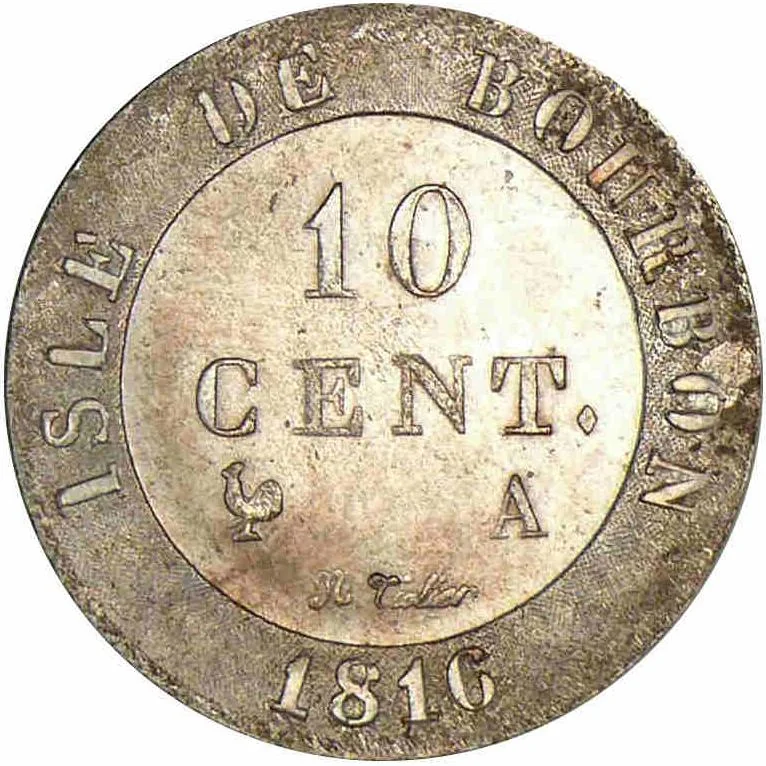
Year: 1816
Country: France 
Issuer: Bourbon Island
Ruler: Louis XVIII
Currency:
(1816—1965)
Demonetized: Yes
Total mintage: 150,000
Material
References
KM: #Click to copy to clipboardA1
Numista: #4213
Obverse
Description:
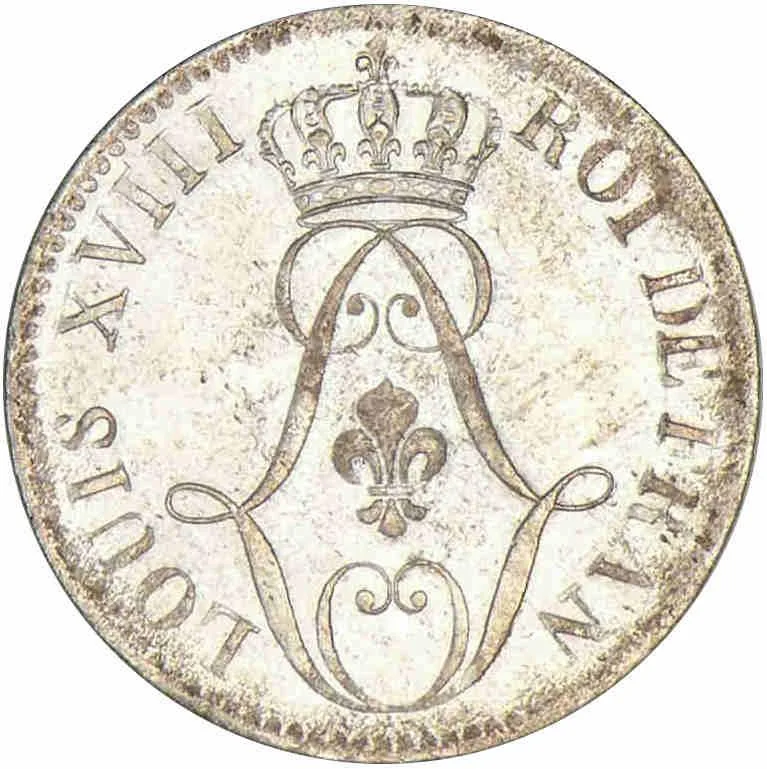
Monogram of Louis XVIII.
Inscription:
LOUIS XVIII ROI DE FRANC
Translation:
LOUIS XVIII KING OF FRANCE
Script: Latin
Language: French
Engraver: Pierre-Joseph Tiolier
Reverse
Edge
Plain
Mints
| Name | Mark |
|---|---|
| Monnaie de Paris | A |
Mintings
| Year | Mint Mark | Mintage | Quality | Collection |
|---|---|---|---|---|
| 1816 | A | 150,000 |
Historical background
In 1816, the French colony of Bourbon Island (today’s Réunion) was emerging from a period of profound economic disruption. The Napoleonic Wars and the British blockade, which lasted until 1810, had severely isolated the island, crippling its plantation-based economy that relied on the export of coffee and, increasingly, sugar. Following the British capture of the island in 1810 and its subsequent return to France under the 1814 Treaty of Paris, the colony found itself in a state of monetary chaos. The official currency, the French franc, was in critically short supply, leading to a severe liquidity crisis that stifled daily transactions and commercial recovery.
This scarcity gave rise to a complex and unreliable multi-currency system. Alongside the few available French coins, a wide variety of foreign specie circulated at fluctuating values, including Spanish piastres (pieces of eight), Indian rupees, and Portuguese gold moedas. Most problematic was the widespread use of billets de caisse (cash notes), a form of paper money issued by local merchants and planters. These private notes were promises to pay in coin, but their value was entirely dependent on the credibility of the individual issuer, leading to frequent depreciation, counterfeiting, and public distrust. The monetary landscape was therefore fragmented and unstable, hindering both internal trade and the island's reintegration into global commerce.
Recognizing this crisis as a barrier to colonial stability and economic growth, the local administration under Governor Pierre Bernard Milius began to take decisive action in 1816. His government moved to centralize and regulate the currency by establishing a Caisse de Règlement (Settlement Fund). This institution was authorized to issue official paper money, backed by the colonial treasury, to replace the chaotic private bills. This reform marked a crucial step toward restoring monetary order, aiming to provide a uniform, trusted medium of exchange to facilitate the island's post-war economic revival under restored French rule.
This scarcity gave rise to a complex and unreliable multi-currency system. Alongside the few available French coins, a wide variety of foreign specie circulated at fluctuating values, including Spanish piastres (pieces of eight), Indian rupees, and Portuguese gold moedas. Most problematic was the widespread use of billets de caisse (cash notes), a form of paper money issued by local merchants and planters. These private notes were promises to pay in coin, but their value was entirely dependent on the credibility of the individual issuer, leading to frequent depreciation, counterfeiting, and public distrust. The monetary landscape was therefore fragmented and unstable, hindering both internal trade and the island's reintegration into global commerce.
Recognizing this crisis as a barrier to colonial stability and economic growth, the local administration under Governor Pierre Bernard Milius began to take decisive action in 1816. His government moved to centralize and regulate the currency by establishing a Caisse de Règlement (Settlement Fund). This institution was authorized to issue official paper money, backed by the colonial treasury, to replace the chaotic private bills. This reform marked a crucial step toward restoring monetary order, aiming to provide a uniform, trusted medium of exchange to facilitate the island's post-war economic revival under restored French rule.
⭐ Rare