

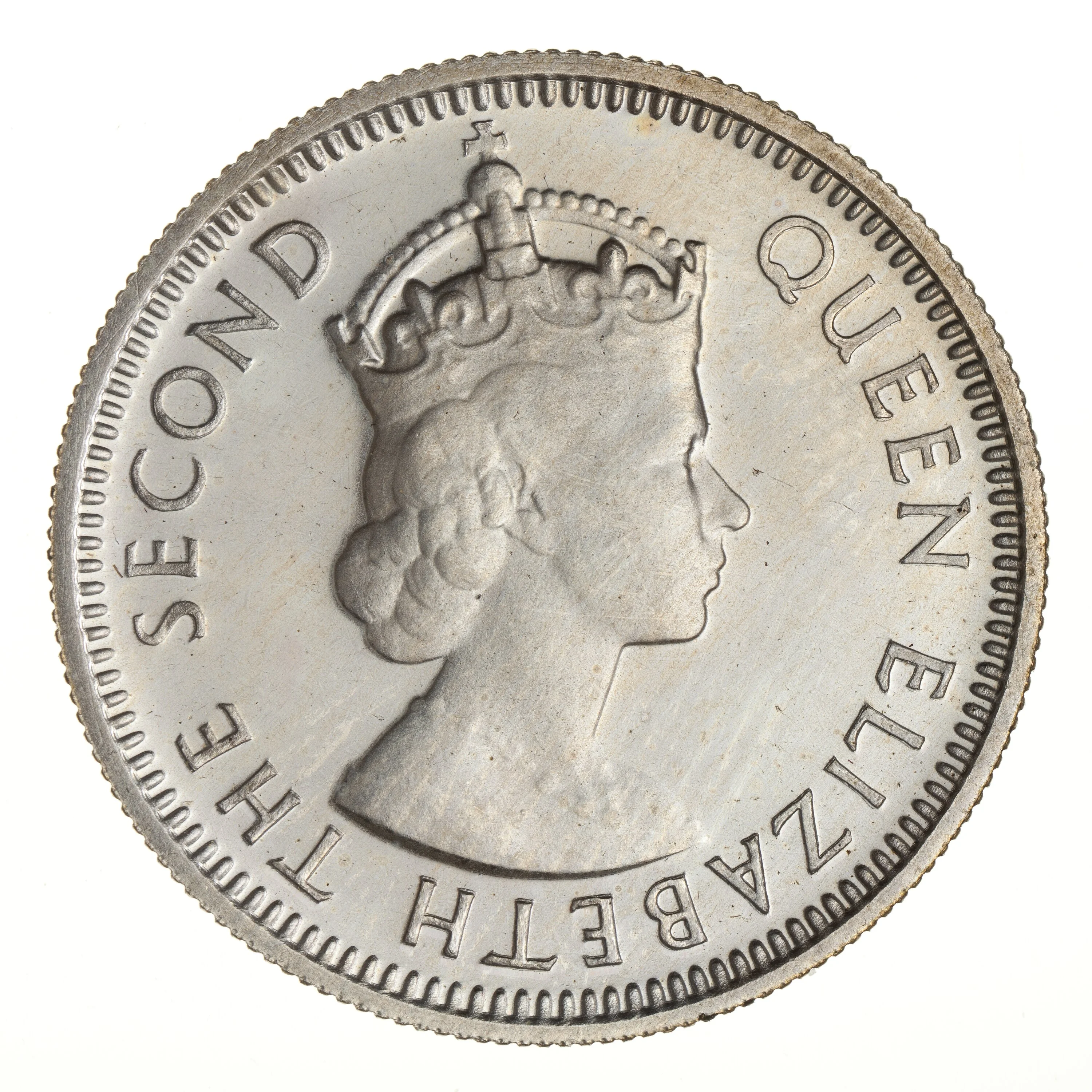
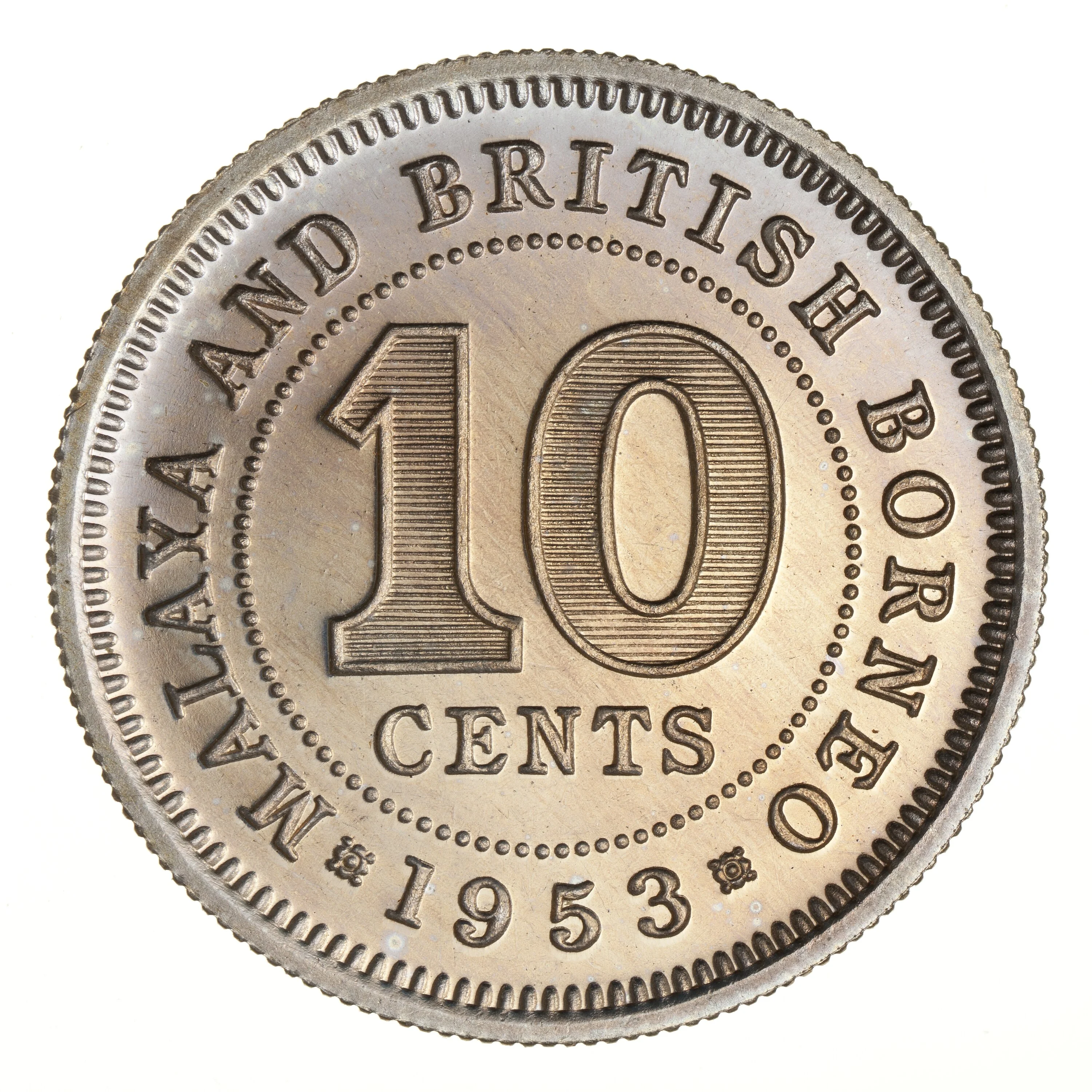
10 Cents – Malaya and British Borneo
Malaysia
Context
Years: 1953–1961
Country: Malaysia 
Issuer: Malaya and British Borneo
Ruler: Elizabeth II
Currency:
(1953—1967)
Demonetized: Yes
Total mintage: 200,004,000
Material
Diameter: 19.5 mm
Weight: 2.82 g
Thickness: 1 mm
Shape: Round
Composition: Copper-nickel
Technique: Milled
Alignment: Medal alignment
flip
References
KM: #Click to copy to clipboard2
Numista: #4204
Obverse
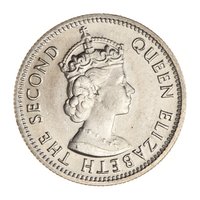
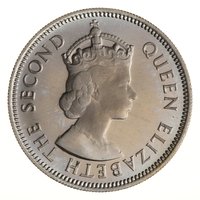
Description:
Right-facing crowned bust.
Inscription:
QUEEN ELIZABETH THE SECOND
Script: Latin
Engraver: Cecil Thomas
Reverse
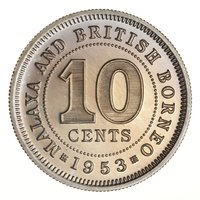
Description:
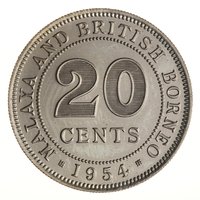
Beaded circle value
Inscription:
MALAYA AND BRITISH BORNEO
10
CENTS
H
1961
10
CENTS
H
1961
Script: Latin
Engraver: Cecil Thomas
Edge
Reeded
Mints
| Name | Mark |
|---|---|
| Royal Mint (Tower Hill) | — |
| Heaton and Sons / The Mint Birmingham | H |
| Kings Norton Metal Company | KN |
Mintings
Historical background
In 1953, the currency situation in Malaya and British Borneo (comprising North Borneo, Sarawak, and Brunei) was defined by the Malayan Dollar, a stable and fully convertible currency managed by the Board of Commissioners of Currency, Malaya and British Borneo. Established in 1952, this unified currency board replaced the earlier Malayan Union board and issued a single currency for all the territories, facilitating trade and economic integration. The system was a classic colonial currency board arrangement, where the local currency was pegged to the British Pound Sterling at a fixed rate of 60 Malayan dollars to 7 pounds, ensuring its value was firmly backed by sterling reserves held in London.
This monetary stability was crucial for the region's primary export economies, which were booming due to high post-Korean War demand for rubber and tin. The fixed exchange rate provided confidence for British and other foreign investments in these commodities. However, the system also meant that monetary policy was entirely subordinated to the needs of the sterling area and Britain's own economic objectives, with no independent capacity for the local authorities to manage money supply or interest rates according to domestic conditions.
Politically, this currency union existed amidst significant change. In Malaya, the Emergency against communist insurgents was ongoing, while moves towards self-government were accelerating. In British Borneo, the territories remained under colonial administration. The currency board's structure, with its seat in Singapore and oversight tied to London, reflected the lingering colonial economic framework. This setup would soon be challenged, as the path towards independence for Malaya (achieved in 1957) and later considerations for Malaysia (formed in 1963) would inevitably necessitate a re-evaluation of the common currency and its governing institutions.
This monetary stability was crucial for the region's primary export economies, which were booming due to high post-Korean War demand for rubber and tin. The fixed exchange rate provided confidence for British and other foreign investments in these commodities. However, the system also meant that monetary policy was entirely subordinated to the needs of the sterling area and Britain's own economic objectives, with no independent capacity for the local authorities to manage money supply or interest rates according to domestic conditions.
Politically, this currency union existed amidst significant change. In Malaya, the Emergency against communist insurgents was ongoing, while moves towards self-government were accelerating. In British Borneo, the territories remained under colonial administration. The currency board's structure, with its seat in Singapore and oversight tied to London, reflected the lingering colonial economic framework. This setup would soon be challenged, as the path towards independence for Malaya (achieved in 1957) and later considerations for Malaysia (formed in 1963) would inevitably necessitate a re-evaluation of the common currency and its governing institutions.
🌱 Very Common