

Obverse
Description:
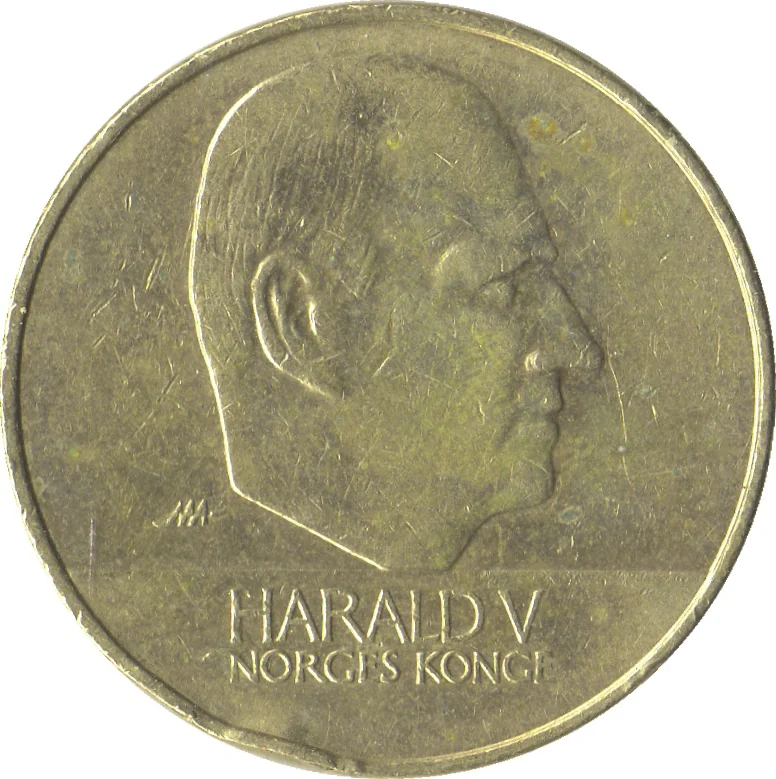
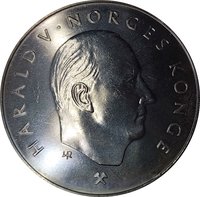
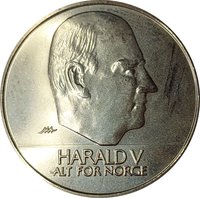
King Harald V bust facing right. Engraver's initials behind bust. Two-line inscription on raised ground below. Solid rim ring.
Inscription:
NAA
HARALD V
NORGES KONGE
HARALD V
NORGES KONGE
Translation:
Harald V
Norway's King
Norway's King
Script: Latin
Language: Norwegian Bokmål
Engraver: Nils Aas
Reverse
Edge
Plain
Categories
| Person> Monarch |
| Transportation> Watercraft |
Mints
| Name | Mark |
|---|---|
| Norwegian Mint | — |
Mintings
| Year | Mint Mark | Mintage | Quality | Collection |
|---|---|---|---|---|
| 1994 | — | 16,023,000 | ||
| 1994 | — | 15,000 | Proof | |
| 1995 | — | 17,317,500 | ||
| 1995 | — | 14,459 | Proof | |
| 1996 | — | 11,551 | Proof | |
| 1996 | — | 1,429,500 | ||
| 1997 | — | 974,873 | ||
| 1997 | — | 14,450 | Proof | |
| 1998 | — | 4,907,000 | ||
| 1998 | — | 10,000 | BU | |
| 1998 | — | 14,977 | Proof | |
| 2000 | — | 11,043,942 | ||
| 2000 | — | 10,000 | BU | |
| 2001 | — | 4,115,510 | ||
| 2001 | — | 11,500 | Proof | |
| 2001 | — | 10,000 | BU | |
| 2002 | — | 20,404,107 | ||
| 2003 | — | 30,028,796 | ||
| 2003 | — | 8,500 | BU | |
| 2003 | — | 11,100 | Proof | |
| 2005 | — | 501,005 | ||
| 2005 | — | 10,005 | BU | |
| 2005 | — | 8,500 | Proof | |
| 2007 | — | 9,750 | BU | |
| 2007 | — | 6,932 | Proof | |
| 2007 | — | 493,000 | ||
| 2008 | — | 449,000 | ||
| 2008 | — | 2,271 | BU | |
| 2008 | — | 7,091 | Proof | |
| 2009 | — | 441,000 | ||
| 2009 | — | 2,271 | BU | |
| 2009 | — | 7,500 | Proof |
Historical background
In 1994, Norway's currency situation was defined by its managed float exchange rate regime, operating within a bandwidth around a central rate pegged to the European Currency Unit (ECU). This system was part of Norway's broader economic policy framework aimed at ensuring stability for its small, open, and oil-dependent economy. However, this period was one of mounting pressure, as Norway was grappling with the aftermath of a severe banking crisis and a deep recession in the late 1980s and early 1990s, which had led to high interest rates and a strained financial sector.
Externally, the situation was heavily influenced by turbulence in European currency markets following the collapse of the European Exchange Rate Mechanism (ERM) in 1992-1993. Speculative attacks had forced several currencies, including the British pound, out of the ERM, and markets remained volatile. For Norway, which had applied for European Union membership and was keen to demonstrate monetary stability, maintaining its ECU peg became increasingly costly. The central bank, Norges Bank, was forced to engage in heavy interventions in the foreign exchange market and maintain high interest rates to defend the krone's value, which conflicted with the need for economic recovery.
By the end of 1994, these pressures culminated in a decisive shift. After a renewed wave of speculation in the autumn, Norges Bank abandoned the fixed exchange rate policy on December 10, 1994. The krone was allowed to float freely, marking the end of a decades-long tradition of fixed exchange rate regimes. This move was seen as necessary to regain control over domestic monetary policy, allowing for lower interest rates to stimulate the economy and freeing the bank from the unsustainable burden of defending a specific parity in volatile international markets.
Externally, the situation was heavily influenced by turbulence in European currency markets following the collapse of the European Exchange Rate Mechanism (ERM) in 1992-1993. Speculative attacks had forced several currencies, including the British pound, out of the ERM, and markets remained volatile. For Norway, which had applied for European Union membership and was keen to demonstrate monetary stability, maintaining its ECU peg became increasingly costly. The central bank, Norges Bank, was forced to engage in heavy interventions in the foreign exchange market and maintain high interest rates to defend the krone's value, which conflicted with the need for economic recovery.
By the end of 1994, these pressures culminated in a decisive shift. After a renewed wave of speculation in the autumn, Norges Bank abandoned the fixed exchange rate policy on December 10, 1994. The krone was allowed to float freely, marking the end of a decades-long tradition of fixed exchange rate regimes. This move was seen as necessary to regain control over domestic monetary policy, allowing for lower interest rates to stimulate the economy and freeing the bank from the unsustainable burden of defending a specific parity in volatile international markets.
🌱 Very Common