

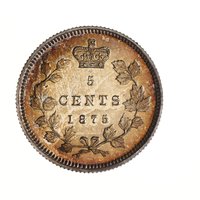
Obverse
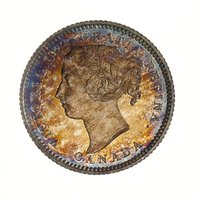
Description:
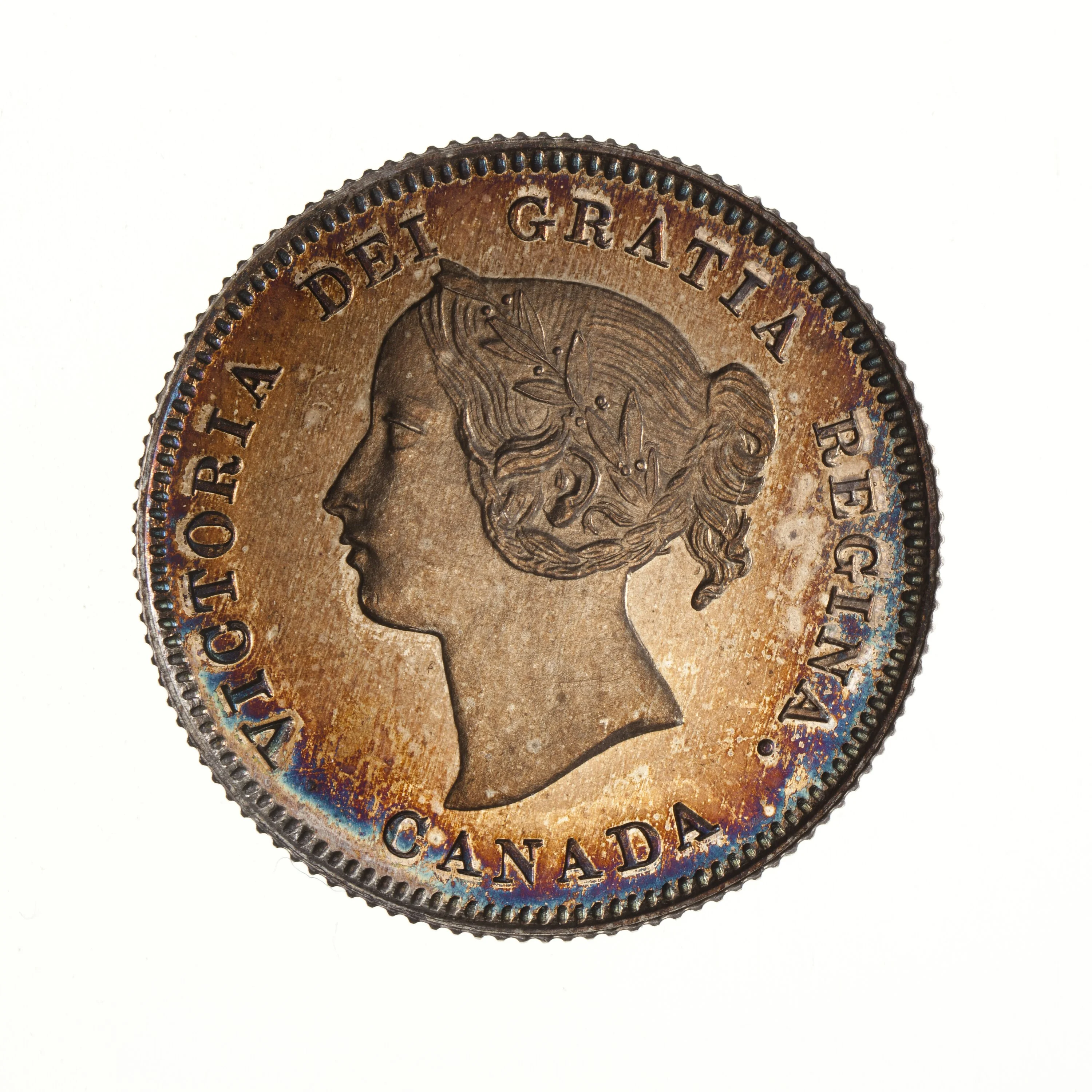
Young Queen Victoria facing left, wearing a laurel wreath.
Inscription:
VICTORIA DEI GRATIA REGINA.
CANADA
CANADA
Translation:
Victoria by the Grace of God Queen.
Canada
Canada
Script: Latin
Language: Latin
Engraver: Leonard Charles Wyon
Reverse
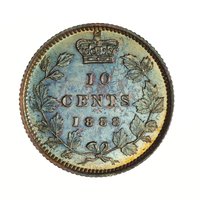
Description:
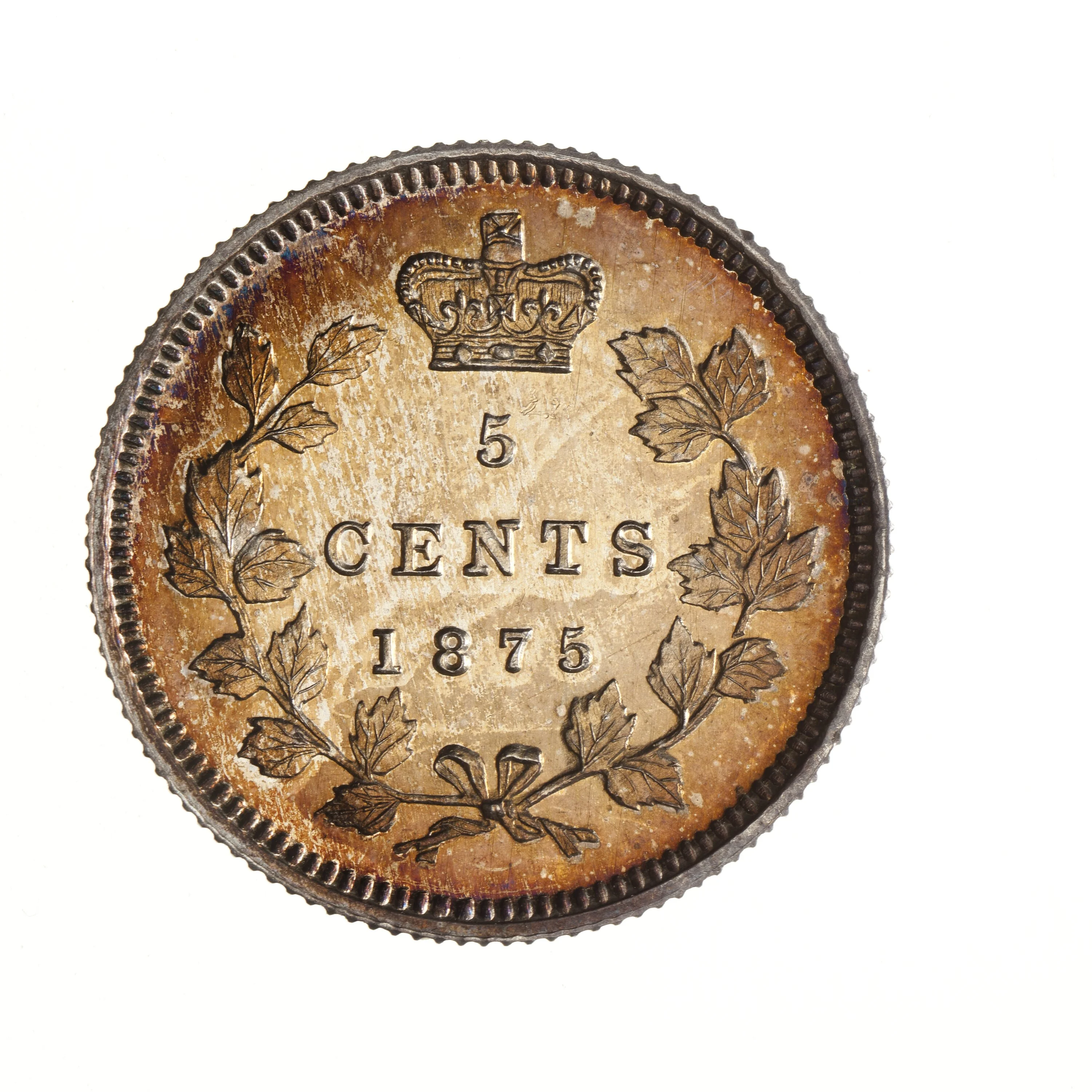
Face value framed by maple boughs and Queen Victoria's crown.
Inscription:
5
CENTS
1858
CENTS
1858
Script: Latin
Engraver: Leonard Charles Wyon
Edge
Reeded
Mints
| Name | Mark |
|---|---|
| Royal Mint (Tower Hill) | — |
| Heaton and Sons / The Mint Birmingham | H |
Mintings
| Year | Mint Mark | Mintage | Quality | Collection |
|---|---|---|---|---|
| 1858 | — | 1,460,389 | ||
| 1870 | — | — | ||
| 1871 | — | 1,400,000 | ||
| 1872 | H | 2,000,000 | ||
| 1874 | H | 800,000 | ||
| 1875 | H | 1,000,000 | ||
| 1880 | H | 3,000,000 | ||
| 1881 | H | 1,500,000 | ||
| 1882 | H | 1,000,000 | ||
| 1883 | H | 600,000 | ||
| 1884 | — | 200,000 | ||
| 1885 | — | 1,000,000 | ||
| 1886 | — | — | ||
| 1887 | — | 500,000 | ||
| 1888 | — | 1,000,000 | ||
| 1889 | — | 1,200,000 | ||
| 1890 | H | 1,000,000 | ||
| 1891 | — | 1,800,000 | ||
| 1892 | — | 860,000 | ||
| 1893 | — | 1,700,000 | ||
| 1894 | — | 500,000 | ||
| 1896 | or | 1,500,000 | ||
| 1897 | — | 1,319,283 | ||
| 1898 | — | 580,717 | ||
| 1899 | — | 3,000,000 | ||
| 1900 | — | 1,800,000 | ||
| 1901 | — | 2,000,000 |
Historical background
In 1858, Canada was in a period of significant monetary transition and confusion, operating without a unified national currency. The Province of Canada (present-day Ontario and Quebec) was awash in a complex mixture of foreign and domestic coinage. British gold sovereigns and silver coins circulated alongside Spanish and Mexican silver dollars, U.S. gold coins, and even French francs. Crucially, the primary paper money consisted of banknotes issued by numerous private chartered banks, the value of which depended entirely on the solvency and reputation of the issuing institution, leading to frequent instability and discounting.
This chaotic system prompted the colonial government to take decisive action. Inspired by the British shift to a gold standard in the early 1850s, the Province of Canada passed the Currency Act of 1857, which took practical effect in 1858. This landmark legislation decimalized the currency, replacing the old Halifax pound (£1 Halifax = $4) with a new dollar unit divided into 100 cents. More importantly, it made the new Canadian dollar the sole official unit of account, requiring all government accounts to be kept in dollars and cents and disallowing the use of British sterling in future transactions.
However, 1858 was a year of implementation, not immediate resolution. While the government had established the legal framework, the new Canadian coins (the first struck at the Royal Mint in London in 1858) were only beginning to enter circulation. The U.S. gold dollar was also declared legal tender to facilitate trade. Consequently, the old mixed-currency system persisted in daily life alongside the new decimal framework. Thus, 1858 stands as the pivotal year when Canada legally committed to its own distinct decimal currency, setting the foundation for a uniform monetary system, even though the full practical realization of that system lay in the future.
This chaotic system prompted the colonial government to take decisive action. Inspired by the British shift to a gold standard in the early 1850s, the Province of Canada passed the Currency Act of 1857, which took practical effect in 1858. This landmark legislation decimalized the currency, replacing the old Halifax pound (£1 Halifax = $4) with a new dollar unit divided into 100 cents. More importantly, it made the new Canadian dollar the sole official unit of account, requiring all government accounts to be kept in dollars and cents and disallowing the use of British sterling in future transactions.
However, 1858 was a year of implementation, not immediate resolution. While the government had established the legal framework, the new Canadian coins (the first struck at the Royal Mint in London in 1858) were only beginning to enter circulation. The U.S. gold dollar was also declared legal tender to facilitate trade. Consequently, the old mixed-currency system persisted in daily life alongside the new decimal framework. Thus, 1858 stands as the pivotal year when Canada legally committed to its own distinct decimal currency, setting the foundation for a uniform monetary system, even though the full practical realization of that system lay in the future.
🌱 Very Common