

1 centavo – Brazil
Add to wishlist
Brazil
Context
Years: 1979–1983
Issuer: Brazil
Issuing organization: Central Bank of Brazil
Period:
(since 1967)
Currency:
(1967—1986)
Demonetization: 15 August 1984
Total mintage: 460,000
Material
Diameter: 14 mm
Weight: 1.58 g
Thickness: 1.4 mm
Shape: Round
Composition: Stainless steel
Standard: Gold twentieth ounce
Technique: Milled
Alignment: Coin alignment

flip
References
KM: #
Numista: #14495
Value
Exchange value: 0.01 BRB
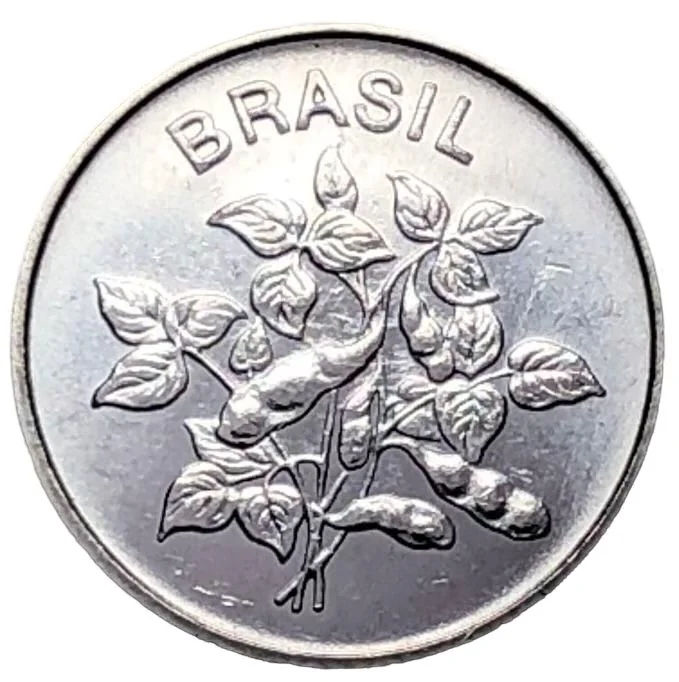
Obverse
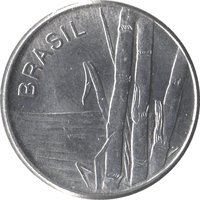
Description:
Soybean origin.
Inscription:
BRASIL
Translation:
BRASIL
Script: Latin
Language: Portuguese
Engraver: Benedicto de Araújo Ribeiro
Reverse
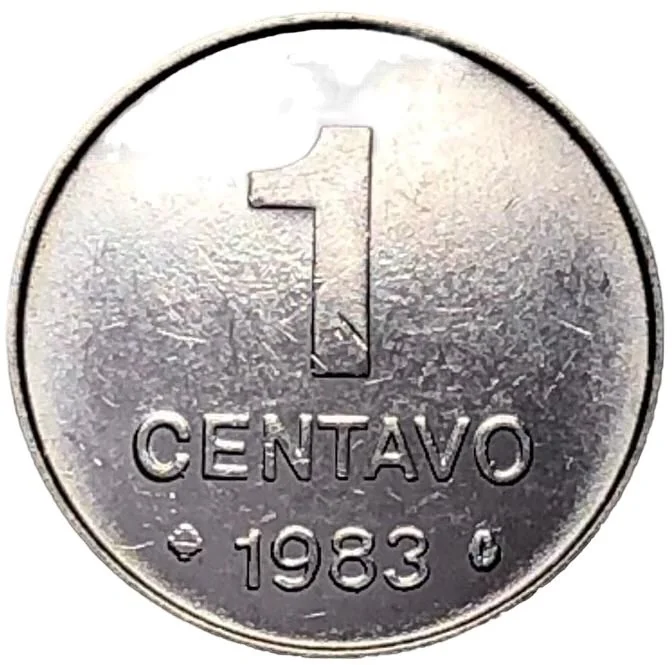
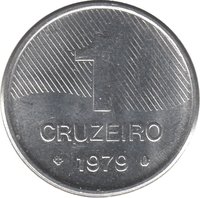
Description:
Face value, date, microcharacters, BC logo, zimbo shell.
Inscription:
1
CENTAVO
1982
CENTAVO
1982
Script: Latin
Engraver: benedicto de araújo
Edge
Plain
Mints
| Name | Mark |
|---|---|
| Casa da Moeda do Brasil | — |
Mintings
| Year | Mint Mark | Mintage | Quality | Collection |
|---|---|---|---|---|
| 1979 | — | 100,000 | ||
| 1980 | — | 60,000 | ||
| 1981 | — | 100,000 | ||
| 1982 | — | 100,000 | ||
| 1983 | — | 100,000 |
Historical background
In 1979, Brazil was in the late stages of its "economic miracle," a period of rapid, debt-fueled growth under the military dictatorship. However, the model was showing severe cracks. The country was highly vulnerable to external shocks, a weakness brutally exposed by the 1979 oil crisis. As global oil prices doubled, Brazil's import bill skyrocketed, devastating its trade balance and creating a massive current account deficit. This external vulnerability was the primary backdrop for the currency situation, placing intense downward pressure on the cruzeiro and draining foreign reserves.
The government's response, under President João Figueiredo and Finance Minister Karlos Rischbieter, was a pivotal and ultimately disastrous policy shift known as the "maxi-devaluation." In December 1979, they announced a complex new exchange rate regime, abandoning the traditional mini-devaluations (crawling peg). The cruzeiro was sharply devalued by 30% overnight, and a pre-announced, declining devaluation schedule was established for 1980. The intent was to shock the economy, curb imports by making them more expensive, boost exports, and restore confidence by providing predictability. Crucially, it was accompanied by a wage law that only partially compensated for inflation, aiming to squeeze real wages and improve competitiveness.
The plan failed catastrophically. Instead of curbing inflation, the massive devaluation directly injected fuel into it by raising the cost of imported goods and inputs. This, combined with widespread indexation in the economy, triggered an inflationary spiral. The predictability of the devaluation schedule also encouraged capital flight, as investors could calculate the exact loss of holding cruzeiros. By mid-1980, the policy was in tatters, abandoned in favor of a new maxi-devaluation. The events of 1979 marked a decisive turn, ending any illusion of stability and plunging Brazil into the "lost decade" of the 1980s, characterized by hyperinflation, stagnation, and a profound debt crisis.
The government's response, under President João Figueiredo and Finance Minister Karlos Rischbieter, was a pivotal and ultimately disastrous policy shift known as the "maxi-devaluation." In December 1979, they announced a complex new exchange rate regime, abandoning the traditional mini-devaluations (crawling peg). The cruzeiro was sharply devalued by 30% overnight, and a pre-announced, declining devaluation schedule was established for 1980. The intent was to shock the economy, curb imports by making them more expensive, boost exports, and restore confidence by providing predictability. Crucially, it was accompanied by a wage law that only partially compensated for inflation, aiming to squeeze real wages and improve competitiveness.
The plan failed catastrophically. Instead of curbing inflation, the massive devaluation directly injected fuel into it by raising the cost of imported goods and inputs. This, combined with widespread indexation in the economy, triggered an inflationary spiral. The predictability of the devaluation schedule also encouraged capital flight, as investors could calculate the exact loss of holding cruzeiros. By mid-1980, the policy was in tatters, abandoned in favor of a new maxi-devaluation. The events of 1979 marked a decisive turn, ending any illusion of stability and plunging Brazil into the "lost decade" of the 1980s, characterized by hyperinflation, stagnation, and a profound debt crisis.
🌱 Common