

25 Cents (Central Bank of The Bahamas) – The Bahamas
Circulating commemorative coins
Commemoration: 50 Years of the Central Bank of The Bahamas.
Bahamas
Context
Year: 2024
Country: Bahamas 
Issuer: The Bahamas
Issuing organization: Central Bank of The Bahamas
Ruler: Charles III
Currency:
(since 1966)
Material
References
KM: #Click to copy to clipboard251
Numista: #418803
Value
Exchange value: 0.25 BSD
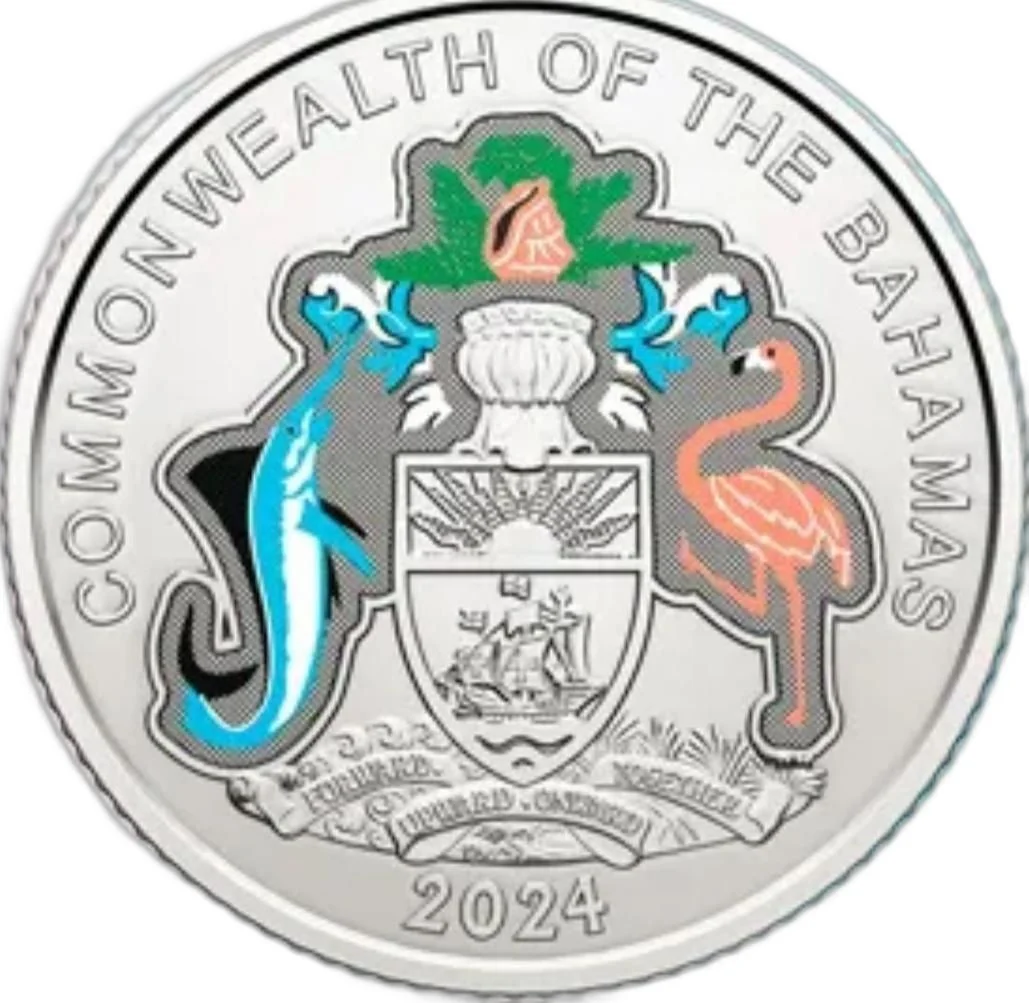
Obverse
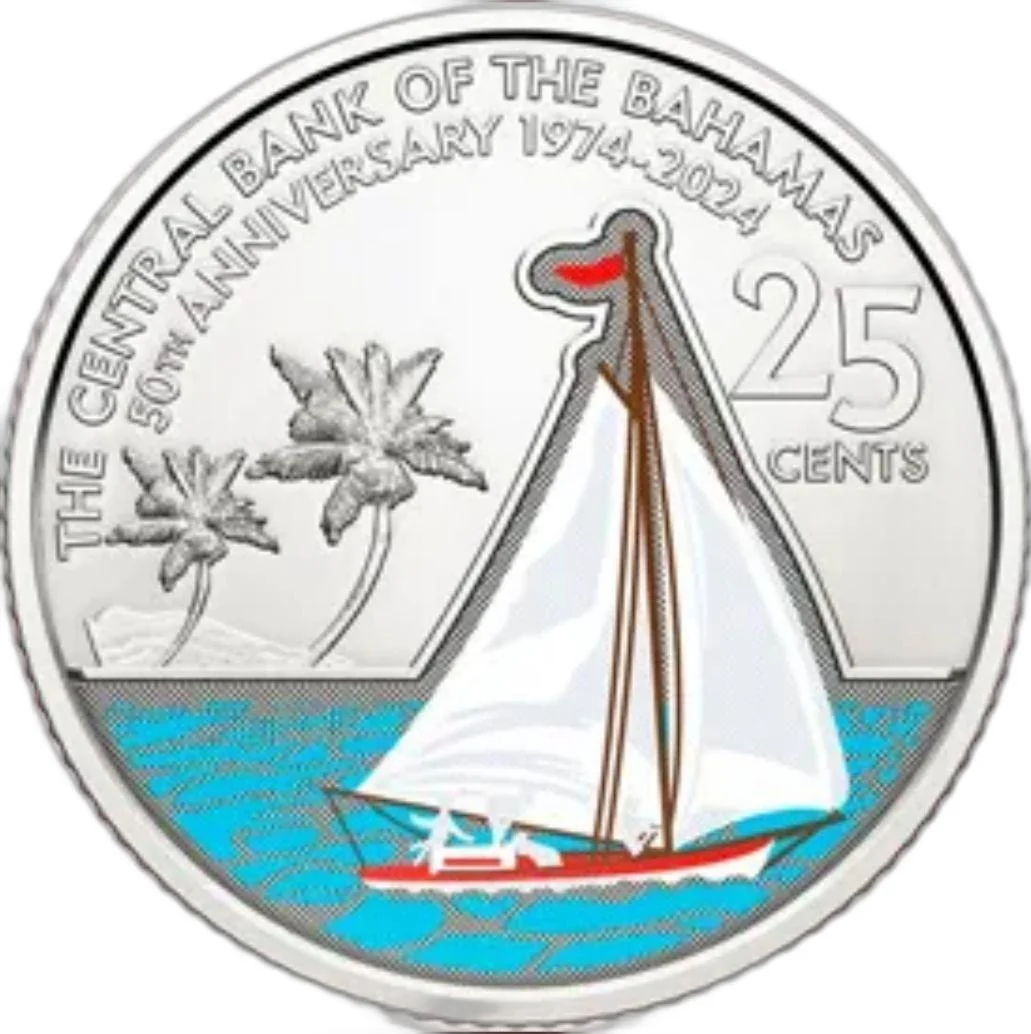
Reverse
Description:
Colorized yacht with two palm trees. Two-line legend above, denomination upper right.
Inscription:
THE CENTRAL BANK OF THE BAHAMAS
50TH ANNIVERSARY 1974-2024
25
CENTS
50TH ANNIVERSARY 1974-2024
25
CENTS
Script: Latin
Edge
Milled
Categories
| Transportation> Watercraft |
| Plant> Tree |
| Symbols> Coat of Arms |
Mints
| Name | Mark |
|---|---|
| Royal Canadian Mint of Winnipeg | — |
Mintings
| Year | Mint Mark | Mintage | Quality | Collection |
|---|---|---|---|---|
| 2024 | — | — |
Historical background
The Bahamian dollar (BSD) has maintained a stable and predictable currency environment in 2024, continuing its decades-long peg of 1:1 to the United States dollar. This fixed exchange rate, administered by The Central Bank of The Bahamas, provides a crucial anchor for the nation's tourism and financial services-dependent economy. It ensures price stability for imports, bolsters investor confidence, and simplifies transactions for the millions of US visitors, who can use their currency interchangeably with BSD notes and coins throughout the islands. This stability remains a cornerstone of national economic policy.
The most significant development in recent years is the ongoing rollout and adoption of the Sand Dollar, the world's first fully deployed central bank digital currency (CBDC). In 2024, efforts are focused on deepening its integration into the financial ecosystem. The Central Bank is actively working to increase merchant acceptance, promote its use for government services and benefits disbursements, and enhance interoperability between different financial service providers. The goal is to improve financial inclusion, particularly in the Family Islands where traditional banking infrastructure is limited, and to modernize the domestic payments system.
Despite this stability, The Bahamas faces external economic pressures that influence its currency management. High inflation in the US, though easing, continues to import cost-of-living increases. Furthermore, the country's high level of public debt, exacerbated by pandemic spending and reconstruction from hurricanes, requires careful foreign reserve management to defend the peg. The Central Bank must balance the need to maintain ample reserves with supporting economic growth, all while navigating the global risks of climate change and fluctuating tourism flows. Thus, the 2024 currency situation is one of traditional stability being proactively future-proofed through digital innovation, against a backdrop of familiar structural challenges.
The most significant development in recent years is the ongoing rollout and adoption of the Sand Dollar, the world's first fully deployed central bank digital currency (CBDC). In 2024, efforts are focused on deepening its integration into the financial ecosystem. The Central Bank is actively working to increase merchant acceptance, promote its use for government services and benefits disbursements, and enhance interoperability between different financial service providers. The goal is to improve financial inclusion, particularly in the Family Islands where traditional banking infrastructure is limited, and to modernize the domestic payments system.
Despite this stability, The Bahamas faces external economic pressures that influence its currency management. High inflation in the US, though easing, continues to import cost-of-living increases. Furthermore, the country's high level of public debt, exacerbated by pandemic spending and reconstruction from hurricanes, requires careful foreign reserve management to defend the peg. The Central Bank must balance the need to maintain ample reserves with supporting economic growth, all while navigating the global risks of climate change and fluctuating tourism flows. Thus, the 2024 currency situation is one of traditional stability being proactively future-proofed through digital innovation, against a backdrop of familiar structural challenges.
🌟 Limited