

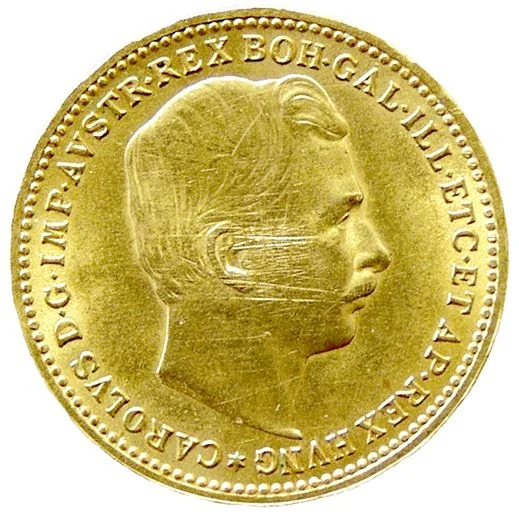
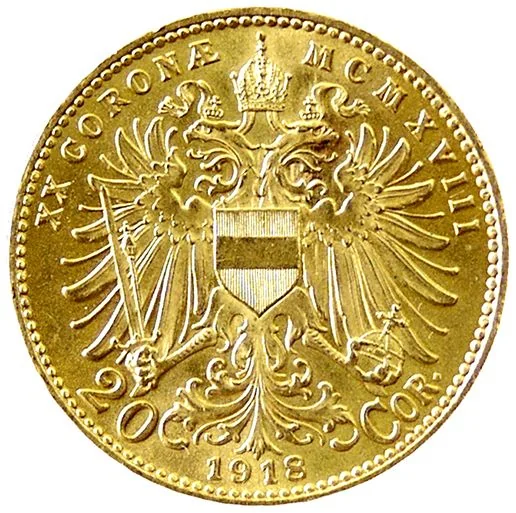
20 crowns – Austrian Empire
Add to wishlist
Austria
Context
Year: 1918
Country: Austria
Issuer: Austrian Empire
Ruler: Charles I
Currency:
(1892—1918)
Demonetized: Yes
Total mintage: 2,000
Material
References
KM: #
Numista: #418417
Value
Bullion value: $935.50
Obverse
Reverse
Edge
Mints
| Name | Mark |
|---|---|
| Münze Österreich | — |
Mintings
| Year | Mint Mark | Mintage | Quality | Collection |
|---|---|---|---|---|
| 1918 | — | 2,000 | BU |
Historical background
By the autumn of 1918, the Austro-Hungarian Empire was in a state of profound monetary and economic collapse, directly stemming from the catastrophic costs of the First World War. The Habsburg state, having long abandoned the gold standard, financed the conflict primarily by printing money, leading to rampant inflation. The Austro-Hungarian Bank (the central bank) acted as a lender of last resort to the imperial government, causing the money supply to increase approximately fourteen-fold between 1914 and 1918. This deliberate monetary expansion eroded public confidence and the currency's value, with prices rising sharply, especially for essential goods, while foreign exchange reserves dwindled to nothing.
The situation was exacerbated by the empire's severe political fragmentation along national lines. As the war effort faltered, the various constituent kingdoms and provinces (like Hungary, Czechoslovakia, and the South Slav territories) began to withhold food supplies and tax revenues from the central government in Vienna, further starving it of resources. Economically, this meant that the unified monetary zone was breaking apart even before the political dissolution. Regions began stamping or sealing existing Austro-Hungarian banknotes to assert control and prevent an influx of notes from other parts of the empire, a practice that foreshadowed the imminent splintering of the currency.
The formal armistice of November 3, 1918, and the empire's subsequent political disintegration into successor states, turned a severe inflationary crisis into a chaotic monetary free-for-all. The Austro-Hungarian Bank lost its empire-wide authority, but its notes—now without a backing state—remained in circulation across the new nations as a deprecated common currency. This "ghost currency" continued to flood the market as each new government initially had no alternative, leading to hyperinflation in 1919-1922. The period thus closed with a legacy of worthless paper kronen, setting the stage for the successor states' urgent and difficult task of establishing their own independent currencies and central banks.
The situation was exacerbated by the empire's severe political fragmentation along national lines. As the war effort faltered, the various constituent kingdoms and provinces (like Hungary, Czechoslovakia, and the South Slav territories) began to withhold food supplies and tax revenues from the central government in Vienna, further starving it of resources. Economically, this meant that the unified monetary zone was breaking apart even before the political dissolution. Regions began stamping or sealing existing Austro-Hungarian banknotes to assert control and prevent an influx of notes from other parts of the empire, a practice that foreshadowed the imminent splintering of the currency.
The formal armistice of November 3, 1918, and the empire's subsequent political disintegration into successor states, turned a severe inflationary crisis into a chaotic monetary free-for-all. The Austro-Hungarian Bank lost its empire-wide authority, but its notes—now without a backing state—remained in circulation across the new nations as a deprecated common currency. This "ghost currency" continued to flood the market as each new government initially had no alternative, leading to hyperinflation in 1919-1922. The period thus closed with a legacy of worthless paper kronen, setting the stage for the successor states' urgent and difficult task of establishing their own independent currencies and central banks.
✨ Legendary