

5 Kroner – Norway
Norway
Context
Material
Diameter: 26 mm
Weight: 7.85 g
Thickness: 2 mm
Shape: Round with a round hole
Standard: Silver quarter ounce
Technique: Milled
Alignment: Medal alignment
flip
References
KM: #Click to copy to clipboard463
Numista: #1448
Value
Exchange value: 5 NOK = $0.52
Inflation-adjusted value: 9.72 NOK
Obverse
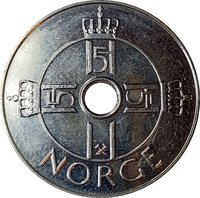
Description:
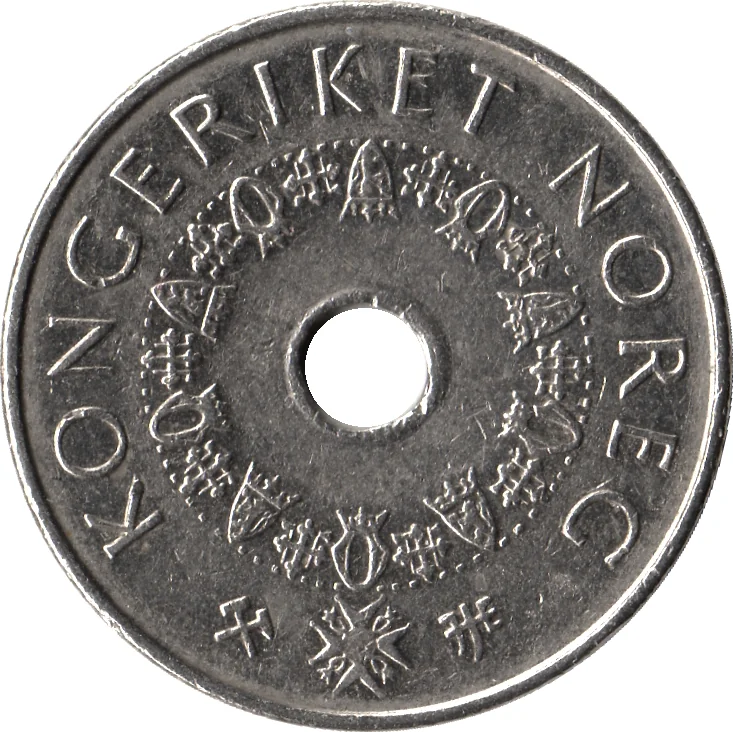
Order of Saint Olaf chain encircling a hole. Inscription around. Mintmark left, mintmaster's initials right. Solid rim ring.
Inscription:
KONGERIKET NOREG
⚒ | JEJ
⚒ | JEJ
Translation:
Kingdom of Norway
Iron | Zinc
Iron | Zinc
Script: Latin
Language: Norwegian
Engraver: Ingrid Austlid Rise
Reverse
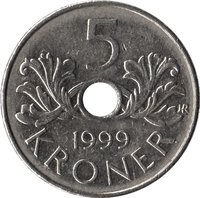
Description:
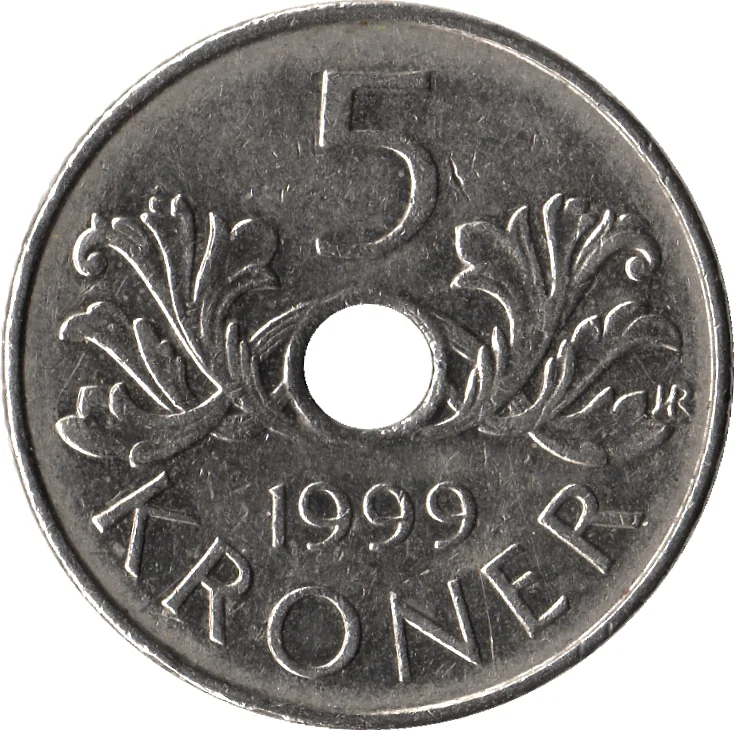
Center hole splits acanthus sprigs. Denomination above, date and value below. Engraver's initials to the right.
Inscription:
5
IAR
1999
KRONER
IAR
1999
KRONER
Script: Latin
Engraver: Ingrid Austlid Rise
Edge
Reeded
Mints
| Name | Mark |
|---|---|
| Norwegian Mint | — |
Mintings
| Year | Mint Mark | Mintage | Quality | Collection |
|---|---|---|---|---|
| 1998 | — | 47,601,000 | ||
| 1998 | — | 14,977 | Proof | |
| 1999 | — | 21,677,423 | ||
| 1999 | — | 12,500 | Proof | |
| 2000 | — | 13,000 | Proof | |
| 2000 | — | 9,621,959 | ||
| 2001 | — | 397,500 | ||
| 2001 | — | 11,500 | Proof | |
| 2002 | — | 3,553,107 | ||
| 2002 | — | 11,500 | Proof | |
| 2003 | — | 11,100 | Proof | |
| 2003 | — | 771,578 | ||
| 2004 | — | 462,000 | ||
| 2004 | — | 8,900 | Proof | |
| 2005 | — | 459,005 | ||
| 2005 | — | 2,005 | BU | |
| 2005 | — | 8,500 | Proof | |
| 2006 | — | 477,756 | ||
| 2006 | — | 2,006 | BU | |
| 2006 | — | 8,800 | Proof | |
| 2007 | — | 9,512,000 | ||
| 2007 | — | 3,750 | BU | |
| 2007 | — | 6,932 | Proof | |
| 2008 | — | 5,470,000 | ||
| 2008 | — | 7,091 | Proof | |
| 2008 | — | 2,271 | BU | |
| 2009 | — | 2,271 | BU | |
| 2009 | — | 7,500 | Proof | |
| 2009 | — | 9,988,000 | ||
| 2012 | — | 3,107 | Proof | |
| 2012 | — | 990,385 | ||
| 2012 | — | 2,000 | BU | |
| 2017 | — | 3,032,000 | ||
| 2017 | — | 2,450 | Proof |
Historical background
In 1998, Norway's currency situation was defined by its managed float exchange rate regime for the Norwegian krone (NOK). The central bank, Norges Bank, did not target a fixed exchange rate but actively intervened in the foreign exchange market to smooth out excessive volatility and maintain stability. This approach was guided by a broad assessment of the economy, with a particular focus on the krone's value against a trade-weighted basket of currencies, as Norway's economy was heavily dependent on oil exports and international trade.
The period was marked by significant external pressures, primarily from the Asian Financial Crisis that began in 1997. This crisis created global financial turbulence and a "flight to quality," strengthening traditional safe-haven currencies while putting pressure on others. Although Norway's robust economy and large foreign exchange reserves provided a buffer, the krone experienced downward pressure at times as investor sentiment turned risk-averse. Norges Bank responded by utilizing its reserves to support the currency, aiming to prevent destabilizing swings without defending a specific, rigid parity.
Ultimately, the monetary policy framework was in a state of evolution. While exchange rate stability was a key consideration, there was a growing emphasis on establishing an explicit inflation target. This shift in focus would culminate in March 2001, when Norges Bank formally adopted an inflation target of 2.5%, allowing the krone to float more freely. Therefore, 1998 represents a late stage of the managed float era, where currency management was increasingly balanced against the future goal of inflation-targeting independence.
The period was marked by significant external pressures, primarily from the Asian Financial Crisis that began in 1997. This crisis created global financial turbulence and a "flight to quality," strengthening traditional safe-haven currencies while putting pressure on others. Although Norway's robust economy and large foreign exchange reserves provided a buffer, the krone experienced downward pressure at times as investor sentiment turned risk-averse. Norges Bank responded by utilizing its reserves to support the currency, aiming to prevent destabilizing swings without defending a specific, rigid parity.
Ultimately, the monetary policy framework was in a state of evolution. While exchange rate stability was a key consideration, there was a growing emphasis on establishing an explicit inflation target. This shift in focus would culminate in March 2001, when Norges Bank formally adopted an inflation target of 2.5%, allowing the krone to float more freely. Therefore, 1998 represents a late stage of the managed float era, where currency management was increasingly balanced against the future goal of inflation-targeting independence.
🌱 Very Common