


100 rubles (Alexander Pushkin) – Russian Federation
Add to wishlist
Non-circulating coins
Commemoration: The 225th Anniversary of the Birth of Alexander Pushkin
Russia
Context
Year: 2024
Country: Russia
Issuer: Russian Federation
Period:
(since 1991)
Currency:
(since 1998)
Total mintage: 100
Material

References
Value
Exchange value: 100 RUB
Bullion value: $2451.79
Inflation-adjusted value: 103.67 RUB
Obverse
Description:
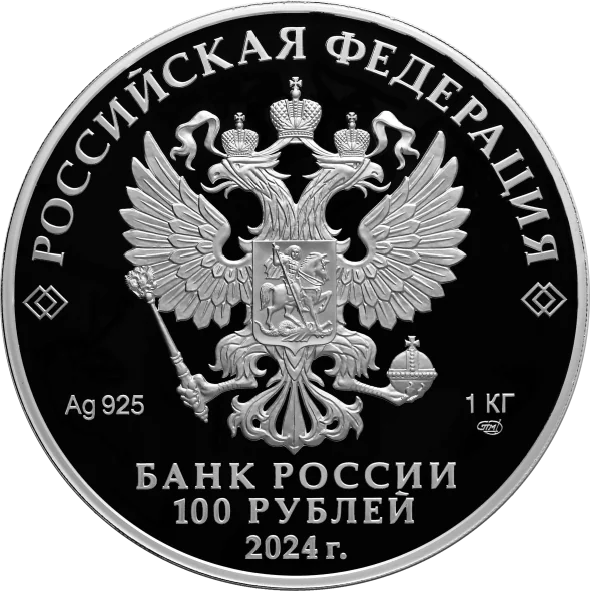
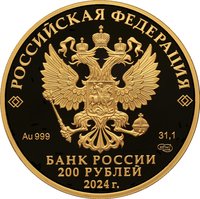
The obverse features the State Coat of Arms of the Russian Federation, inscriptions for "RUSSIAN FEDERATION," "BANK OF RUSSIA," "100 ROUBLES," "2024," metal specifications, mint mark, and fine metal content.
Inscription:
РОССИЙСКАЯ ФЕДЕРАЦИЯ
Ag 925 1 кг
СПМД
БАНК РОССИИ
100 РУБЛЕЙ
2024 г.
Ag 925 1 кг
СПМД
БАНК РОССИИ
100 РУБЛЕЙ
2024 г.
Translation:
RUSSIAN FEDERATION
Ag 925 1 kg
SPMD
BANK OF RUSSIA
100 ROUBLES
2024 yr.
Ag 925 1 kg
SPMD
BANK OF RUSSIA
100 ROUBLES
2024 yr.
Language: Russian
Engraver: Alexandra Arsenyevna Dolgopolova
Designer: Elena Viktorovna Kramskaya
Reverse
Description:
The disc's mirror field features a laser-treated matte relief of Alexander Pushkin before the Hermitage Theatre and Bridge, with scenes of the Winter Canal, Peter and Paul Fortress, the city, and a cloudy sky. An arch displays lines from the "Monument" manuscript. The right side bears the relief inscription "А.С. Пушкин," his dates "1799" and "1837," and a decorative ornament.
Inscription:
А.С. Пушкин
1799 1837
1799 1837
Translation:
A.S. Pushkin
1799 1837
1799 1837
Script: Cyrillic (cursive)
Language: Russian
Engraver: Alexander Nikolaevich Bessonov
Designer: Sergey Vladilenovich Sutyagin
Edge
360 corrugations
Categories
| Art> Literature |
| Building> Bridge |
| Event> Birth anniversary |
| Geography> River |
Mints
| Name | Mark |
|---|---|
| Saint Petersburg | (СПМД) |
Mintings
| Year | Mint Mark | Mintage | Quality | Collection |
|---|---|---|---|---|
| 2024 | СПМД | 100 | Prooflike |
Historical background
In 2024, the currency situation in the Russian Federation is defined by a state of managed stability under persistent pressure. The ruble's value is primarily dictated by a complex system of capital controls, mandatory foreign currency revenue sales for exporters, and high central bank interest rates (held at 16% for much of the year to combat inflation). This artificial stability has been engineered to shield the economy from the immediate shocks of extensive Western sanctions, particularly those targeting the financial system and energy exports. However, this stability is underpinned by a fundamental shift in trade flows and a sustained decline in imports, rather than robust economic health or investor confidence.
The underlying pressures are significant and structural. The country's current account surplus has sharply narrowed, primarily due to the effective G7 oil price cap and the costly re-routing of energy exports to alternative markets like India and China, which increases transportation costs and discounts. Simultaneously, military-related imports and "parallel imports" of consumer goods to replace departed Western brands have kept demand for foreign currency high. This creates a constant tug-of-war: export revenues in foreign currency are being squeezed while import needs persist, applying a steady depreciatory force on the ruble that requires continuous administrative measures to contain.
Looking forward, the currency regime remains a critical vulnerability. The stability is costly, relying on draining reserves and stringent controls that deter foreign investment and distort the domestic economy. The central bank faces a difficult balancing act between controlling inflation (fueled by high military spending and labor shortages) and avoiding excessive tightening that could stifle economic activity. Consequently, the ruble's trajectory in 2024 is less a reflection of market sentiment and more a direct barometer of the state's ability to enforce its financial defenses, the efficacy of sanctions evasion, and the long-term fiscal burden of the war in Ukraine.
The underlying pressures are significant and structural. The country's current account surplus has sharply narrowed, primarily due to the effective G7 oil price cap and the costly re-routing of energy exports to alternative markets like India and China, which increases transportation costs and discounts. Simultaneously, military-related imports and "parallel imports" of consumer goods to replace departed Western brands have kept demand for foreign currency high. This creates a constant tug-of-war: export revenues in foreign currency are being squeezed while import needs persist, applying a steady depreciatory force on the ruble that requires continuous administrative measures to contain.
Looking forward, the currency regime remains a critical vulnerability. The stability is costly, relying on draining reserves and stringent controls that deter foreign investment and distort the domestic economy. The central bank faces a difficult balancing act between controlling inflation (fueled by high military spending and labor shortages) and avoiding excessive tightening that could stifle economic activity. Consequently, the ruble's trajectory in 2024 is less a reflection of market sentiment and more a direct barometer of the state's ability to enforce its financial defenses, the efficacy of sanctions evasion, and the long-term fiscal burden of the war in Ukraine.

✨ Legendary