

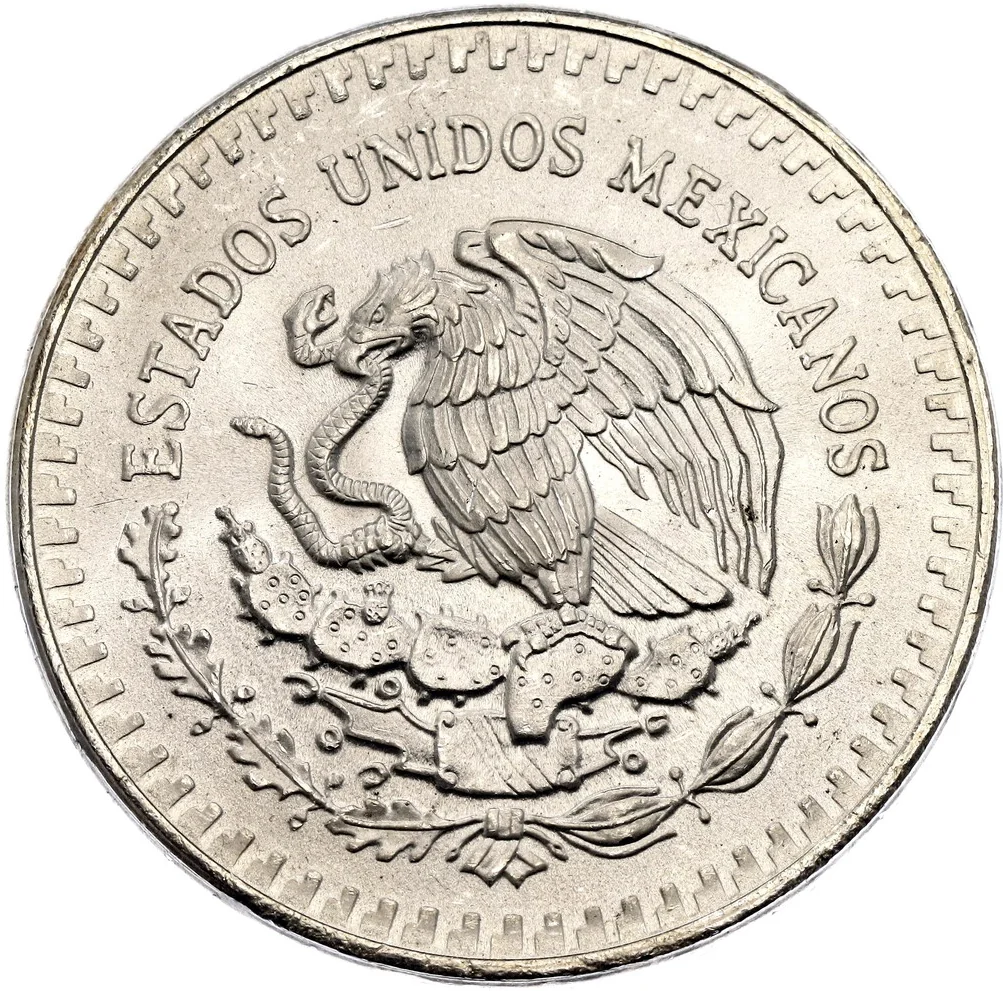
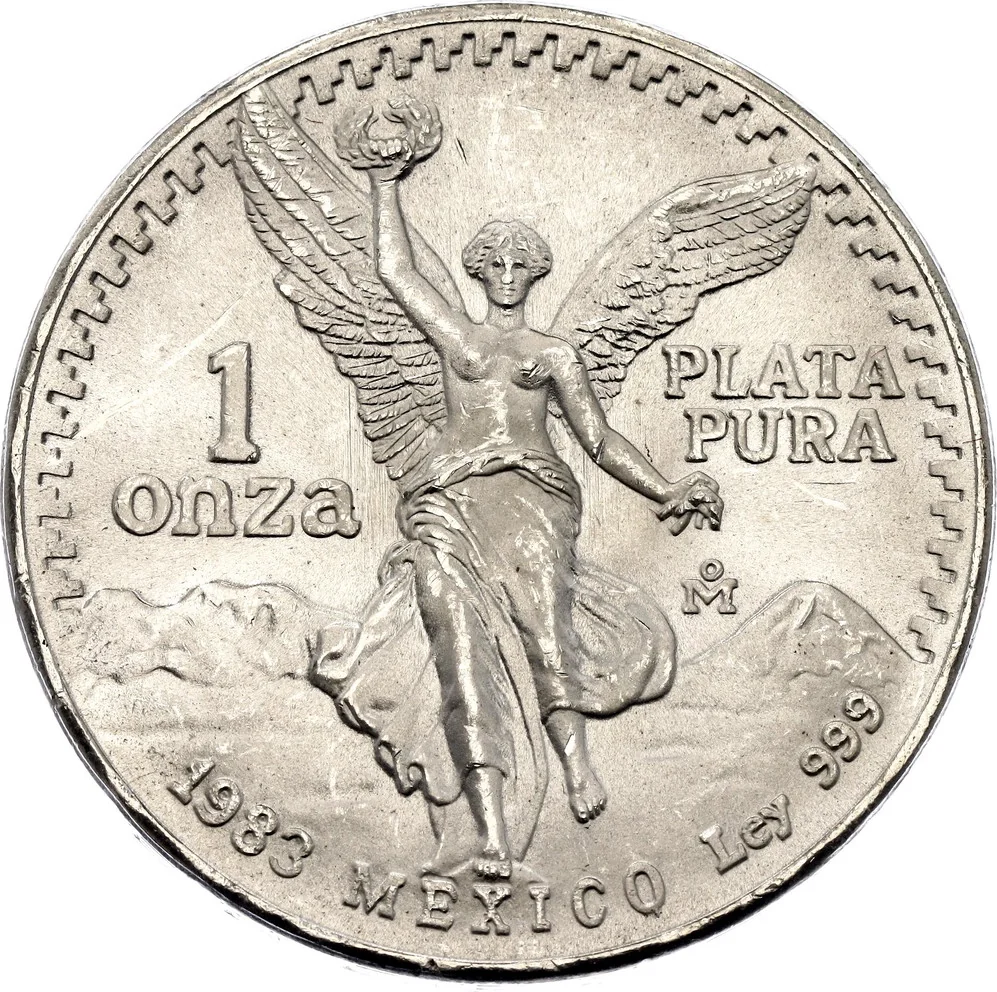
1 Onza "Libertad" – Mexico
Mexico
Context
Material
Diameter: 36 mm
Weight: 31.1 g
Silver weight: 31.07 g
Thickness: 3.47 mm
Shape: Round
Composition: 99.9% Silver
Standard: Silver ounce
Magnetic: No
Technique: Milled
Alignment: Coin alignment
flip
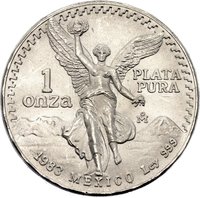
References
KM: #Click to copy to clipboard494.1-494.
Numista: #14465
Value
Bullion value: $89.57
Obverse
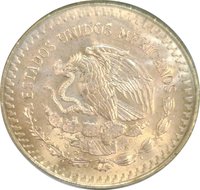
Reverse
Edge
Lettered (KM#494.1) or Reeded (see comments)
Legend:
INDEPENDENCIA Y LIBERTAD
Translation:
Independence and Liberty
Language: Spanish
Mints
| Name | Mark |
|---|---|
| Mexican Mint | Mo |
Mintings
| Year | Mint Mark | Mintage | Quality | Collection |
|---|---|---|---|---|
| 1982 | Mo | 1,049,680 | ||
| 1983 | Mo | 1,001,768 | ||
| 1983 | Mo | 998 | Proof | |
| 1984 | Mo | 1,014,000 | ||
| 1985 | Mo | 2,017,000 | ||
| 1986 | Mo | 30,006 | Proof | |
| 1986 | Mo | 1,699,426 | ||
| 1987 | Mo | 12,000 | Proof | |
| 1987 | Mo | 500,000 | ||
| 1988 | Mo | 10,000 | Proof | |
| 1988 | Mo | 1,500,500 | ||
| 1989 | Mo | — | Proof | |
| 1989 | Mo | 1,396,500 | ||
| 1990 | Mo | 10,000 | Proof | |
| 1990 | Mo | 1,200,000 | ||
| 1991 | Mo | 10,000 | Proof | |
| 1991 | Mo | — | ||
| 1992 | Mo | 2,458,000 | ||
| 1992 | Mo | 10,000 | Proof | |
| 1993 | Mo | 5,002 | Proof | |
| 1993 | Mo | 1,000,000 | ||
| 1994 | Mo | 5,002 | Proof | |
| 1994 | Mo | 400,000 | ||
| 1995 | Mo | 2,000 | Proof | |
| 1995 | Mo | 500,000 |
Historical background
In 1982, Mexico faced a profound currency and financial crisis that marked a pivotal moment in its economic history and sent shockwaves through the global financial system. The roots of the crisis lay in the previous decade, when the discovery of vast oil reserves led the government to borrow heavily from international banks, betting that future oil revenues would cover the debts. This spending fueled growth but also high inflation and an overvalued peso, which was maintained under a fixed exchange rate regime. By the early 1980s, the situation became untenable as world oil prices collapsed, interest rates on foreign debt soared, and capital flight accelerated, draining the country's foreign reserves.
The breaking point arrived in August 1982. With reserves nearly exhausted, Finance Minister Jesús Silva Herzog announced that Mexico could no longer service its massive external debt, triggering what became the Latin American debt crisis. Simultaneously, the government was forced to abandon the fixed exchange rate. The peso was devalued drastically, losing over half its value against the U.S. dollar in a matter of months. In a radical move to stem capital flight and assert control, President José López Portillo nationalized the private banking system and imposed strict currency controls, shocking both domestic and international markets.
The 1982 crisis had devastating and lasting consequences. It plunged Mexico into a deep recession characterized by soaring inflation, a collapsed peso, and a "lost decade" of economic stagnation. The event fundamentally altered Mexico's economic policy, leading eventually to neoliberal reforms, trade liberalization, and a shift away from state-led development. Internationally, it exposed the vulnerabilities of global lending and forced a restructuring of sovereign debt, setting the stage for future financial interventions by the IMF and World Bank.
The breaking point arrived in August 1982. With reserves nearly exhausted, Finance Minister Jesús Silva Herzog announced that Mexico could no longer service its massive external debt, triggering what became the Latin American debt crisis. Simultaneously, the government was forced to abandon the fixed exchange rate. The peso was devalued drastically, losing over half its value against the U.S. dollar in a matter of months. In a radical move to stem capital flight and assert control, President José López Portillo nationalized the private banking system and imposed strict currency controls, shocking both domestic and international markets.
The 1982 crisis had devastating and lasting consequences. It plunged Mexico into a deep recession characterized by soaring inflation, a collapsed peso, and a "lost decade" of economic stagnation. The event fundamentally altered Mexico's economic policy, leading eventually to neoliberal reforms, trade liberalization, and a shift away from state-led development. Internationally, it exposed the vulnerabilities of global lending and forced a restructuring of sovereign debt, setting the stage for future financial interventions by the IMF and World Bank.
🌱 Common