

50 Francs – Comoro Islands
Circulating commemorative coins
Commemoration: Republic Independence
Context
Year: 1975
Issuer: Comoro Islands
Period:
(1975—2001)
Currency:
(since 1976)
Total mintage: 1,200,200
Material
References
KM: #Click to copy to clipboard9
Numista: #4149
Value
Exchange value: 50 KMF
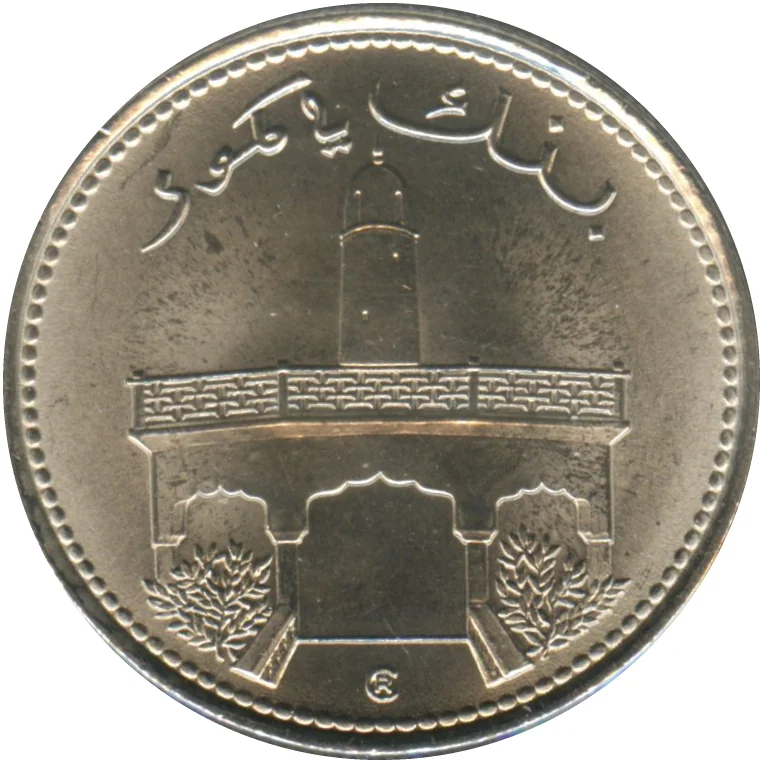
Obverse
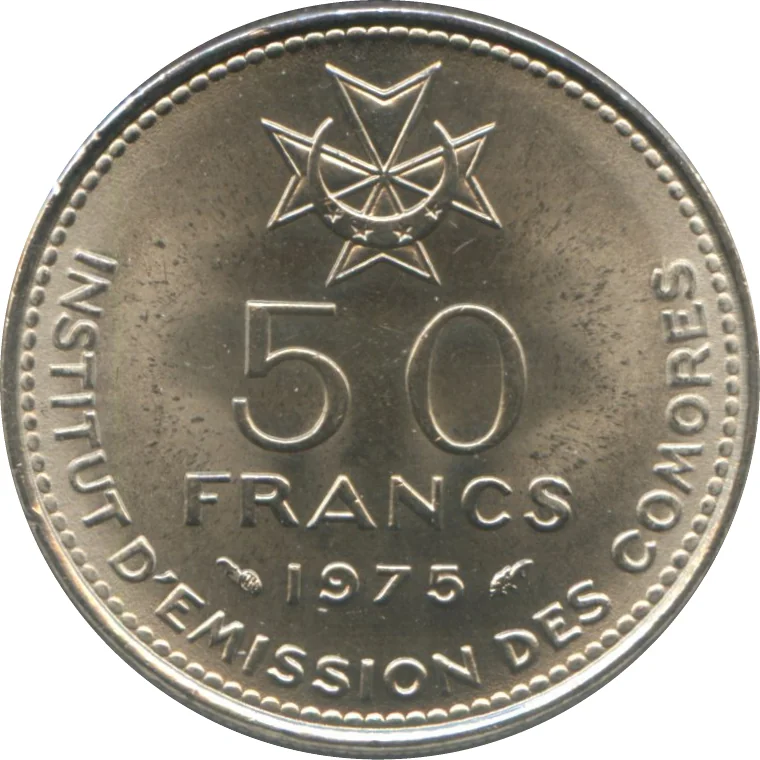
Reverse
Description:
Lesser Coat of Arms
Denomination and date below
Denomination and date below
Inscription:
50 FRANCS 1975
INSTITUT D'EMISSION DES COMORES
INSTITUT D'EMISSION DES COMORES
Script: Latin
Edge
Reeded
Categories
| Building> Religious building |
| Event> Independence |
Mints
| Name | Mark |
|---|---|
| Monnaie de Paris | — |
Mintings
| Year | Mint Mark | Mintage | Quality | Collection |
|---|---|---|---|---|
| 1975 | — | 1,200,200 |
Historical background
Following independence from France in July 1975, the Comoros faced immediate monetary uncertainty, inheriting the CFA franc as its currency. This placed the new nation within the CFA franc zone, a system guaranteed by the French Treasury and pegged to the French franc. While this arrangement provided stability and facilitated trade with France, it also symbolized a continued economic dependence that conflicted with the political sovereignty just won. The government of President Ahmed Abdallah was thus confronted with a critical early decision: maintain the security of the colonial-era currency or pursue a national monetary identity.
The choice was made swiftly. Still within its first year of independence, the Comorian government introduced the Comorian franc (KMF) to replace the CFA franc. This new currency, established in 1975, maintained a fixed parity with the French franc, mirroring the old peg. Crucially, and reflecting the nation's fragile economic position, the Comoros entered into a monetary cooperation agreement with France. This agreement ensured the convertibility of the Comorian franc, backed by French guarantees, and provided for Comorian membership in the French Franc Zone, albeit with its own distinct issuance.
Therefore, the 1975 currency situation was one of transitional pragmatism. The creation of the Comorian franc was a symbolic act of national sovereignty, yet its management was deliberately linked to France for economic security. This established a dependent but stable monetary framework that would characterize the Comorian economy for decades, with the KMF remaining pegged first to the French franc and later to the euro, under the oversight of the French-backed Institut d'Émission des Comores.
The choice was made swiftly. Still within its first year of independence, the Comorian government introduced the Comorian franc (KMF) to replace the CFA franc. This new currency, established in 1975, maintained a fixed parity with the French franc, mirroring the old peg. Crucially, and reflecting the nation's fragile economic position, the Comoros entered into a monetary cooperation agreement with France. This agreement ensured the convertibility of the Comorian franc, backed by French guarantees, and provided for Comorian membership in the French Franc Zone, albeit with its own distinct issuance.
Therefore, the 1975 currency situation was one of transitional pragmatism. The creation of the Comorian franc was a symbolic act of national sovereignty, yet its management was deliberately linked to France for economic security. This established a dependent but stable monetary framework that would characterize the Comorian economy for decades, with the KMF remaining pegged first to the French franc and later to the euro, under the oversight of the French-backed Institut d'Émission des Comores.
🌱 Common