

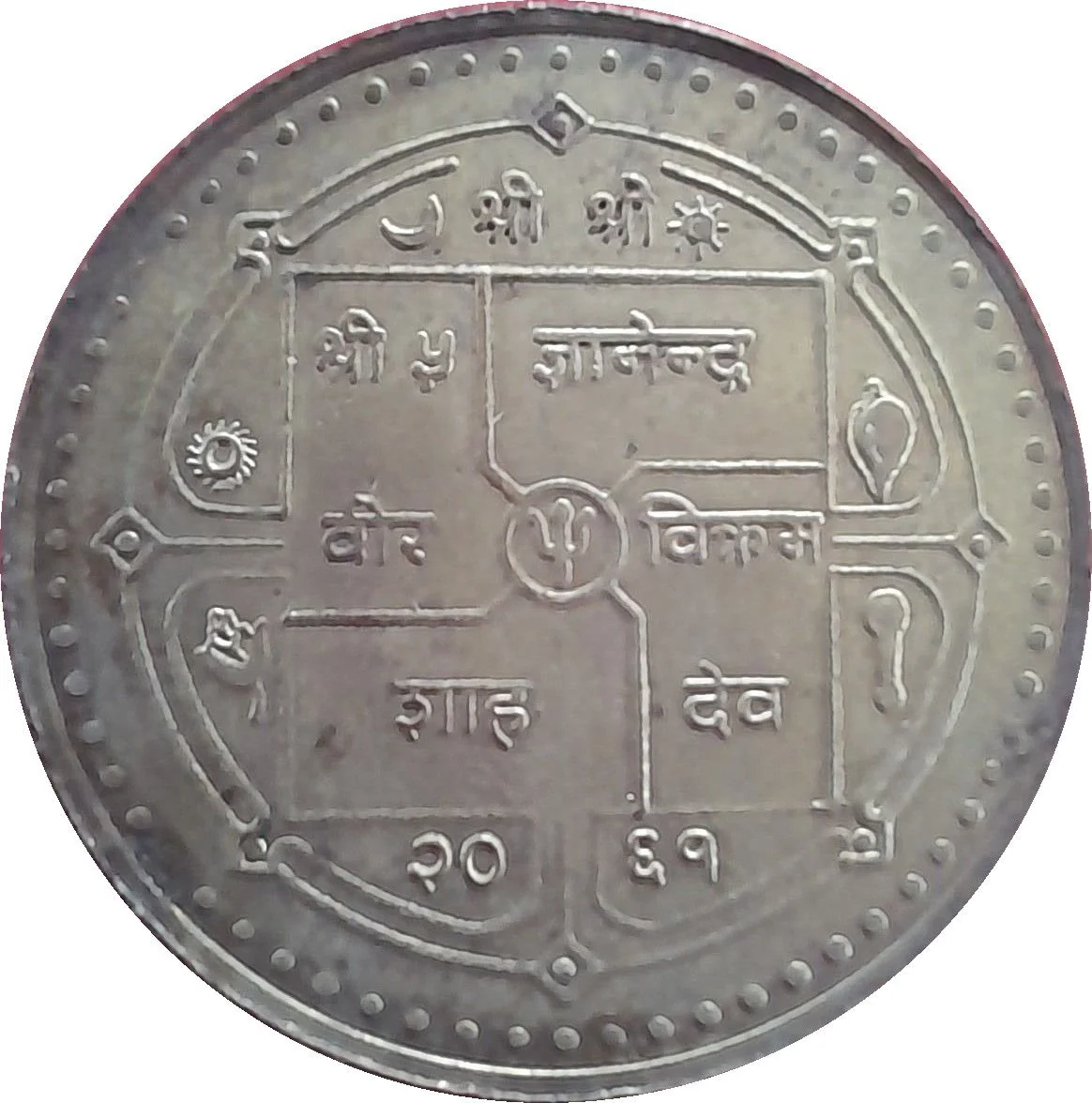
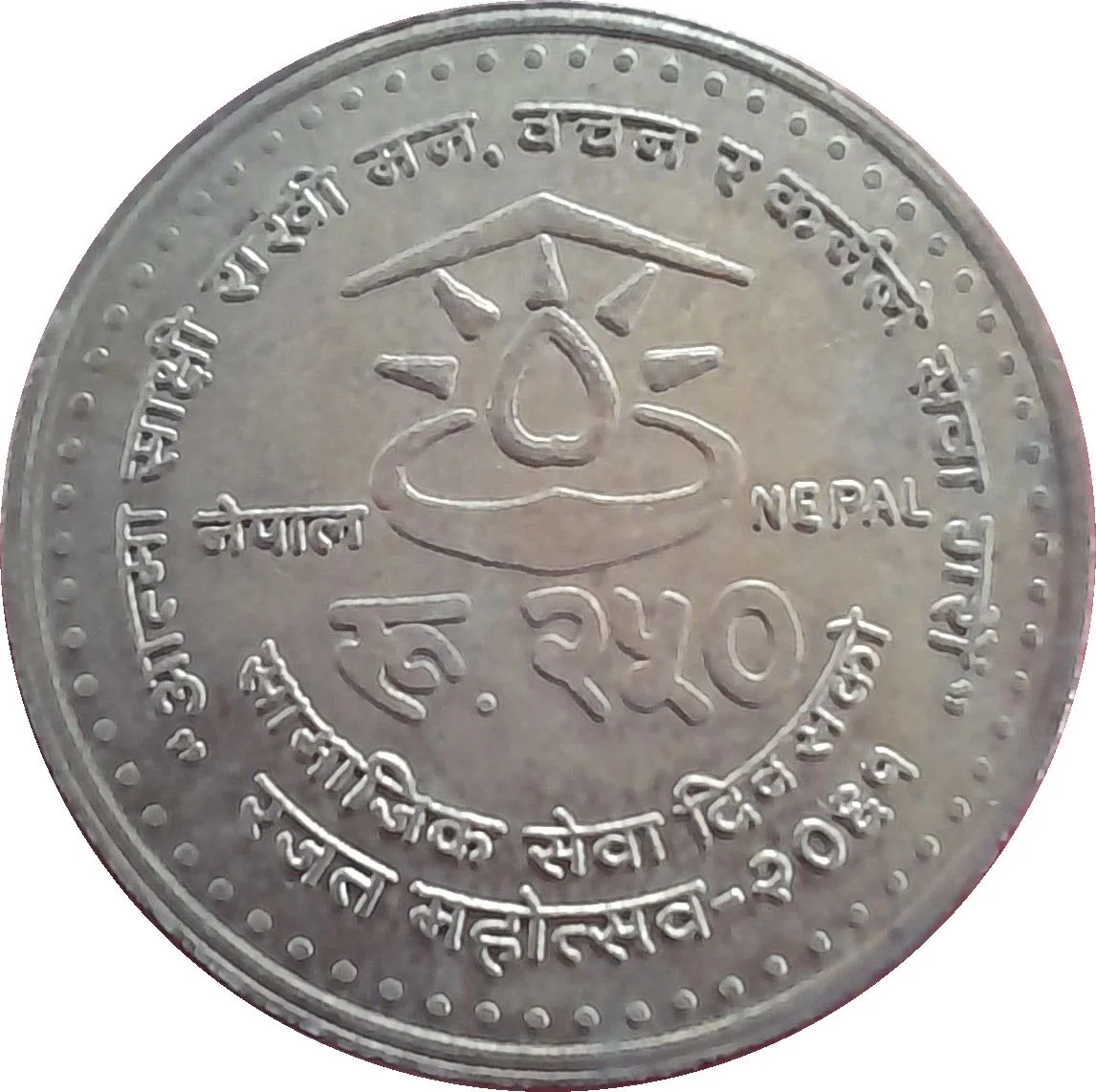
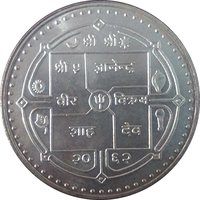
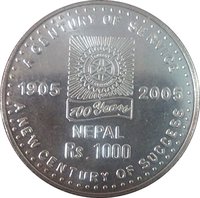
250 rupees (Social Service Day) – Nepal
Add to wishlist
Non-circulating coins
Commemoration: 25th Anniversary of Social Service Day
Nepal
Context
Year: 2004
Vikram Samvat Year:: 2061
Issuer: Nepal
Ruler: Gyanendra Bir Bikram Shah
Currency:
(since 1932)
Total mintage: 5,000
Material
References
Numista: #41442
Value
Exchange value: 250 NPR
Mints
| Name | Mark |
|---|---|
| Mint Division of the Central Bank of Nepal | — |
Mintings
| Year | Mint Mark | Mintage | Quality | Collection |
|---|---|---|---|---|
| 2004 | — | 5,000 |
Historical background
In 2004, Nepal's currency situation was characterized by relative stability but underlying vulnerabilities tied to its fixed exchange rate regime and political instability. The Nepalese rupee (NPR) was pegged to the Indian rupee (INR) at a rate of 1.6 NPR to 1 INR, a long-standing arrangement critical for the open border and massive trade deficit with India, which accounted for over 60% of Nepal's trade. This peg provided stability, controlled inflationary spillovers from India, and facilitated cross-border transactions. However, it also meant Nepal ceded control over its independent monetary policy, essentially importing the monetary stance of the Reserve Bank of India.
The economy faced significant pressures that strained this fixed system. The decade-long Maoist insurgency was at its peak, severely disrupting economic activity, tourism, and investment. This conflict, combined with weak governance, led to declining foreign exchange reserves and a growing fiscal deficit. Furthermore, Nepal's competitiveness was eroding, and its trade deficit with India was widening, creating a persistent downward pressure on the rupee. The Nepal Rastra Bank (NRB) had to actively intervene in the foreign exchange market to maintain the peg, depleting reserves in the process.
Despite these challenges, the peg held firmly throughout 2004. The government and central bank prioritized maintaining the exchange rate anchor as a source of macroeconomic stability amidst political chaos. Inflation was moderate, largely imported from India, and there was no formal devaluation or currency crisis that year. However, the situation highlighted the structural fragility of an economy reliant on remittances and tourism, with a fixed exchange rate, while grappling with internal conflict—a combination that would necessitate careful management in the coming years.
The economy faced significant pressures that strained this fixed system. The decade-long Maoist insurgency was at its peak, severely disrupting economic activity, tourism, and investment. This conflict, combined with weak governance, led to declining foreign exchange reserves and a growing fiscal deficit. Furthermore, Nepal's competitiveness was eroding, and its trade deficit with India was widening, creating a persistent downward pressure on the rupee. The Nepal Rastra Bank (NRB) had to actively intervene in the foreign exchange market to maintain the peg, depleting reserves in the process.
Despite these challenges, the peg held firmly throughout 2004. The government and central bank prioritized maintaining the exchange rate anchor as a source of macroeconomic stability amidst political chaos. Inflation was moderate, largely imported from India, and there was no formal devaluation or currency crisis that year. However, the situation highlighted the structural fragility of an economy reliant on remittances and tourism, with a fixed exchange rate, while grappling with internal conflict—a combination that would necessitate careful management in the coming years.
💎 Extremely Rare