

2000 Rupees – Nepal
Non-circulating coins
Commemoration: Accession of Gyanendra Bir Bikram Shah
Nepal
Context
Year: 2001
Vikram Samvat Year: 2058
Issuer: Nepal 
Ruler: Gyanendra Bir Bikram Shah
Currency:
(since 1932)
Total mintage: 7,000
Material
Diameter: 40 mm
Weight: 31.1 g
Silver weight: 30.94 g
Shape: Round
Composition: 99.5% Silver
Standard: Silver ounce
Magnetic: No
Technique: Milled
Alignment: Medal alignment
flip
References
KM: #Click to copy to clipboard1172
Numista: #41440
Value
Exchange value: 2000 NPR
Bullion value: $87.10
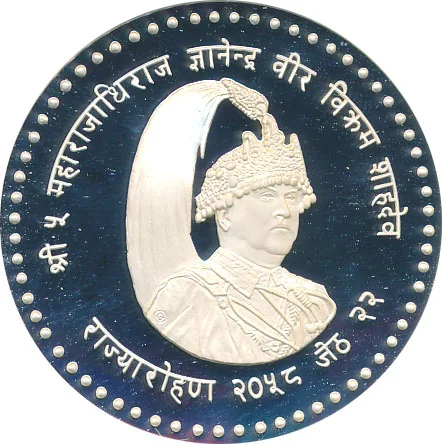
Obverse
Description:
Crowned head facing right.
Inscription:
श्री ५ महाराजाधिराज ज्ञानेन्द्र वीर विक्रम शाहदेव
राज्यारोहण २०५८ जेठ २२
राज्यारोहण २०५८ जेठ २२
Translation:
His Majesty the Great King of Kings Gyanendra Bir Bikram Shah Dev
Ascension to the throne 2058 Jeth 22
Ascension to the throne 2058 Jeth 22
Script: Devanagari
Language: Nepali
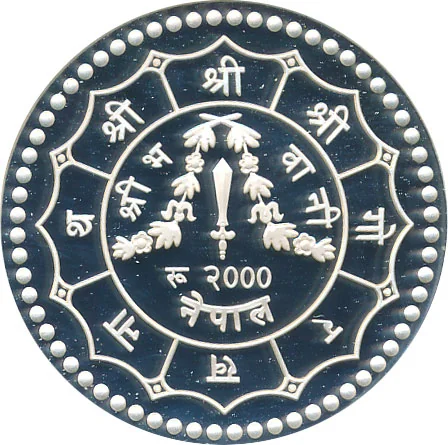
Reverse
Description:
Sword over value in circle.
Inscription:
श्री श्री श्री गोरखनाथ
श्री भवानी
रु २०००
नेपाल
श्री भवानी
रु २०००
नेपाल
Translation:
Shri Shri Shri Gorakhnath
Shri Bhavani
Rs. 2000
Nepal
Shri Bhavani
Rs. 2000
Nepal
Script: Devanagari
Edge
Reeded
Mints
| Name | Mark |
|---|---|
| Mint Division of the Central Bank of Nepal | — |
| Royal Australian Mint | — |
Mintings
| Year | Mint Mark | Mintage | Quality | Collection |
|---|---|---|---|---|
| 2001 | — | 2,000 | ||
| 2001 | — | 5,000 | Proof |
Historical background
In 2001, Nepal's currency situation was characterized by a dual exchange rate system and significant pressure on foreign exchange reserves, all set against a backdrop of political instability and economic distress. The country maintained a fixed peg of the Nepalese Rupee (NPR) to the Indian Rupee (INR) at a rate of 1.6 NPR = 1 INR, a cornerstone of the 1960 bilateral trade treaty which facilitated open-border commerce. However, alongside this official rate, a thriving black market for foreign currency, especially US dollars, existed due to capital controls and limited convertibility. This parallel market highlighted a growing imbalance as the country's trade deficit with India widened and tourism revenues, a critical source of hard currency, were severely impacted by the aftermath of the 9/11 attacks and a domestic Maoist insurgency that had escalated since 1996.
The year proved particularly challenging for Nepal's external sector. Foreign exchange reserves were under strain, declining to precarious levels that could cover only about five months of import bills by the year's end. This reserve depletion was driven by a combination of factors: a ballooning trade deficit, a sharp drop in tourism earnings, and a slowdown in remittance inflows which were yet to become the massive economic lifeline they are today. The situation was exacerbated by the need to finance a growing government deficit and the economic disruption caused by the Maoist conflict, which damaged infrastructure and discouraged foreign investment.
Consequently, the monetary authorities at the Nepal Rastra Bank (NRB) faced a difficult policy dilemma. Maintaining the fixed peg to the Indian rupee provided crucial stability for trade but required using dwindling reserves to defend the currency, limiting the bank's ability to conduct independent monetary policy. While a formal devaluation was not undertaken in 2001, the pressures were mounting and set the stage for a significant adjustment. The persistent economic weaknesses and the dual-rate system underscored an urgent need for broader structural reforms and hinted at the inevitable exchange rate corrections that would follow in the coming years.
The year proved particularly challenging for Nepal's external sector. Foreign exchange reserves were under strain, declining to precarious levels that could cover only about five months of import bills by the year's end. This reserve depletion was driven by a combination of factors: a ballooning trade deficit, a sharp drop in tourism earnings, and a slowdown in remittance inflows which were yet to become the massive economic lifeline they are today. The situation was exacerbated by the need to finance a growing government deficit and the economic disruption caused by the Maoist conflict, which damaged infrastructure and discouraged foreign investment.
Consequently, the monetary authorities at the Nepal Rastra Bank (NRB) faced a difficult policy dilemma. Maintaining the fixed peg to the Indian rupee provided crucial stability for trade but required using dwindling reserves to defend the currency, limiting the bank's ability to conduct independent monetary policy. While a formal devaluation was not undertaken in 2001, the pressures were mounting and set the stage for a significant adjustment. The persistent economic weaknesses and the dual-rate system underscored an urgent need for broader structural reforms and hinted at the inevitable exchange rate corrections that would follow in the coming years.
✨ Legendary