

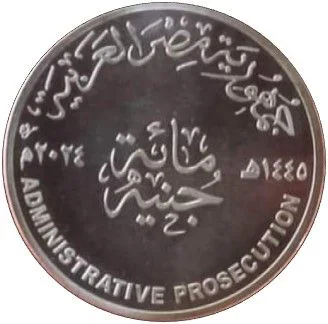

100 pounds (Administrative Prosecution Authority) – Egypt
Add to wishlist
Non-circulating coins
Commemoration: 70 Years on the Establishment of the Administrative Prosecution Authority
Egypt
Context
Year: 2024
Islamic (Hijri) Year:: 1445
Issuer: Egypt
Period:
(since 1971)
Currency:
(since 1916)
Total mintage: 3,000
Material


References
Numista: #413044
Value
Exchange value: 100 EGP
Bullion value: $52.42
Obverse
Description:
Denomination & Dates
Inscription:
جمهورية مصر العربيه
مائة
جنيه
١٤٤٥ هـ ٢٠٢٤ م
ADMINISTRATIVE PROSECUTION
مائة
جنيه
١٤٤٥ هـ ٢٠٢٤ م
ADMINISTRATIVE PROSECUTION
Translation:
Arab Republic of Egypt
One Hundred
Pounds
1445 H 2024 AD
ADMINISTRATIVE PROSECUTION
One Hundred
Pounds
1445 H 2024 AD
ADMINISTRATIVE PROSECUTION
Scripts: Arabic (naskh), Latin
Language: Arabic
Designer: Marwa Fathy
Reverse
Description:
A justice scale draped with a scarf, centered within laurel wreaths and topped by a coat of arms.
Inscription:
النيابة الإدارية
١٩٥٤
٢٠٢٤
٧٠ عاماً من العطاء
١٩٥٤
٢٠٢٤
٧٠ عاماً من العطاء
Translation:
Administrative Prosecution
1954
2024
70 Years of Giving
1954
2024
70 Years of Giving
Language: Arabic
Designer: Marwa Fathy
Edge
Mints
| Name | Mark |
|---|---|
| Egyptian Mint Authority | — |
Mintings
| Year | Mint Mark | Mintage | Quality | Collection |
|---|---|---|---|---|
| 2024 | — | 3,000 |
Historical background
In 2024, Egypt faces a protracted and severe currency crisis, fundamentally rooted in a chronic shortage of foreign exchange. The situation is characterized by a stark divergence between the official exchange rate, maintained by the Central Bank of Egypt (CBE), and a much weaker rate on the parallel black market. This gap, which has at times exceeded 40%, reflects a severe dollar liquidity crunch driven by years of high external debt repayments, a large trade deficit, and the lingering economic impacts of the war in Ukraine. The government has long relied on a system of capital controls and import restrictions to conserve dollars, creating significant bottlenecks for businesses and fueling inflation.
The crisis reached a critical juncture in early 2024, prompting a major policy shift. Under pressure to secure a larger International Monetary Fund (IMF) financial package, Egypt announced a long-awaited move to a flexible exchange rate regime in March. The CBE devalued the pound by over 35% in a single move and committed to allowing market forces to determine its value. Concurrently, the country secured an expanded $8 billion IMF loan and received a landmark $35 billion investment deal with the United Arab Emirates for the development of the Ras El-Hekma peninsula, which provided a massive, immediate injection of foreign currency.
These dramatic steps have temporarily stabilized the official market and unified the exchange rates, but the long-term outlook remains challenging. The devaluation has immediately exacerbated already soaring inflation, which exceeds 30%, severely eroding household purchasing power. The success of the new regime now hinges on Egypt's ability to attract sustained foreign direct investment, boost exports, and implement promised structural reforms to reduce the state's footprint in the economy. While the immediate liquidity crisis has been alleviated, 2024 is a year of painful economic adjustment for the Egyptian population as the full effects of the currency devaluation ripple through the economy.
The crisis reached a critical juncture in early 2024, prompting a major policy shift. Under pressure to secure a larger International Monetary Fund (IMF) financial package, Egypt announced a long-awaited move to a flexible exchange rate regime in March. The CBE devalued the pound by over 35% in a single move and committed to allowing market forces to determine its value. Concurrently, the country secured an expanded $8 billion IMF loan and received a landmark $35 billion investment deal with the United Arab Emirates for the development of the Ras El-Hekma peninsula, which provided a massive, immediate injection of foreign currency.
These dramatic steps have temporarily stabilized the official market and unified the exchange rates, but the long-term outlook remains challenging. The devaluation has immediately exacerbated already soaring inflation, which exceeds 30%, severely eroding household purchasing power. The success of the new regime now hinges on Egypt's ability to attract sustained foreign direct investment, boost exports, and implement promised structural reforms to reduce the state's footprint in the economy. While the immediate liquidity crisis has been alleviated, 2024 is a year of painful economic adjustment for the Egyptian population as the full effects of the currency devaluation ripple through the economy.




✨ Legendary