

5 euro (Ethnographic Open-air museum of Latvia) – Latvia
Add to wishlist
Non-circulating coins
Commemoration: 100th anniversary of the Ethnographic Open-air museum of Latvia
Latvia
Context
Year: 2024
Issuer: Latvia
Issuing organization: Bank of Latvia
Period:
(since 1991)
Currency:
(since 2014)
Total mintage: 3,000
Material

References
KM: #
Numista: #411278
Value
Exchange value: 5 EUR
Bullion value: $54.85
Inflation-adjusted value: 5.07 EUR
Obverse
Description:
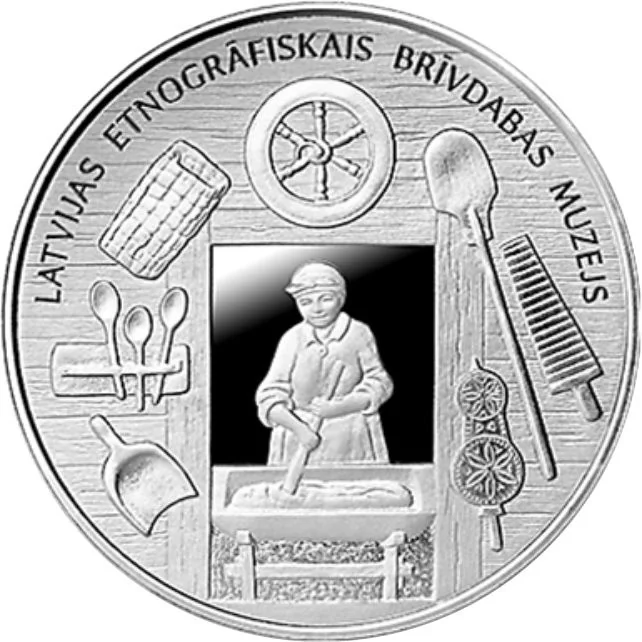
A woman mixing dough in a bread trough. Above, a spinning wheel and the semicircular inscription "LATVIJAS ETNOGRĀFISKAIS BRĪVDABAS MUZEJS". Flanking the scene are historic objects: left—a fish basket, spoon board, flour scoop; right—a distaff, bread-shovel, washboard.
Inscription:
LATVIJAS ETNOGRĀFISKAIS BRĪVDABAS MUZEJS
Translation:
Latvia's Ethnographic Open-Air Museum
Script: Latin
Language: Latvian
Engraver: Ligita Franckeviča
Designer: Arvīds Priedīte
Reverse
Description:
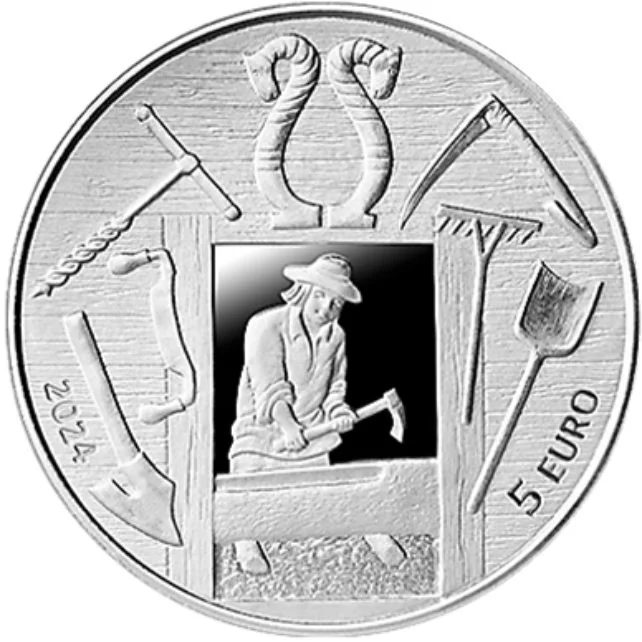
Center: a man carving a trough. Above: a horse-collar. Left: a hand drill, broad-blade axe, and spoke-shave. Right: a hand scythe, hand rake, and grain shovel. "2024" arcs on the left reverse, "5 EURO" on the right.
Inscription:
2024
5 EURO
5 EURO
Script: Latin
Engraver: Ligita Franckeviča
Designer: Arvīds Priedīte
Edge
The inscriptions "LATVIJAS BANKA" and "LATVIJAS REPUBLIKA", separated by rhombic dots.
Legend:
LATVIJAS BANKA • LATVIJAS REPUBLIKA
Mints
| Name | Mark |
|---|---|
| Lithuanian Mint | — |
Mintings
| Year | Mint Mark | Mintage | Quality | Collection |
|---|---|---|---|---|
| 2024 | — | 3,000 | Proof |
Historical background
In 2024, Latvia's currency situation is defined by its stable and integrated position within the Eurozone. As a member since 2014, the country uses the euro (EUR) as its sole legal tender, having successfully transitioned from the Latvian lats. This membership anchors Latvia's financial system to the European Central Bank (ECB), meaning domestic monetary policy, including interest rates and inflation control measures, is set at the euro area level. The primary focus for Latvian authorities and businesses is therefore not on exchange rate fluctuations but on navigating the common Eurozone challenges of managing inflation and ensuring economic competitiveness within the single currency area.
The key domestic discussions around currency in 2024 revolve around the economic implications of euro membership. While the euro has eliminated exchange rate risk with major trading partners and bolstered financial stability, Latvia, like other smaller Eurozone economies, must contend with a one-size-fits-all monetary policy that may not always perfectly align with its specific economic cycle. Current debates often focus on fiscal policy as the main tool for addressing local economic conditions, alongside efforts to improve productivity and manage inflation, which has been a concern across Europe following the energy crisis and geopolitical tensions.
Looking ahead, Latvia's currency stability is intrinsically linked to the broader health of the Eurozone and the ECB's policy trajectory. The Latvian economy benefits from the credibility and deep capital markets of the euro, which supports investment and trade. The main "currency situation" for Latvia in 2024 is thus one of embedded stability, with national economic strategy focused on leveraging the advantages of euro membership while using structural reforms and prudent fiscal management to mitigate any disadvantages of not having an independent monetary policy.
The key domestic discussions around currency in 2024 revolve around the economic implications of euro membership. While the euro has eliminated exchange rate risk with major trading partners and bolstered financial stability, Latvia, like other smaller Eurozone economies, must contend with a one-size-fits-all monetary policy that may not always perfectly align with its specific economic cycle. Current debates often focus on fiscal policy as the main tool for addressing local economic conditions, alongside efforts to improve productivity and manage inflation, which has been a concern across Europe following the energy crisis and geopolitical tensions.
Looking ahead, Latvia's currency stability is intrinsically linked to the broader health of the Eurozone and the ECB's policy trajectory. The Latvian economy benefits from the credibility and deep capital markets of the euro, which supports investment and trade. The main "currency situation" for Latvia in 2024 is thus one of embedded stability, with national economic strategy focused on leveraging the advantages of euro membership while using structural reforms and prudent fiscal management to mitigate any disadvantages of not having an independent monetary policy.



✨ Legendary