

5 Euro – Cyprus
Non-circulating coins
Commemoration: Cyprus Presidency of the Council of the European Union
Cyprus
Context
Material
References
KM: #Click to copy to clipboard98
Numista: #41115
Value
Exchange value: 5 EUR = $5.91
Bullion value: $72.88
Obverse
Description:
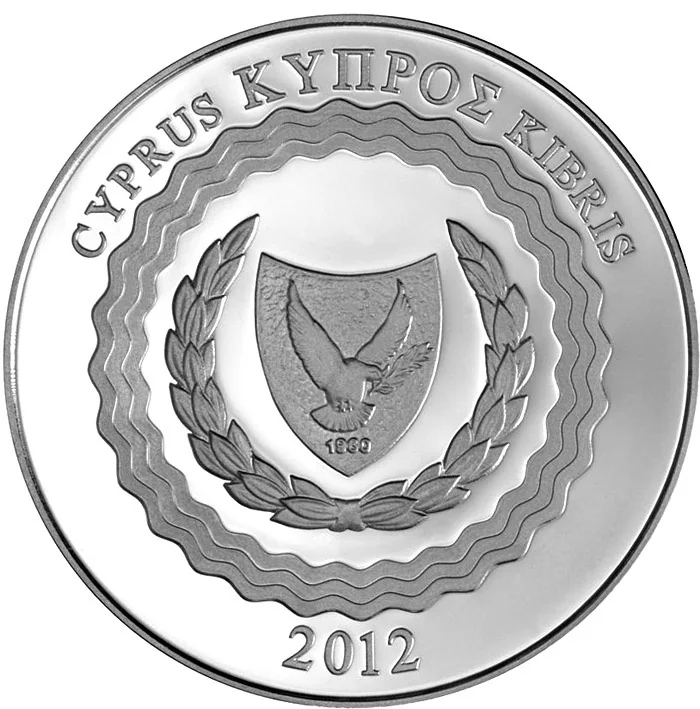
The original emblem of the Republic of Cyprus (also of its Central Bank), with the words "ΚΥΠΡΟΣ", "CYPRUS", "KIBRIS", and the year "2012".
Inscription:
CYPRUS ΚΥΠΡΟΣ KIBRIS
1960
2012
1960
2012
Translation:
CYPRUS CYPRUS CYPRUS
1960
2012
1960
2012
Engraver: Ioanna Kalli
Reverse
Description:
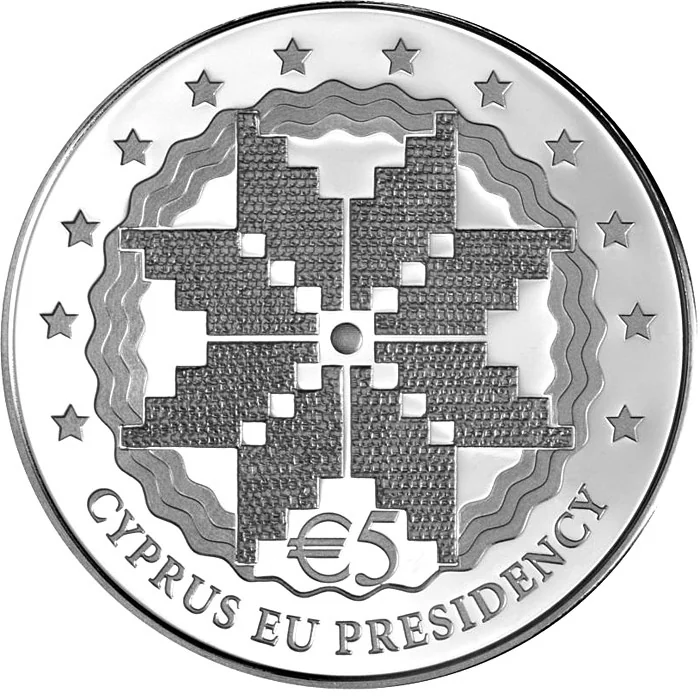
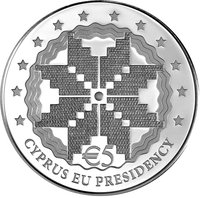
A daisy from "lefkaritiko" lace, a UNESCO-listed Cypriot embroidery symbolizing hospitality, enclosed in wavy circles representing the Mediterranean Sea. The €5 coin also features the text "CYPRUS EU PRESIDENCY".
Inscription:
€ 5
CYPRUS UE PRESIDENCY
CYPRUS UE PRESIDENCY
Engraver: Ioanna Kalli
Edge
Categories
| Symbols> Coat of Arms |
Mints
| Name | Mark |
|---|---|
| National Mint of the Bank of Greece | — |
Mintings
| Year | Mint Mark | Mintage | Quality | Collection |
|---|---|---|---|---|
| 2012 | — | 8,000 | Proof |
Historical background
In early 2012, Cyprus found itself at the epicenter of the European sovereign debt crisis. Its oversized banking sector, heavily exposed to the collapsing Greek economy, faced massive losses from the Greek government debt restructuring (the "haircut"). This rendered the country's two largest banks, Bank of Cyprus and Laiki Bank, insolvent and unable to secure private funding. By mid-2012, the Cypriot government, unable to bail out its financial system alone, was forced to formally request a financial rescue from the European Union and the International Monetary Fund (IMF).
The ensuing negotiations in March 2013 resulted in a controversial €10 billion bailout agreement that included an unprecedented measure for the Eurozone: a "bail-in" of bank depositors. To secure the funds, the Cypriot government was required to impose significant losses on uninsured depositors (those with over €100,000) in the failing banks. This led to the closure of Laiki Bank and the radical restructuring of Bank of Cyprus, where large deposits were forcibly converted into bank shares. Crucially, the agreement initially included a levy on all deposits, including insured ones, causing public outrage and a bank run before being hastily revised to protect small savers.
The immediate consequence was the imposition of strict capital controls for approximately two weeks—the first in the Eurozone's history—to prevent a flight of capital, severely disrupting business and shaking confidence in the banking union. The economy contracted sharply, with a deep recession and soaring unemployment. The 2012-2013 crisis fundamentally reshaped Cyprus, drastically shrinking its banking sector and forcing an economic reorientation towards sectors like tourism, real estate, and services. It also established a contentious precedent for future European banking crises, demonstrating that taxpayer-funded bailouts could be replaced by imposing losses directly on private creditors and depositors.
The ensuing negotiations in March 2013 resulted in a controversial €10 billion bailout agreement that included an unprecedented measure for the Eurozone: a "bail-in" of bank depositors. To secure the funds, the Cypriot government was required to impose significant losses on uninsured depositors (those with over €100,000) in the failing banks. This led to the closure of Laiki Bank and the radical restructuring of Bank of Cyprus, where large deposits were forcibly converted into bank shares. Crucially, the agreement initially included a levy on all deposits, including insured ones, causing public outrage and a bank run before being hastily revised to protect small savers.
The immediate consequence was the imposition of strict capital controls for approximately two weeks—the first in the Eurozone's history—to prevent a flight of capital, severely disrupting business and shaking confidence in the banking union. The economy contracted sharply, with a deep recession and soaring unemployment. The 2012-2013 crisis fundamentally reshaped Cyprus, drastically shrinking its banking sector and forcing an economic reorientation towards sectors like tourism, real estate, and services. It also established a contentious precedent for future European banking crises, demonstrating that taxpayer-funded bailouts could be replaced by imposing losses directly on private creditors and depositors.



💎 Extremely Rare