

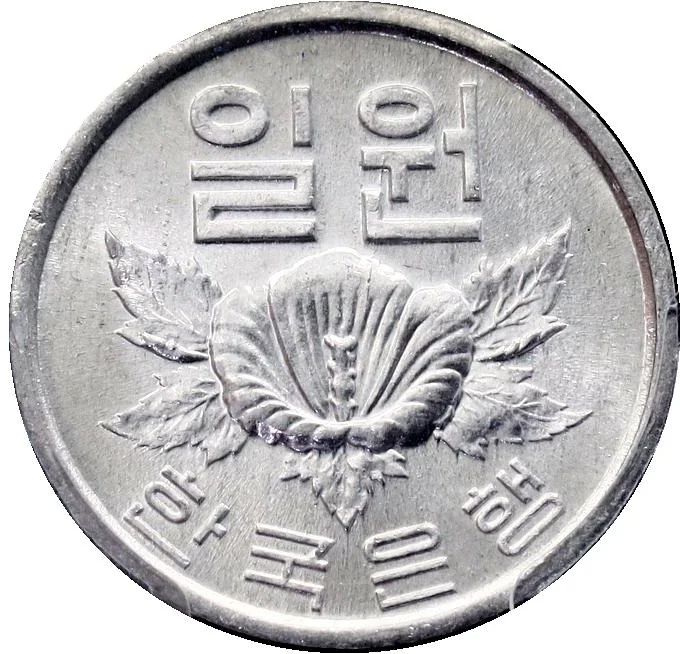
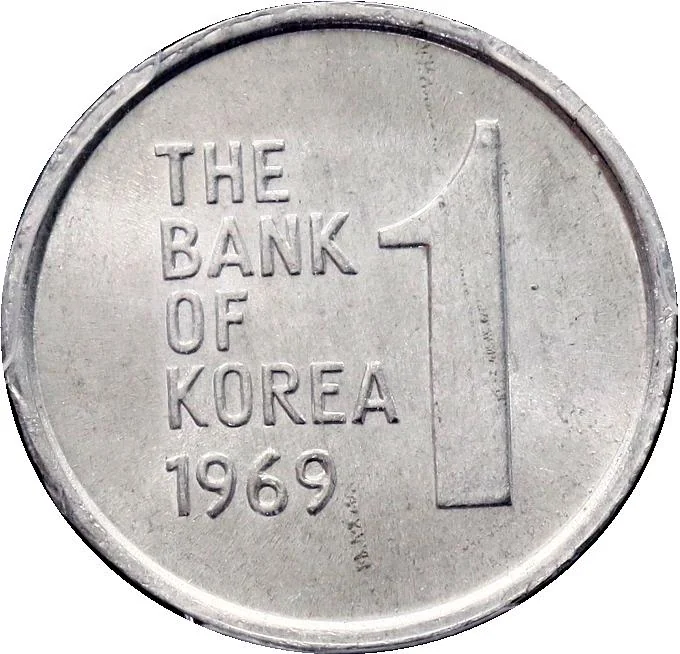
1 won – South Korea
Add to wishlist
South Korea
Context
Years: 1968–1982
Issuer: South Korea
Issuing organization: Bank of Korea
Period:
(since 1948)
Currency:
(since 1962)
Total mintage: 398,502,000
Material
References
KM: #
Numista: #4107
Value
Exchange value: 1 KRW
Inflation-adjusted value: 35.97 KRW
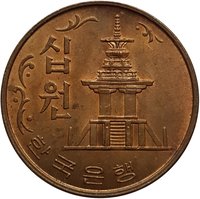
Obverse
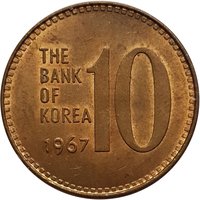
Reverse
Edge
Plain
Mints
| Name | Mark |
|---|---|
| Korea Minting and Security Printing Corporation | — |
Mintings
| Year | Mint Mark | Mintage | Quality | Collection |
|---|---|---|---|---|
| 1968 | — | 66,500,000 | ||
| 1969 | — | 85,000,000 | ||
| 1970 | — | 45,000,000 | ||
| 1974 | — | 12,000,000 | ||
| 1975 | — | 10,000,000 | ||
| 1976 | — | 20,000,000 | ||
| 1977 | — | 30,000,000 | ||
| 1978 | — | 30,000,000 | ||
| 1979 | — | 30,000,000 | ||
| 1980 | — | 20,000,000 | ||
| 1981 | — | 20,000,000 | ||
| 1982 | — | 30,000,000 | ||
| 1982 | — | 2,000 | Proof |
Historical background
In 1968, South Korea's currency situation was characterized by a tightly controlled and undervalued won, operating within a complex framework of fixed exchange rates and severe restrictions. The official exchange rate was pegged at 271.5 won to the US dollar, a rate set in 1964 as part of a major devaluation aimed at boosting exports. This rate was maintained by the Bank of Korea, which held a monopoly on foreign exchange transactions. However, this official system existed alongside a substantial black market where the won traded at a significant discount, reflecting the scarcity of hard currency and the restrictive nature of the official regime. The government's overarching policy was to concentrate all available foreign exchange on financing the import of raw materials and capital goods essential for the heavy and chemical industrialization drive, a central pillar of President Park Chung-hee's Third Five-Year Economic Development Plan (1972-1976).
The currency controls were a direct instrument of the state-led development model. All foreign earnings from the nation's growing export sector—primarily textiles, wigs, and plywood—were required to be surrendered to the government at the official rate. Access to dollars for imports, travel, or other purposes was strictly rationed through a licensing system, creating bottlenecks and inefficiencies but ensuring that precious foreign reserves were allocated according to state priorities. This mercantilist approach was deemed necessary to manage a chronic balance of payments deficit, service external debt from earlier loans, and fund the ambitious industrial projects deemed vital for economic sovereignty and survival.
Consequently, 1968 represented a period of stability in the official exchange rate but underlying pressure and distortion in the financial system. The gap between the official and black-market rates, while narrower than in the early 1960s, persisted as a symptom of the controlled economy. The situation would remain largely unchanged until the early 1970s, when global monetary shifts, notably the Nixon Shock and the collapse of the Bretton Woods system, eventually forced South Korea to move toward a more flexible multiple-exchange rate system before further liberalization in the 1980s.
The currency controls were a direct instrument of the state-led development model. All foreign earnings from the nation's growing export sector—primarily textiles, wigs, and plywood—were required to be surrendered to the government at the official rate. Access to dollars for imports, travel, or other purposes was strictly rationed through a licensing system, creating bottlenecks and inefficiencies but ensuring that precious foreign reserves were allocated according to state priorities. This mercantilist approach was deemed necessary to manage a chronic balance of payments deficit, service external debt from earlier loans, and fund the ambitious industrial projects deemed vital for economic sovereignty and survival.
Consequently, 1968 represented a period of stability in the official exchange rate but underlying pressure and distortion in the financial system. The gap between the official and black-market rates, while narrower than in the early 1960s, persisted as a symptom of the controlled economy. The situation would remain largely unchanged until the early 1970s, when global monetary shifts, notably the Nixon Shock and the collapse of the Bretton Woods system, eventually forced South Korea to move toward a more flexible multiple-exchange rate system before further liberalization in the 1980s.
🌱 Very Common