

1000 escudos – Portugal
Add to wishlist
Non-circulating coins
Commemoration: 2004 UEFA Euro, Portugal
Portugal
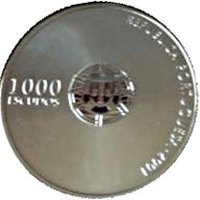
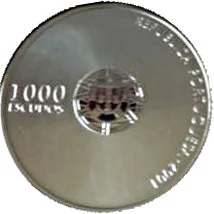
Obverse
Description:
Portuguese coat of arms.
Inscription:
REPUBLICA PORTUGUESA · 2001
1000 ESCUDOS
1000 ESCUDOS
Translation:
PORTUGUESE REPUBLIC · 2001
1000 ESCUDOS
1000 ESCUDOS
Script: Latin
Language: Portuguese
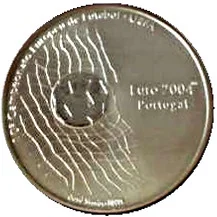
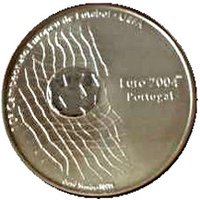
Reverse
Description:
A soccer ball in the net.
Inscription:
10° Campeonato Europeu de Futebol · UEFA
Euro 2004™
Portugal
José Simão - INCM
Euro 2004™
Portugal
José Simão - INCM
Translation:
10th European Football Championship · UEFA
Euro 2004™
Portugal
José Simão - Portuguese Mint and Official Printing Office
Euro 2004™
Portugal
José Simão - Portuguese Mint and Official Printing Office
Script: Latin
Languages: English, Portuguese
Engraver: José Simão
Edge
Mintings
| Year | Mint Mark | Mintage | Quality | Collection |
|---|---|---|---|---|
| 2001 | INCM | 10,000 | Proof |
Historical background
In 2001, Portugal's currency situation was defined by its full and committed participation in the final stage of European Economic and Monetary Union (EMU). The Portuguese escudo, which had been in circulation for over a century, was in its final year of existence as legal tender. Since January 1, 1999, the escudo had been irrevocably fixed to the euro at a rate of 1 euro = 200.482 escudos, with the euro existing as a virtual currency for electronic payments and accounting. This period was one of dual display, where prices were shown in both currencies to prepare the public for the imminent physical changeover.
The macroeconomic context was one of both opportunity and concern. Adoption of the euro brought significant benefits, including elimination of exchange rate risk and transaction costs with major trading partners, lower interest rates due to convergence with German bunds, and a symbol of Portugal's deep European integration. However, these conditions also fueled a domestic demand boom, facilitated by easier access to credit. This led to rising inflation, which consistently exceeded the Eurozone average, and a growing current account deficit. Wages and public spending increased rapidly, eroding competitiveness within the new single currency area where devaluation was no longer an option.
Consequently, 2001 was a year of transition and mounting economic pressure. While the technical process of introducing euro banknotes and coins, scheduled for January 1, 2002, proceeded smoothly, policymakers were increasingly preoccupied with the underlying imbalances. The loss of national monetary policy meant Portugal could not independently adjust interest rates to cool its overheating economy; that responsibility now lay with the European Central Bank (ECB), which set policy for the entire Eurozone. This tension set the stage for the challenges Portugal would face in the following decade, as it struggled to adjust within the rigid framework of the single currency without the traditional tool of currency devaluation.
The macroeconomic context was one of both opportunity and concern. Adoption of the euro brought significant benefits, including elimination of exchange rate risk and transaction costs with major trading partners, lower interest rates due to convergence with German bunds, and a symbol of Portugal's deep European integration. However, these conditions also fueled a domestic demand boom, facilitated by easier access to credit. This led to rising inflation, which consistently exceeded the Eurozone average, and a growing current account deficit. Wages and public spending increased rapidly, eroding competitiveness within the new single currency area where devaluation was no longer an option.
Consequently, 2001 was a year of transition and mounting economic pressure. While the technical process of introducing euro banknotes and coins, scheduled for January 1, 2002, proceeded smoothly, policymakers were increasingly preoccupied with the underlying imbalances. The loss of national monetary policy meant Portugal could not independently adjust interest rates to cool its overheating economy; that responsibility now lay with the European Central Bank (ECB), which set policy for the entire Eurozone. This tension set the stage for the challenges Portugal would face in the following decade, as it struggled to adjust within the rigid framework of the single currency without the traditional tool of currency devaluation.
⭐ Rare