

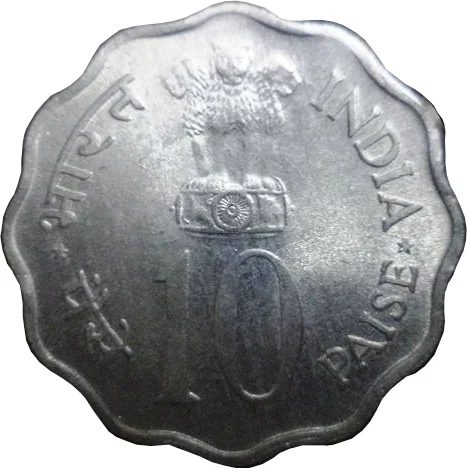
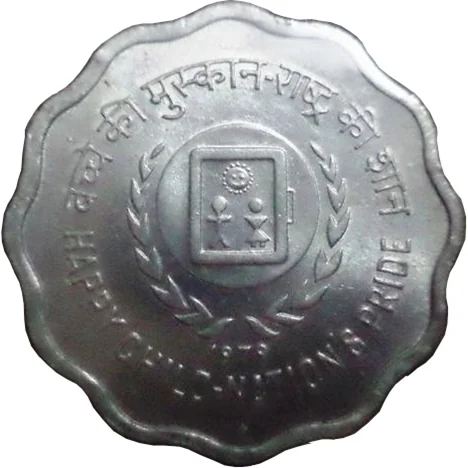
10 Paise – India
Circulating commemorative coins
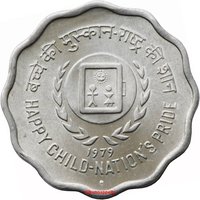
Commemoration: International Year of the Child
India
Context

Material
References
KM: #Click to copy to clipboard34
Numista: #40950
Value
Exchange value: 0.10 INR = $0.00
Inflation-adjusted value: 2.89 INR
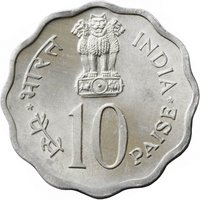
Obverse
Reverse
Edge
Plain
Mintings
| Year | Mint Mark | Mintage | Quality | Collection |
|---|---|---|---|---|
| 1979 | ♦ | — |
Historical background
In 1979, India's currency situation was characterized by severe economic strain, marked by high inflation, a weakening rupee, and a growing balance of payments crisis. The decade had been turbulent, with the aftermath of the 1973 oil shock and the political upheaval of the Emergency (1975-77). By 1979, a second major oil price shock, triggered by the Iranian Revolution, dealt a crippling blow to the import-dependent Indian economy. This dramatically increased the cost of essential imports, widening the trade deficit and putting immense pressure on foreign exchange reserves, which dwindled to a level barely sufficient to cover a few weeks of imports.
Domestically, the currency was under pressure from double-digit inflation, fueled by both external oil prices and poor agricultural output due to monsoon failures. This period of "stagflation" – combining high inflation with low industrial growth – eroded the rupee's purchasing power and public confidence. The government, led by the Janata Party and later by Charan Singh's caretaker administration, faced political instability, which hampered decisive policy action. Fiscal deficits were high, financed by borrowing from the Reserve Bank of India (a process known as deficit financing), which further increased the money supply and exacerbated inflationary pressures.
Consequently, the Indian rupee, which was pegged to a basket of currencies, experienced significant devaluation. The period set the stage for a major economic turning point. The crisis of 1979-80 underscored the structural vulnerabilities of India's inward-looking economic model and directly paved the way for the more comprehensive economic reforms and an IMF loan that would follow in the early 1980s, beginning a gradual process of liberalization that would accelerate dramatically in 1991.
Domestically, the currency was under pressure from double-digit inflation, fueled by both external oil prices and poor agricultural output due to monsoon failures. This period of "stagflation" – combining high inflation with low industrial growth – eroded the rupee's purchasing power and public confidence. The government, led by the Janata Party and later by Charan Singh's caretaker administration, faced political instability, which hampered decisive policy action. Fiscal deficits were high, financed by borrowing from the Reserve Bank of India (a process known as deficit financing), which further increased the money supply and exacerbated inflationary pressures.
Consequently, the Indian rupee, which was pegged to a basket of currencies, experienced significant devaluation. The period set the stage for a major economic turning point. The crisis of 1979-80 underscored the structural vulnerabilities of India's inward-looking economic model and directly paved the way for the more comprehensive economic reforms and an IMF loan that would follow in the early 1980s, beginning a gradual process of liberalization that would accelerate dramatically in 1991.
⭐ Somewhat Rare