

5 Pounds – Egypt
Non-circulating coins
Commemoration: Operation of Cairo Metro
Egypt
Context
Year: 1987
Islamic (Hijri) Year: 1408
Issuer: Egypt 
Period:
(since 1971)
Currency:
(since 1916)
Total mintage: 200
Material
References
KM: #Click to copy to clipboard674
Numista: #409099
Value
Exchange value: 5 EGP
Bullion value: $3793.12
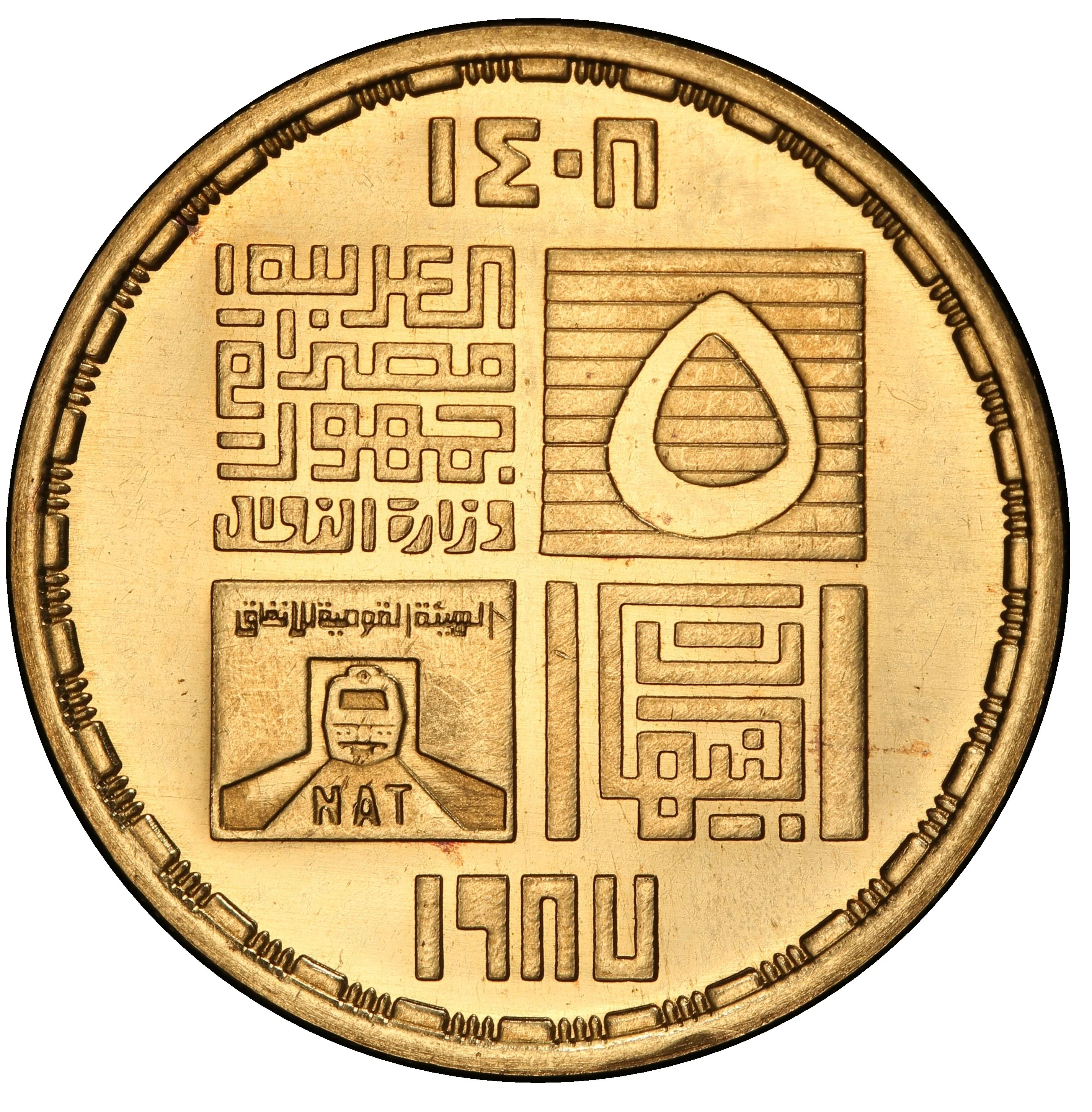
Obverse
Description:
Four squares separate dates.
Inscription:
١٤٠٨
٥
جنيهات
جمهورية مصر العربية
وزارة النقل
الهيئة القومية للأنفاق
NAT
١٩٨٧
٥
جنيهات
جمهورية مصر العربية
وزارة النقل
الهيئة القومية للأنفاق
NAT
١٩٨٧
Translation:
1408
5
Pounds
Arab Republic of Egypt
Ministry of Transport
National Authority for Tunnels
NAT
1987
5
Pounds
Arab Republic of Egypt
Ministry of Transport
National Authority for Tunnels
NAT
1987
Script: Arabic (kufic)
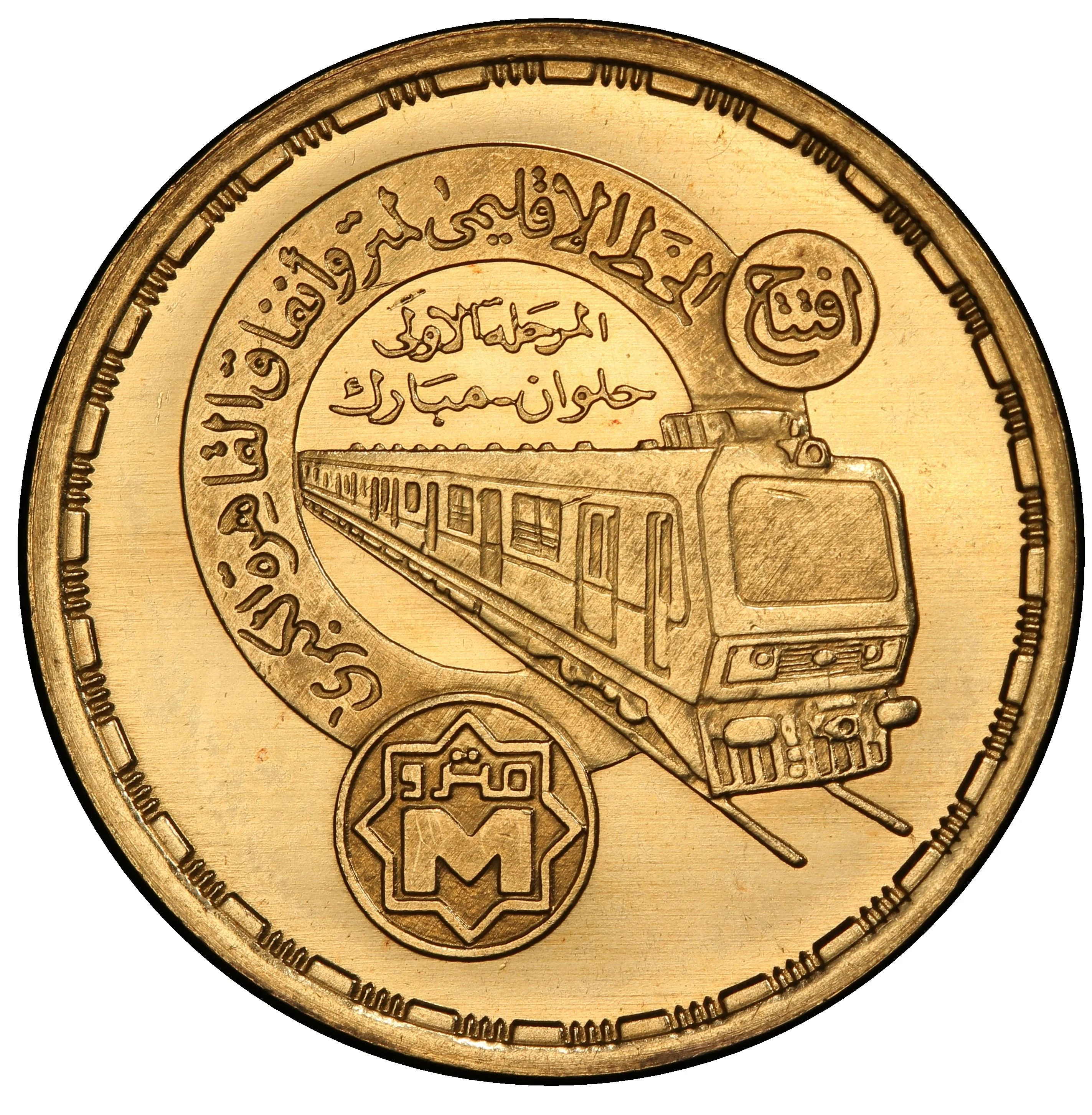
Reverse
Description:
Train exiting tunnel.
Inscription:
افتتاح الخط الاقليمى لمترو أنفاق القاهرة الكبرى
المرحلة الأولى
حلوان - مبارك
مترو
M
المرحلة الأولى
حلوان - مبارك
مترو
M
Translation:
Opening of the Regional Line of the Greater Cairo Metro
First Phase
Helwan - Mubarak
Metro
First Phase
Helwan - Mubarak
Metro
Script: Arabic (naskh)
Language: Arabic
Edge
Categories
| Transportation> Tunnel |
| Transportation> Train |
Mints
| Name | Mark |
|---|---|
| Egyptian Mint Authority | — |
Mintings
| Year | Mint Mark | Mintage | Quality | Collection |
|---|---|---|---|---|
| 1987 | — | 200 |
Historical background
In 1987, Egypt's currency situation was characterized by a severe and entrenched parallel market for foreign exchange, primarily the US dollar. The official exchange rate, fixed by the Central Bank of Egypt (CBE), was set at approximately EGP 0.70 to the dollar, a rate that was artificially strong and did not reflect economic realities. However, a vast and active black market operated where the Egyptian pound traded at a significant discount, often exceeding EGP 1.20 to the dollar. This wide disparity created a two-tier economy, incentivizing capital flight, discouraging vital remittances through official channels, and distorting trade and investment.
The root causes of this crisis were multifaceted, stemming from long-standing structural issues. Egypt faced a chronic balance of payments deficit, burdensome external debt, and low foreign currency reserves. Government policies, including extensive subsidies and a large public sector, fueled high inflation and budget deficits. Furthermore, the fixed official rate, maintained to control import costs and service foreign debt, was unsustainable. It created a scarcity of hard currency within the official banking system, forcing most businesses and individuals to resort to the black market to meet their foreign exchange needs, thereby perpetuating its dominance.
The government of President Hosni Mubarak, under pressure from the International Monetary Fund (IMF), had begun to acknowledge the necessity of reform. The year 1987 itself saw a pivotal step with the signing of a standby agreement with the IMF, which included commitments to unify the exchange rate and move toward a more flexible system. While a full devaluation and unification would not occur until the major economic reforms of 1991, the 1987 agreement marked the critical beginning of the end for the rigid dual-rate system, setting the stage for the painful but necessary economic liberalization to come.
The root causes of this crisis were multifaceted, stemming from long-standing structural issues. Egypt faced a chronic balance of payments deficit, burdensome external debt, and low foreign currency reserves. Government policies, including extensive subsidies and a large public sector, fueled high inflation and budget deficits. Furthermore, the fixed official rate, maintained to control import costs and service foreign debt, was unsustainable. It created a scarcity of hard currency within the official banking system, forcing most businesses and individuals to resort to the black market to meet their foreign exchange needs, thereby perpetuating its dominance.
The government of President Hosni Mubarak, under pressure from the International Monetary Fund (IMF), had begun to acknowledge the necessity of reform. The year 1987 itself saw a pivotal step with the signing of a standby agreement with the IMF, which included commitments to unify the exchange rate and move toward a more flexible system. While a full devaluation and unification would not occur until the major economic reforms of 1991, the 1987 agreement marked the critical beginning of the end for the rigid dual-rate system, setting the stage for the painful but necessary economic liberalization to come.

✨ Legendary