

1 peso – Cuba
Add to wishlist
Non-circulating coins
Commemoration: II International Economists Meeting - Globalization
Cuba
Context
Year: 2000
Issuer: Cuba
Issuing organization: Central Bank of Cuba
Period:
(since 1959)
Currency:
(since 1914)
Demonetization: 2000
Total mintage: 1,200
Material
Diameter: 38 mm
Weight: 26 g
Thickness: 2.9 mm
Shape: Round
Composition: Copper-nickel
Alignment: Coin alignment
flip
References
KM: #
Numista: #40790
Value
Exchange value: 1 CUP
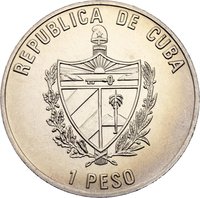
Obverse
Description:
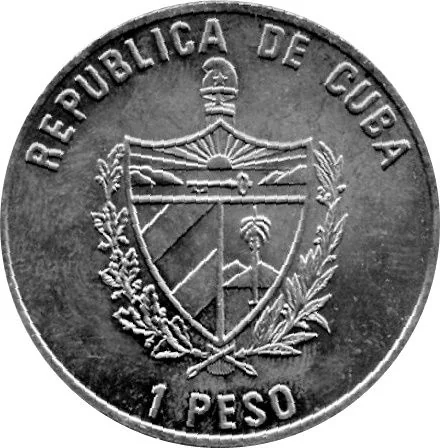
Cuban coat of arms with country name above and face value below.
Inscription:
REPUBLICA DE CUBA
1 PESO
1 PESO
Translation:
REPUBLIC OF CUBA
1 PESO
1 PESO
Script: Latin
Language: Spanish
Designer: Charles Edward Barber
Reverse
Description:
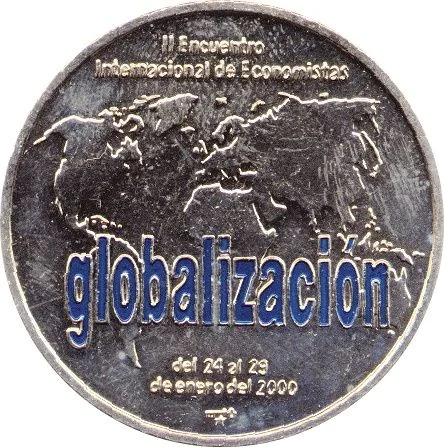
World map with event name above, "globalización" highlighted at center, dates below, mintmark at bottom.
Inscription:
II Encuentro
Internacional de Economistas
globalización
del 24 al 29
de enero del 2000
Internacional de Economistas
globalización
del 24 al 29
de enero del 2000
Translation:
Second International Meeting
of Economists
on Globalization
from the 24th to the 29th
of January 2000
of Economists
on Globalization
from the 24th to the 29th
of January 2000
Script: Latin
Language: Spanish
Edge
Plain
Categories
| Symbols> Coat of Arms |
| Map |
Mints
| Name | Mark |
|---|---|
| Empresa Cubana de Acuñaciones | — |
Mintings
| Year | Mint Mark | Mintage | Quality | Collection |
|---|---|---|---|---|
| 2000 | — | 1,200 | BU |
Historical background
In the year 2000, Cuba's monetary system was defined by a complex and problematic dual-currency structure, a legacy of the economic crisis known as the "Special Period" following the collapse of the Soviet Union. The system revolved around two main currencies: the Cuban Peso (CUP), the national currency in which most Cubans were paid, and the Cuban Convertible Peso (CUC), introduced in 1994. The CUC was pegged 1:1 to the US dollar and was designed to attract hard currency from tourism and foreign investment, while insulating the domestic economy. This created a stark economic apartheid, as access to CUCs, which could purchase imported goods and higher-quality items in state-run stores, became essential for a decent standard of living.
The dual system led to severe social inequalities and economic distortions. Cubans working in state jobs, paid in weak CUPs, found their salaries inadequate for purchasing CUC-priced necessities, while those with access to tourism, remittances from abroad, or jobs in joint-venture enterprises thrived. This divide was exacerbated by the continued circulation of the US dollar itself, which had been legalized in 1993. Although the government aimed to capture these dollars by exchanging them for CUCs at a penalty, the greenback remained a preferred currency on the black market. The economy was effectively dollarized in key sectors, undermining the state's control and creating a parallel market.
By 2000, the system was entrenched but unstable. The government maintained an official exchange rate of 1 CUP to 1 USD for accounting purposes, but the reality for citizens was a vastly different market rate of approximately 25 CUP to 1 CUC (and thus 1 USD). This disconnect crippled state enterprises operating in CUPs and created pervasive inefficiencies. The situation highlighted the profound contradictions of Cuba's post-Soviet economic model: attempting to open to essential foreign capital while maintaining a centrally planned system, resulting in a fractured economy that would burden the nation for two more decades until the eventual elimination of the CUC in 2021.
The dual system led to severe social inequalities and economic distortions. Cubans working in state jobs, paid in weak CUPs, found their salaries inadequate for purchasing CUC-priced necessities, while those with access to tourism, remittances from abroad, or jobs in joint-venture enterprises thrived. This divide was exacerbated by the continued circulation of the US dollar itself, which had been legalized in 1993. Although the government aimed to capture these dollars by exchanging them for CUCs at a penalty, the greenback remained a preferred currency on the black market. The economy was effectively dollarized in key sectors, undermining the state's control and creating a parallel market.
By 2000, the system was entrenched but unstable. The government maintained an official exchange rate of 1 CUP to 1 USD for accounting purposes, but the reality for citizens was a vastly different market rate of approximately 25 CUP to 1 CUC (and thus 1 USD). This disconnect crippled state enterprises operating in CUPs and created pervasive inefficiencies. The situation highlighted the profound contradictions of Cuba's post-Soviet economic model: attempting to open to essential foreign capital while maintaining a centrally planned system, resulting in a fractured economy that would burden the nation for two more decades until the eventual elimination of the CUC in 2021.
✨ Legendary