

50 litų – Lithuania
Add to wishlist
Non-circulating coins
Commemoration: European Basketball Championship
Lithuania
Context
Material
Diameter: 16.25 mm
Weight: 3.1 g
Gold Weight:: 3.10 g
Shape: Round
Composition: 99.9% Gold
Standard: Gold tenth ounce
Magnetic: No
Technique: Milled
Alignment: Medal alignment
flip
References
KM: #
Numista: #40731
Value
Exchange value: 50 LTL
Bullion value: $477.71
Inflation-adjusted value: 83.06 LTL
Obverse
Description:
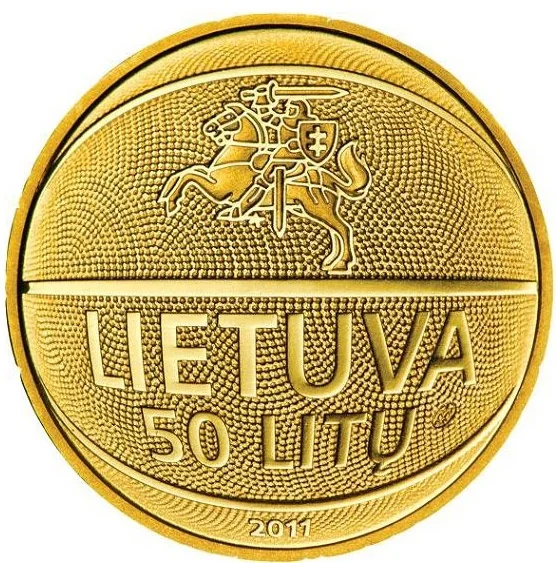
The obverse shows a stylized basketball and the Vytis, with inscriptions for Lithuania, 50 litas, 2011, and the mintmark.
Inscription:
LIETUVA
50 LITŲ LMK
2011
50 LITŲ LMK
2011
Translation:
LITHUANIA
50 LITAS LMK
2011
50 LITAS LMK
2011
Script: Latin
Language: Lithuanian
Engravers: Liudas Parulskis, Giedrius Paulauskis
Reverse
Description:
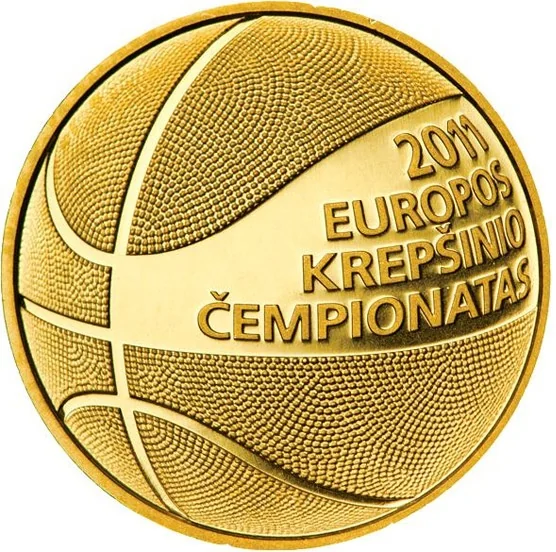
The reverse shows a stylized basketball and the text "2011 EUROPOS KREPŠINIO ČEMPIONATAS."
Inscription:
2011
EUROPOS
KREPŠINIO
ČEMPIONATAS
EUROPOS
KREPŠINIO
ČEMPIONATAS
Translation:
2011
EUROPEAN
BASKETBALL
CHAMPIONSHIP
EUROPEAN
BASKETBALL
CHAMPIONSHIP
Script: Latin
Language: Lithuanian
Engravers: Liudas Parulskis, Giedrius Paulauskis
Edge
Reeded
Categories
| Sport> Basketball |
Mints
| Name | Mark |
|---|---|
| Lithuanian Mint | (LMK) |
Mintings
| Year | Mint Mark | Mintage | Quality | Collection |
|---|---|---|---|---|
| 2011 | LMK | 5,000 | Proof |
Historical background
In 2011, Lithuania was in a pivotal phase of its post-Soviet economic journey, actively pursuing membership in the Eurozone. Having pegged its currency, the litas (LTL), to the euro at a fixed rate of 3.4528 since 2002 (and to the US dollar before that), the country operated under a currency board arrangement. This provided crucial monetary stability and helped tame inflation after the turbulence of the 1990s. The primary focus in 2011 was on meeting the strict Maastricht convergence criteria—particularly concerning inflation, budget deficit, and public debt—to qualify for euro adoption. The government, led by Prime Minister Andrius Kubilius, was implementing stringent austerity measures following the severe 2009 recession, aiming to consolidate public finances in line with these requirements.
The year was marked by both progress and debate. Officially, Lithuania was on a clear path toward the euro, with a target adoption date of January 1, 2014. The fixed peg to the euro was functioning smoothly, effectively making the litas a satellite of the euro even before formal adoption. However, the euro area itself was embroiled in the sovereign debt crisis, with Greece, Ireland, and Portugal requiring international bailouts. This context fueled a domestic political and public discussion about the timing and wisdom of joining a currency union under such stress. Some argued for delay or reconsideration, fearing Lithuania would inherit the bloc's instability and lose control over its economic policy tools.
Ultimately, 2011 was a year of determined preparation despite external headwinds. The government maintained its unwavering commitment to the euro roadmap, viewing it as an irreversible strategic anchor for Lithuania's integration into the European core. The currency situation was stable but overshadowed by the wider European crisis, which tested political resolve. The successful fulfillment of the convergence criteria by 2013, as assessed in mid-2012, validated the austerity efforts of this period, setting the stage for Lithuania's eventual euro adoption on January 1, 2014.
The year was marked by both progress and debate. Officially, Lithuania was on a clear path toward the euro, with a target adoption date of January 1, 2014. The fixed peg to the euro was functioning smoothly, effectively making the litas a satellite of the euro even before formal adoption. However, the euro area itself was embroiled in the sovereign debt crisis, with Greece, Ireland, and Portugal requiring international bailouts. This context fueled a domestic political and public discussion about the timing and wisdom of joining a currency union under such stress. Some argued for delay or reconsideration, fearing Lithuania would inherit the bloc's instability and lose control over its economic policy tools.
Ultimately, 2011 was a year of determined preparation despite external headwinds. The government maintained its unwavering commitment to the euro roadmap, viewing it as an irreversible strategic anchor for Lithuania's integration into the European core. The currency situation was stable but overshadowed by the wider European crisis, which tested political resolve. The successful fulfillment of the convergence criteria by 2013, as assessed in mid-2012, validated the austerity efforts of this period, setting the stage for Lithuania's eventual euro adoption on January 1, 2014.

💎 Extremely Rare