

5 Pounds (Queen Elizabeth I) – Gibraltar
Non-circulating coins
Commemoration: 400th Anniversary of the Life of Queen Elizabeth I
United Kingdom
Context
Year: 2003
Country: United Kingdom 
Issuer: Gibraltar 
Ruler: Elizabeth II
Currency:
(since 1971)
Total mintage: 10,000
Material
References
KM: #Click to copy to clipboard1122a
Numista: #406174
Value
Exchange value: 5 GIP
Bullion value: $62.96
Inflation-adjusted value: 10.39 GIP
Obverse
Description:
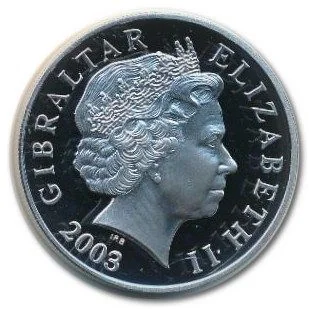
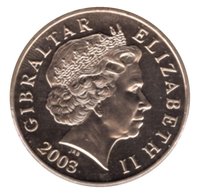
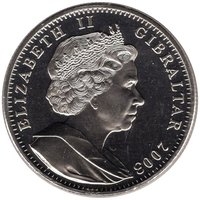
Queen Elizabeth II facing right, wearing the "Girls of Great Britain and Ireland" Tiara, with legend and date.
Inscription:
GIBRALTAR ELIZABETH II
IRB
2003
IRB
2003
Script: Latin
Designer: Ian Rank-Broadley
Reverse
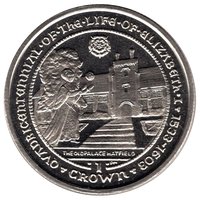
Description:
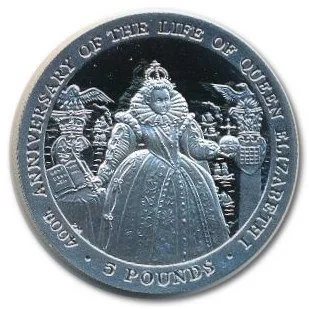
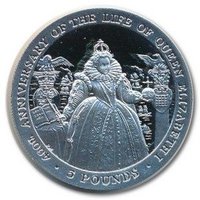
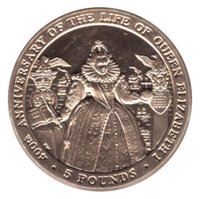
Design from an engraving of Queen Elizabeth I after the Armada's defeat, shown majestically with orb and sceptre, backed by battling ships and flanked by heraldic Pillars of Hercules.
Inscription:
400th ANNIVERSARY OF THE LIFE OF QUEEN ELIZABETH I
5 POUNDS
5 POUNDS
Script: Latin
Edge
Reeded
Categories
| Animal> Bird |
| Person> Monarch |
| Transportation> Watercraft |
| Symbol> Crown |
Mints
| Name | Mark |
|---|---|
| Pobjoy Mint | (PM) |
Mintings
| Year | Mint Mark | Mintage | Quality | Collection |
|---|---|---|---|---|
| 2003 | PM | 10,000 | Proof |
Historical background
In 2003, Gibraltar’s currency situation was defined by its unique political status and its deep economic integration with the United Kingdom. As a British Overseas Territory, its official currency was (and remains) the Gibraltar pound (GIP), issued by the Government of Gibraltar under the terms of the 1934 Currency Notes Act. This currency was pegged at par with the British pound sterling (GBP), which also circulated freely and was accepted as legal tender within the territory. This dual circulation created a stable and familiar monetary environment for local commerce and financial services, a key sector of Gibraltar's economy.
The year 2003, however, fell within a significant transitional period following the introduction of euro banknotes and coins in the eurozone in 2002. While the UK itself had opted out of the euro, Gibraltar's close physical and economic ties with neighbouring Spain—a euro member—presented a practical challenge. Many businesses, particularly in the retail and hospitality sectors facing daily cross-border traffic, readily accepted euros, but often at exchange rates less favourable than the official rate. This created a de facto dual-currency economy at the point of sale, with sterling dominant for residents and euros commonly used by many visitors.
Ultimately, the Gibraltar government maintained a firm commitment to sterling as the cornerstone of monetary policy, viewing it as essential to constitutional links with Britain and financial stability. There was no serious political move to adopt the euro, as this would have required the UK itself to do so first. Therefore, the 2003 landscape was one of pragmatic adaptation on the ground, with widespread euro acceptance for convenience, underpinned by the formal and unchanging sterling peg that guaranteed macroeconomic stability and aligned Gibraltar’s banking and finance sector directly with the City of London.
The year 2003, however, fell within a significant transitional period following the introduction of euro banknotes and coins in the eurozone in 2002. While the UK itself had opted out of the euro, Gibraltar's close physical and economic ties with neighbouring Spain—a euro member—presented a practical challenge. Many businesses, particularly in the retail and hospitality sectors facing daily cross-border traffic, readily accepted euros, but often at exchange rates less favourable than the official rate. This created a de facto dual-currency economy at the point of sale, with sterling dominant for residents and euros commonly used by many visitors.
Ultimately, the Gibraltar government maintained a firm commitment to sterling as the cornerstone of monetary policy, viewing it as essential to constitutional links with Britain and financial stability. There was no serious political move to adopt the euro, as this would have required the UK itself to do so first. Therefore, the 2003 landscape was one of pragmatic adaptation on the ground, with widespread euro acceptance for convenience, underpinned by the formal and unchanging sterling peg that guaranteed macroeconomic stability and aligned Gibraltar’s banking and finance sector directly with the City of London.
✨ Legendary