

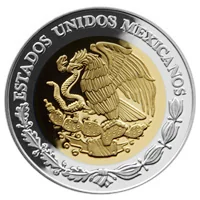
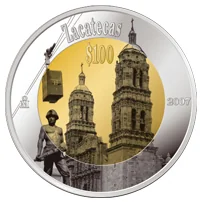
100 Pesos (Zacatecas) – Mexico
Non-circulating coins
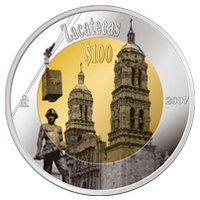
Commemoration: 180th Anniversary of Federation - Zacatecas (2nd edition)
Mexico
Context
Material
References
KM: #Click to copy to clipboard893
Numista: #40448
Value
Exchange value: 100 MXN = $5.82
Inflation-adjusted value: 219.89 MXN
Obverse
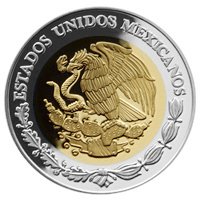
Reverse
Edge
Segmented reeding
Mintings
| Year | Mint Mark | Mintage | Quality | Collection |
|---|---|---|---|---|
| 2007 | Mo | 600 | Proof |
Historical background
In 2007, Mexico's currency situation was characterized by a period of unusual strength and stability for the peso, which stood in stark contrast to its volatile history. The Mexican peso (MXN) traded at approximately 10.8 to 11.0 per US dollar, reaching its strongest level since 1999. This appreciation was driven by several key factors: high global oil prices, which boosted export revenues and fiscal income for the oil-dependent state; robust remittance flows from the United States, which reached a record high that year; and sustained foreign direct investment, particularly in manufacturing and financial services. Furthermore, the Banco de México had established strong credibility through its inflation-targeting regime and a policy of building substantial foreign exchange reserves, which instilled investor confidence.
However, this strength was not without underlying vulnerabilities and policy debates. The strong peso raised concerns among exporters, particularly in the manufacturing sector, as it made Mexican goods more expensive abroad and squeezed profit margins. The central bank faced a complex balancing act; while a strong currency helped curb imported inflation, there was political and industrial pressure to intervene to weaken the peso. The Banco de México responded with a limited program of dollar purchases starting in early 2007 to accumulate reserves and moderate the pace of appreciation, but it largely avoided heavy-handed intervention, preferring to let market forces operate within a floating exchange rate regime established after the 1994 crisis.
By the end of 2007, the global financial storm clouds were gathering, which would soon dramatically alter this stable picture. While the subprime mortgage crisis in the United States had begun, its full impact had not yet hit the Mexican economy. The peso remained relatively strong, but the nation's deep economic ties to its northern neighbor meant it was highly exposed to an impending downturn. The currency stability of 2007, therefore, proved to be a calm before the storm, as 2008 would see the peso plummet in value due to capital flight, falling oil prices, and a collapse in remittances and trade, testing the resilience of Mexico's monetary framework.
However, this strength was not without underlying vulnerabilities and policy debates. The strong peso raised concerns among exporters, particularly in the manufacturing sector, as it made Mexican goods more expensive abroad and squeezed profit margins. The central bank faced a complex balancing act; while a strong currency helped curb imported inflation, there was political and industrial pressure to intervene to weaken the peso. The Banco de México responded with a limited program of dollar purchases starting in early 2007 to accumulate reserves and moderate the pace of appreciation, but it largely avoided heavy-handed intervention, preferring to let market forces operate within a floating exchange rate regime established after the 1994 crisis.
By the end of 2007, the global financial storm clouds were gathering, which would soon dramatically alter this stable picture. While the subprime mortgage crisis in the United States had begun, its full impact had not yet hit the Mexican economy. The peso remained relatively strong, but the nation's deep economic ties to its northern neighbor meant it was highly exposed to an impending downturn. The currency stability of 2007, therefore, proved to be a calm before the storm, as 2008 would see the peso plummet in value due to capital flight, falling oil prices, and a collapse in remittances and trade, testing the resilience of Mexico's monetary framework.

✨ Legendary