

1 rand – South Africa
Add to wishlist
South Africa
Context
Material
Diameter: 16.5 mm
Weight: 3.11 g
Gold Weight:: 3.11 g
Shape: Round
Composition: 99.99% Gold
Standard: Gold tenth ounce
Magnetic: No
Technique: Milled
Alignment: Medal alignment
flip
References
KM: #
Numista: #404257
Value
Exchange value: 1 ZAR
Bullion value: $477.41
Inflation-adjusted value: 2.69 ZAR
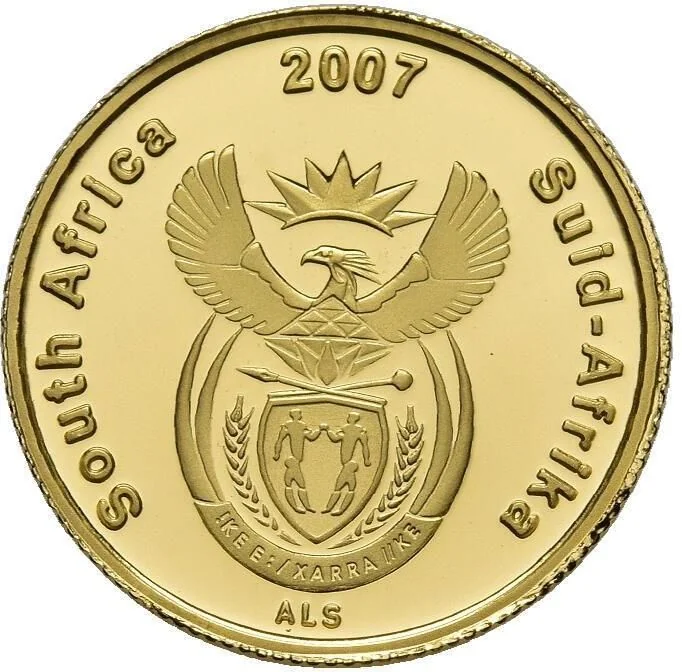
Obverse
Description:
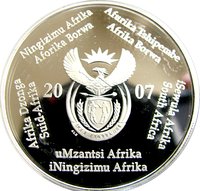
Heraldic emblem.
Inscription:
South Africa 2007 Suid-Afrika
ALS
ALS
Script: Latin
Engraver: Arthur Sutherland
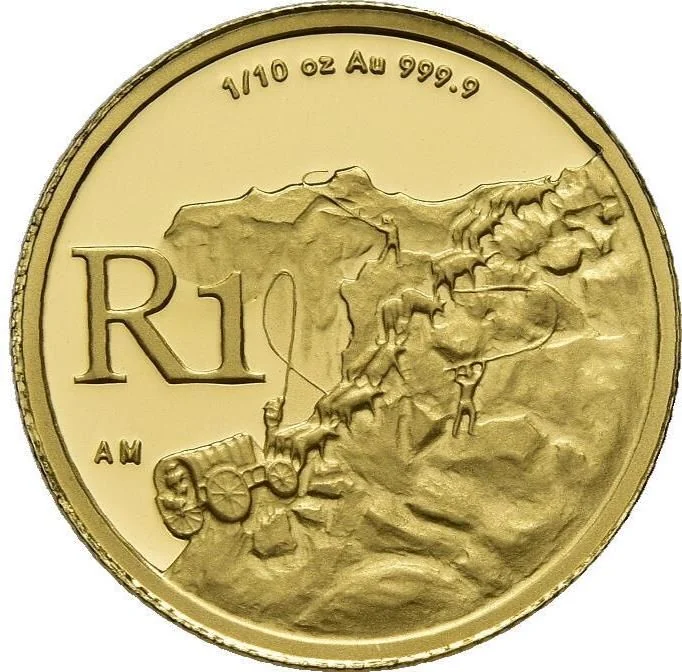
Reverse
Description:
Oxcart climbing hill.
Inscription:
1/10 oz Au 999.9
R1
AM
R1
AM
Script: Latin
Engraver: Aldrid Minnie
Edge
Reeded
Categories
| Animal> Cow |
| Symbols> Coat of Arms |
Mintings
| Year | Mint Mark | Mintage | Quality | Collection |
|---|---|---|---|---|
| 2007 | — | 734 | Proof |
Historical background
In 2007, South Africa's currency, the rand, exhibited significant volatility but ended the year on a strong note, influenced by a complex mix of domestic and global factors. The year began with the rand under pressure, trading around ZAR 7.20 to the US dollar, as the country faced a large and widening current account deficit, fueled by high consumer demand for imports. This structural vulnerability made the currency sensitive to shifts in global investor sentiment, particularly regarding emerging markets.
The dominant theme of the year, however, was the global "carry trade," where investors borrowed in low-yielding currencies like the Japanese yen to invest in higher-yielding assets. South Africa's relatively high interest rates, with the repo rate rising from 8.5% to 9.0% in June 2007, made rand-denominated assets attractive. This sustained capital inflow drove a pronounced appreciation, with the rand strengthening to near ZAR 6.60/USD by late in the year. This strength occurred despite ongoing domestic concerns, including political uncertainty ahead of the ANC's Polokwane conference and persistent electricity supply constraints.
By the close of 2007, the rand's resilience was being tested by the early tremors of the unfolding global financial crisis. While the full impact of the US subprime mortgage collapse would hit in 2008, risk aversion began to increase in late 2007, causing volatility and foreshadowing the rand's sharp depreciation in the coming year. Thus, 2007 represented a period of contradictory forces: strong carry-trade inflows masking underlying economic imbalances, setting the stage for a dramatic reversal when global liquidity dried up.
The dominant theme of the year, however, was the global "carry trade," where investors borrowed in low-yielding currencies like the Japanese yen to invest in higher-yielding assets. South Africa's relatively high interest rates, with the repo rate rising from 8.5% to 9.0% in June 2007, made rand-denominated assets attractive. This sustained capital inflow drove a pronounced appreciation, with the rand strengthening to near ZAR 6.60/USD by late in the year. This strength occurred despite ongoing domestic concerns, including political uncertainty ahead of the ANC's Polokwane conference and persistent electricity supply constraints.
By the close of 2007, the rand's resilience was being tested by the early tremors of the unfolding global financial crisis. While the full impact of the US subprime mortgage collapse would hit in 2008, risk aversion began to increase in late 2007, causing volatility and foreshadowing the rand's sharp depreciation in the coming year. Thus, 2007 represented a period of contradictory forces: strong carry-trade inflows masking underlying economic imbalances, setting the stage for a dramatic reversal when global liquidity dried up.

✨ Legendary