

1 ounce – South Africa
Add to wishlist
Non-circulating coins
Commemoration: Conservation Centennial
South Africa
Context
Year: 1994
Issuer: South Africa
Issuing organization: South African Reserve Bank
Period:
(since 1961)
Currency:
(since 1986)
Total mintage: 1,187
Material
References
KM: #
Numista: #403346
Value
Bullion value: $4743.47
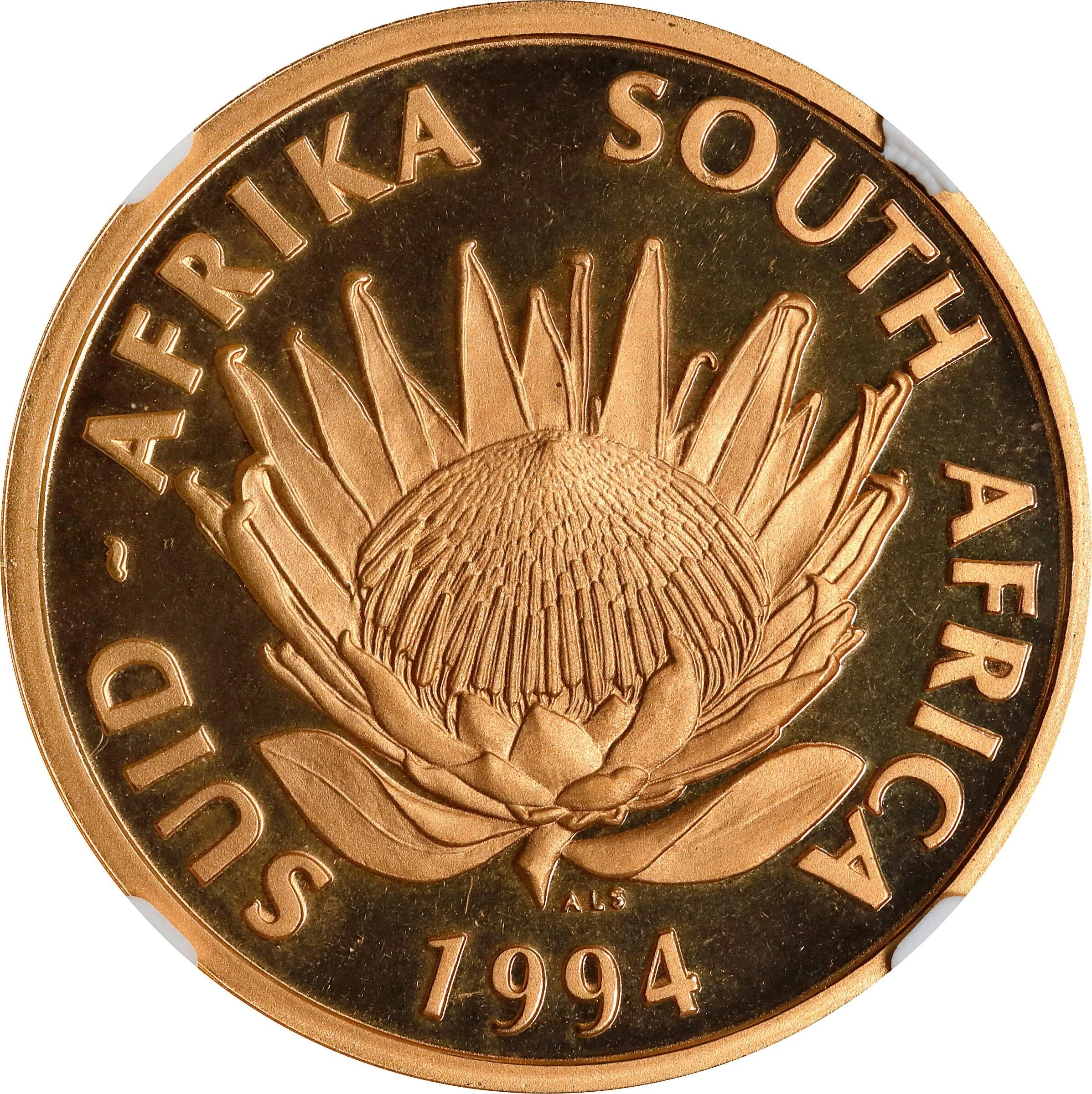
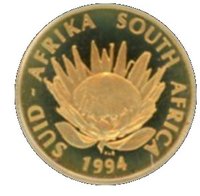
Obverse
Description:
Protea with handwritten text and date.
Inscription:
SUID - AFRIKA SOUTH AFRICA
ALS
1994
ALS
1994
Script: Latin
Engraver: Arthur Sutherland
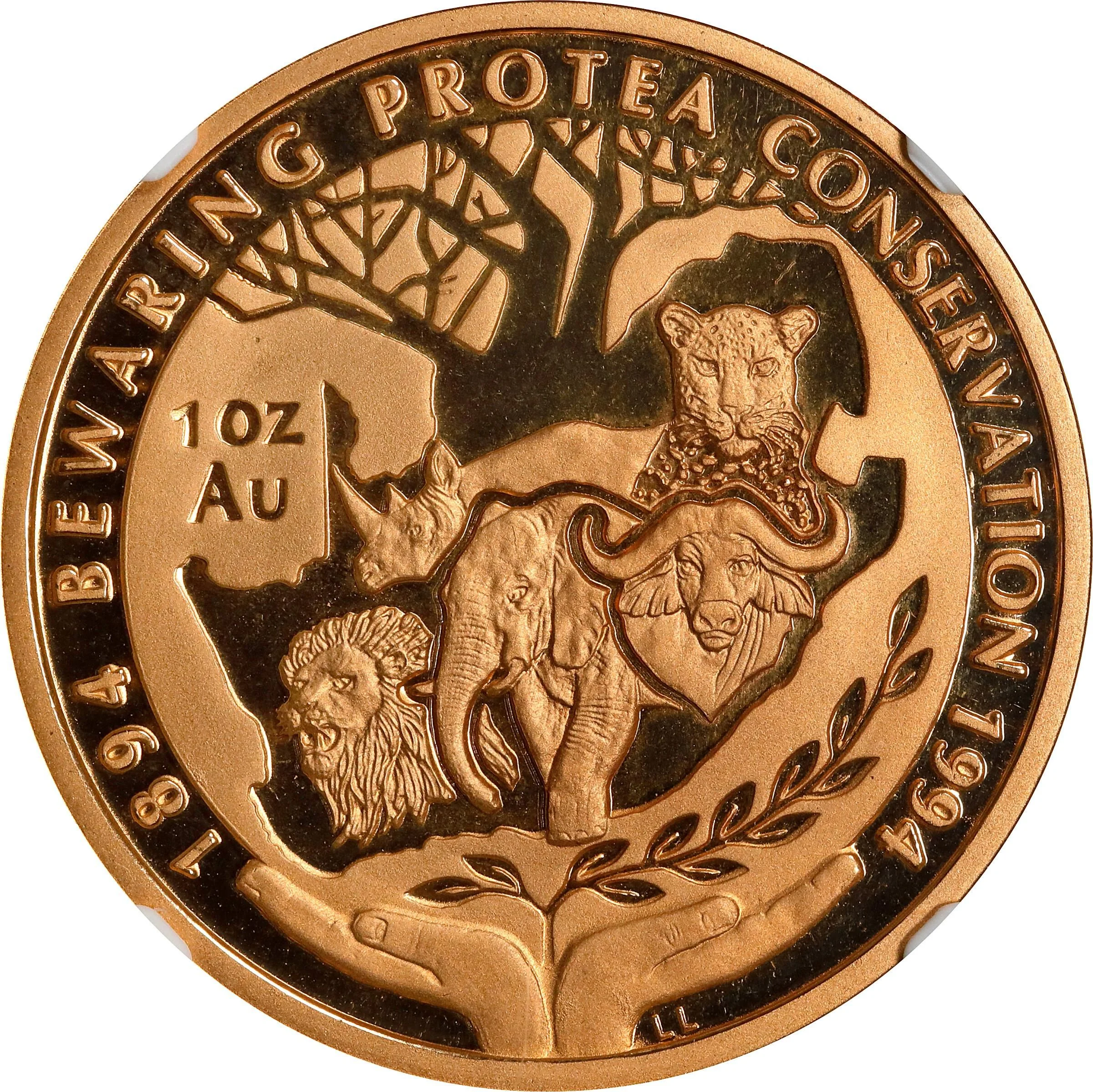
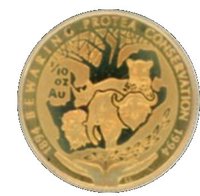
Reverse
Description:
Map outline with Big Five animal heads and surrounding text.
Inscription:
1894 BEWARING PROTEA CONSERVATION 1994
1oz
Au
LL
1oz
Au
LL
Script: Latin
Engraver: Linda Lotriet
Edge
Reeded
Mintings
| Year | Mint Mark | Mintage | Quality | Collection |
|---|---|---|---|---|
| 1994 | — | 1,187 | Proof |
Historical background
In 1994, South Africa's currency, the rand, entered a new political era under significant pressure. The historic transition to democracy, culminating in Nelson Mandela's election, occurred against a backdrop of deep economic uncertainty. International sanctions were being lifted, promising renewed access to global capital, but the markets were wary of the incoming government's economic policies and the potential for fiscal expansion. The rand, which had been a managed floating currency since 1983, was vulnerable to this political risk and speculative forces, reflecting the anxieties of a nation in profound transformation.
Economically, the rand in early 1994 was still reeling from a prolonged period of weakness and volatility throughout the 1980s and early 1990s, driven by political instability, debt crises, and inflation. The Reserve Bank's primary focus was on stabilizing the currency and controlling inflation, which averaged around 9% that year. There was no formal exchange control for non-residents, but strict financial rand systems and capital controls for residents remained in place to prevent a sudden flight of domestic capital, a legacy of the apartheid-era isolation.
Ultimately, the African National Congress (ANC) government, under the leadership of Finance Minister Derek Keys and later Chris Liebenberg, adopted a notably orthodox and reassuring macroeconomic stance. This commitment to fiscal discipline, explicitly outlined in the Reconstruction and Development Programme (RDP), helped to calm markets. Consequently, rather than collapsing, the rand experienced a short-lived rally in the immediate aftermath of the election, as the peaceful transition and prudent economic signals boosted international confidence. This stability provided a crucial foundation for the macroeconomic reforms that would follow in the coming years.
Economically, the rand in early 1994 was still reeling from a prolonged period of weakness and volatility throughout the 1980s and early 1990s, driven by political instability, debt crises, and inflation. The Reserve Bank's primary focus was on stabilizing the currency and controlling inflation, which averaged around 9% that year. There was no formal exchange control for non-residents, but strict financial rand systems and capital controls for residents remained in place to prevent a sudden flight of domestic capital, a legacy of the apartheid-era isolation.
Ultimately, the African National Congress (ANC) government, under the leadership of Finance Minister Derek Keys and later Chris Liebenberg, adopted a notably orthodox and reassuring macroeconomic stance. This commitment to fiscal discipline, explicitly outlined in the Reconstruction and Development Programme (RDP), helped to calm markets. Consequently, rather than collapsing, the rand experienced a short-lived rally in the immediate aftermath of the election, as the peaceful transition and prudent economic signals boosted international confidence. This stability provided a crucial foundation for the macroeconomic reforms that would follow in the coming years.
✨ Legendary