

1000 Dinars – Yugoslavia
Non-circulating coins
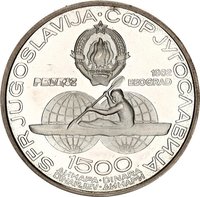
Commemoration: International Canoeing Championships
Context
Year: 1982
Issuer: Yugoslavia
Period:
(1963—1992)
Currency:
(1966—1989)
Demonetized: Yes
Total mintage: 46,000
Material
References
KM: #Click to copy to clipboard93
Numista: #40325
Value
Exchange value: 1000 YUD
Bullion value: $47.63
Obverse
Inscription:
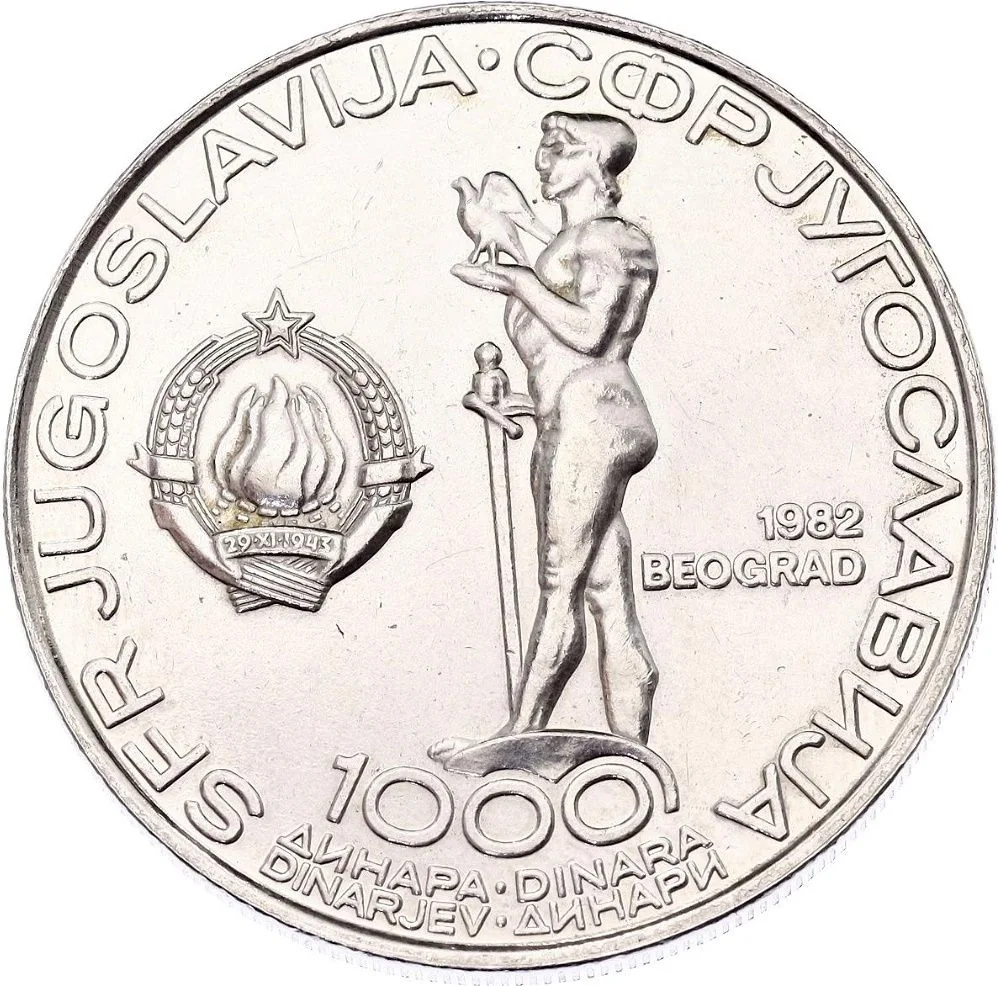
SFR JUGOSLAVIJA СФР ЈУГОСЛАВИЈА
29·XI·1943
1982 BEOGRAD
1000
ДИHAPA DINARA DINARJEV ДИHAPИ
29·XI·1943
1982 BEOGRAD
1000
ДИHAPA DINARA DINARJEV ДИHAPИ
Translation:
SOCIALIST FEDERAL REPUBLIC OF YUGOSLAVIA SOCIALIST FEDERAL REPUBLIC OF YUGOSLAVIA
29 NOVEMBER 1943
1982 BELGRADE
1000
DINARA DINARA DINARS DINARA
29 NOVEMBER 1943
1982 BELGRADE
1000
DINARA DINARA DINARS DINARA
Languages: Slovenian, Serbo-Croatian
Reverse
Inscription:
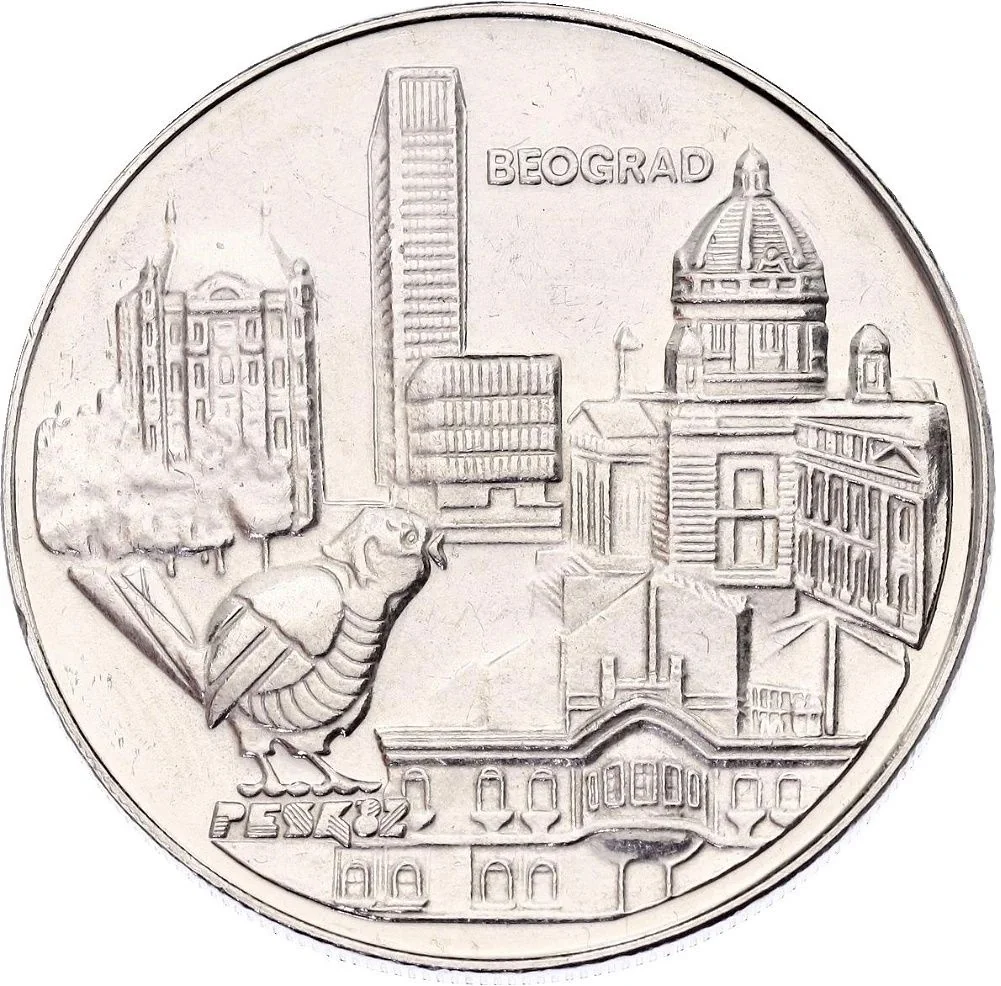
BEOGRAD
Script: Latin
Edge
Mintings
| Year | Mint Mark | Mintage | Quality | Collection |
|---|---|---|---|---|
| 1982 | — | 46,000 | Proof |
Historical background
By 1982, Yugoslavia's currency situation was a critical symptom of its deepening economic and political crisis. The country was grappling with severe stagflation—a combination of stagnant economic growth, high unemployment, and rampant inflation. The Yugoslav dinar, though officially pegged to a basket of currencies, was losing value rapidly on the black market, which had become a parallel and essential economy. This instability stemmed from decades of heavy foreign borrowing to fund industrial growth and imports, a policy that culminated in a crushing external debt exceeding $20 billion. Servicing this debt consumed a massive portion of the country's hard currency earnings from exports and tourism, creating chronic shortages of foreign exchange.
The federal structure of Yugoslavia exacerbated the monetary problems. The country's six republics and two autonomous provinces operated with significant economic independence, leading to divergent fiscal policies, internal trade barriers, and competition for foreign loans. The National Bank of Yugoslavia struggled to implement a coherent monetary policy, as constituent regions often circumvented federal credit restrictions. This resulted in excessive money printing to cover government deficits and the losses of inefficient, socially-owned enterprises, which directly fed hyperinflation. The dinar's instability was thus a direct reflection of the political system's inability to reconcile regional interests with federal economic discipline.
Internationally, 1982 marked a pivotal year as Yugoslavia formally entered negotiations with the International Monetary Fund (IMF) for a major stabilization loan. This move was a desperate necessity to avoid default and secure debt rescheduling with Western commercial banks. The impending IMF agreement, finalized in 1983, would impose harsh austerity measures—devaluation, spending cuts, and price liberalization—that further eroded living standards. Therefore, the currency situation in 1982 represented the final unraveling of the Yugoslav economic model, setting the stage for the severe austerity and social unrest of the following decade, which would ultimately contribute to the state's dissolution.
The federal structure of Yugoslavia exacerbated the monetary problems. The country's six republics and two autonomous provinces operated with significant economic independence, leading to divergent fiscal policies, internal trade barriers, and competition for foreign loans. The National Bank of Yugoslavia struggled to implement a coherent monetary policy, as constituent regions often circumvented federal credit restrictions. This resulted in excessive money printing to cover government deficits and the losses of inefficient, socially-owned enterprises, which directly fed hyperinflation. The dinar's instability was thus a direct reflection of the political system's inability to reconcile regional interests with federal economic discipline.
Internationally, 1982 marked a pivotal year as Yugoslavia formally entered negotiations with the International Monetary Fund (IMF) for a major stabilization loan. This move was a desperate necessity to avoid default and secure debt rescheduling with Western commercial banks. The impending IMF agreement, finalized in 1983, would impose harsh austerity measures—devaluation, spending cuts, and price liberalization—that further eroded living standards. Therefore, the currency situation in 1982 represented the final unraveling of the Yugoslav economic model, setting the stage for the severe austerity and social unrest of the following decade, which would ultimately contribute to the state's dissolution.
💎 Very Rare