

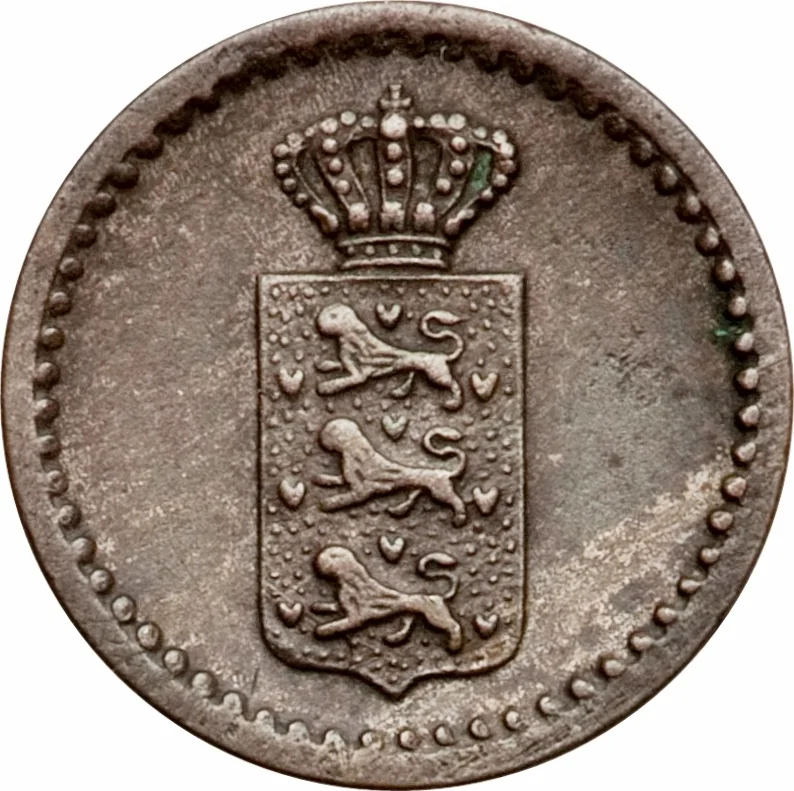
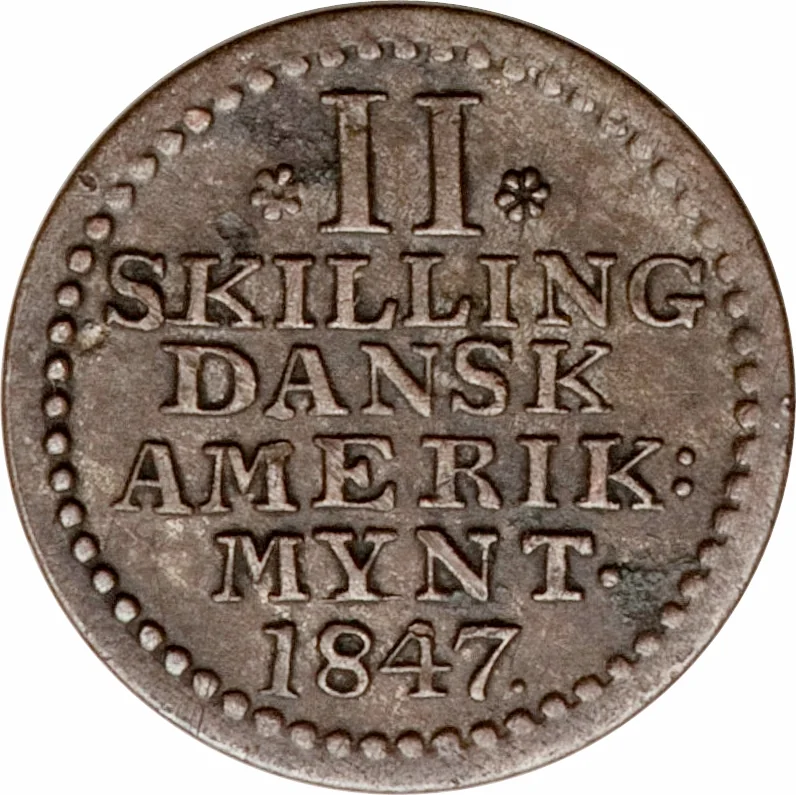
2 skilling – Danish West Indies
Add to wishlist
United States
Context
Year: 1847
Country: United States
Issuer: Danish West Indies
Ruler: Christian VIII
Currency:
(1740—1849)
Demonetized: Yes
Total mintage: 244,000
Material
References
KM: #
Numista: #40056
Obverse
Description:
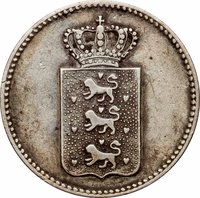
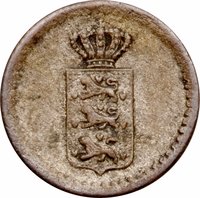
Arms with a crown.
Reverse
Edge
Plain
Mintings
| Year | Mint Mark | Mintage | Quality | Collection |
|---|---|---|---|---|
| 1847 | — | 244,000 |
Historical background
In 1847, the currency situation in the Danish West Indies (present-day U.S. Virgin Islands) was characterized by a complex and problematic multiplicity of circulating coins. The official currency was the Danish rigsdaler, divided into 96 skilling, but this system existed largely on paper for official accounts. In daily practice, the islands' economy, deeply integrated into regional Caribbean trade, relied heavily on a chaotic mix of foreign silver coins. Spanish and Mexican pesos, Dutch guilders, British sterling, and U.S. dollars all circulated simultaneously, their values fluctuating against each other and against the official Danish standard, causing confusion and facilitating fraud in commercial transactions.
This monetary disorder was a direct impediment to the colony's economic stability and administrative efficiency. Merchants and planters faced constant difficulties in calculating debts, contracts, and taxes, as the value of a coin depended not only on its type but also on its physical condition and the prevailing market rate on any given day. The colonial government recognized this as a major issue, as it complicated revenue collection and hindered clear financial planning. The problem was exacerbated by a chronic shortage of small change, which further disrupted local markets and wage payments to the labor force, primarily enslaved Africans and, increasingly after the 1848 emancipation, free workers.
The year 1847 is particularly significant as it marked a turning point, with the Danish authorities finally taking decisive action to resolve the long-standing crisis. A royal ordinance was issued that year to introduce a new, unified currency system specifically for the colony, scheduled to take effect in 1849. This reform aimed to replace the jumble of foreign coins with a single, decimal-based system pegged to the Danish rigsdaler, thereby simplifying trade and administration. Thus, the currency situation in 1847 was one of entrenched dysfunction, but also stood on the brink of a major, state-driven reform intended to modernize the colony's financial infrastructure.
This monetary disorder was a direct impediment to the colony's economic stability and administrative efficiency. Merchants and planters faced constant difficulties in calculating debts, contracts, and taxes, as the value of a coin depended not only on its type but also on its physical condition and the prevailing market rate on any given day. The colonial government recognized this as a major issue, as it complicated revenue collection and hindered clear financial planning. The problem was exacerbated by a chronic shortage of small change, which further disrupted local markets and wage payments to the labor force, primarily enslaved Africans and, increasingly after the 1848 emancipation, free workers.
The year 1847 is particularly significant as it marked a turning point, with the Danish authorities finally taking decisive action to resolve the long-standing crisis. A royal ordinance was issued that year to introduce a new, unified currency system specifically for the colony, scheduled to take effect in 1849. This reform aimed to replace the jumble of foreign coins with a single, decimal-based system pegged to the Danish rigsdaler, thereby simplifying trade and administration. Thus, the currency situation in 1847 was one of entrenched dysfunction, but also stood on the brink of a major, state-driven reform intended to modernize the colony's financial infrastructure.
💎 Very Rare