

1 Peso – Cuba
Non-circulating coins
Commemoration: Globalization
Cuba
Context
Year: 1999
Issuer: Cuba 
Issuing organization: Central Bank of Cuba
Period:
(since 1959)
Currency:
(since 1914)
Demonetization: 1999
Total mintage: 1,200
Material
Diameter: 38 mm
Weight: 26 g
Thickness: 2.9 mm
Shape: Round
Composition: Copper-nickel
Technique: Milled
Alignment: Coin alignment

flip
References
KM: #Click to copy to clipboard842
Numista: #400494
Value
Exchange value: 1 CUP
Obverse
Description:
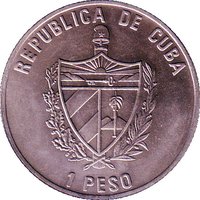
Cuban coat of arms with country name above and face value below. Same design as KM# 845 and 848.
Inscription:
REPUBLICA DE CUBA
1 PESO
1 PESO
Translation:
REPUBLIC OF CUBA
1 PESO
1 PESO
Script: Latin
Language: Spanish
Designer: Charles Edward Barber
Reverse
Description:
World map with event name above, "globalización" at center, and dates below. Mintmark at bottom. Design matches KM#845/848 with updated event and date.
Inscription:
I Encuentro
Internacional de Economistas
globalización
del 18 al 22
de enero de 1999
Internacional de Economistas
globalización
del 18 al 22
de enero de 1999
Translation:
First International Meeting of Economists on Globalization
from January 18 to 22, 1999
from January 18 to 22, 1999
Script: Latin
Language: Spanish
Edge
Plain
Categories
| Map |
| Symbols> Coat of Arms |
Mints
| Name | Mark |
|---|---|
| Empresa Cubana de Acuñaciones | — |
Mintings
| Year | Mint Mark | Mintage | Quality | Collection |
|---|---|---|---|---|
| 1999 | — | 1,200 | BU |
Historical background
In 1999, Cuba’s currency situation was defined by a deep and problematic duality, operating under a system of two separate, non-convertible currencies. The Cuban Peso (CUP), the national currency for the populace, was used for salaries and the purchase of subsidized goods in rationed markets (la libreta), but its value was extremely low and it was virtually worthless internationally. Alongside it, the U.S. Dollar (USD) had been fully legalized for use by Cuban citizens since 1993, circulating widely in a parallel economy of "dollar-only" stores (shopping or diplotiendas) where a superior selection of food, medicine, and consumer goods was available exclusively for hard currency.
This dual system was a direct result of the economic crisis known as the Special Period, triggered by the collapse of the Soviet Union. The loss of Soviet subsidies and trade forced the government to open the economy to limited dollarization to attract foreign exchange from tourism, remittances, and foreign investment. Consequently, a stark social divide emerged between those with access to dollars (through tourism jobs, family abroad, or the black market) and those reliant solely on peso salaries, whose purchasing power had collapsed. The state itself became dependent on capturing these dollar flows to fund essential imports and maintain basic services.
The year 1999 fell within a period of relative stabilization for this awkward system, following the economic freefall of the early 1990s. However, the contradictions were acute and widely resented. The government maintained a fixed, artificial exchange rate of 1 USD to 1 CUP for official accounting, while the much weaker black-market rate reflected the peso's true value. This monetary apartheid created pervasive inequalities and inefficiencies, setting the stage for future, albeit slow-moving, reforms that would eventually lead to the creation of a convertible peso (CUC) in the 2000s as an intermediary step toward a more unified currency system.
This dual system was a direct result of the economic crisis known as the Special Period, triggered by the collapse of the Soviet Union. The loss of Soviet subsidies and trade forced the government to open the economy to limited dollarization to attract foreign exchange from tourism, remittances, and foreign investment. Consequently, a stark social divide emerged between those with access to dollars (through tourism jobs, family abroad, or the black market) and those reliant solely on peso salaries, whose purchasing power had collapsed. The state itself became dependent on capturing these dollar flows to fund essential imports and maintain basic services.
The year 1999 fell within a period of relative stabilization for this awkward system, following the economic freefall of the early 1990s. However, the contradictions were acute and widely resented. The government maintained a fixed, artificial exchange rate of 1 USD to 1 CUP for official accounting, while the much weaker black-market rate reflected the peso's true value. This monetary apartheid created pervasive inequalities and inefficiencies, setting the stage for future, albeit slow-moving, reforms that would eventually lead to the creation of a convertible peso (CUC) in the 2000s as an intermediary step toward a more unified currency system.
✨ Legendary