

20 centimes – France
Add to wishlist
France
Obverse
Description:
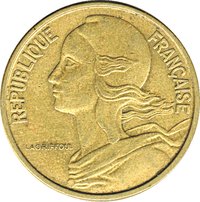
Marianne in left profile, wearing France's Phrygian cap of liberty, encircled by "REPUBLIQUE FRANÇAISE."
Inscription:
REPUBLIQUE FRANÇAISE
LAGRIFFOUL
LAGRIFFOUL
Translation:
FRENCH REPUBLIC
LAGRIFFOUL
LAGRIFFOUL
Script: Latin
Language: French
Engraver: Henri Lagriffoul
Reverse
Description:
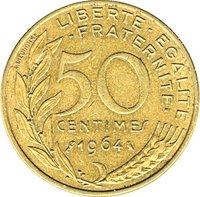
The face value is encircled by a wheat ear, an olive branch, and the French motto "LIBERTÉ - ÉGALITÉ - FRATERNITÉ".
Inscription:
A.DIEUDONNE
LIBERTE·EGALITE
·FRATERNITE·
20
CENTIMES
1968
LIBERTE·EGALITE
·FRATERNITE·
20
CENTIMES
1968
Translation:
By the grace of God
Liberty, Equality
Fraternity
20
Centimes
1968
Liberty, Equality
Fraternity
20
Centimes
1968
Script: Latin
Language: French
Engraver: Adrien Dieudonné
Edge
Plain
Categories
| Symbol> Allegory |
| Symbol> Phrygian cap |
Mints
| Name | Mark |
|---|---|
| Monnaie de Paris | — |
Mintings
| Year | Mint Mark | Mintage | Quality | Collection |
|---|---|---|---|---|
| 1962 | — | 3,500 | ||
| 1963 | — | 190,330,000 | ||
| 1964 | — | 127,546,600 | ||
| 1965 | — | 27,059,000 | ||
| 1966 | — | 21,762,171 | ||
| 1967 | — | 138,782,305 | ||
| 1968 | — | 77,411,000 | ||
| 1969 | — | 50,576,050 | ||
| 1970 | — | 70,050,000 | ||
| 1971 | — | 31,092,000 | ||
| 1972 | — | 39,755,000 | ||
| 1973 | — | 45,319,000 | ||
| 1974 | — | 54,348,811 | ||
| 1975 | — | 40,622,011 | ||
| 1976 | — | 117,645,711 | ||
| 1977 | — | 100,365,011 | ||
| 1978 | — | 125,039,011 | ||
| 1979 | — | 70,040,511 | ||
| 1980 | — | 20,010,011 | ||
| 1981 | — | 125,000,011 | ||
| 1982 | — | 150,002,511 | ||
| 1983 | — | 110,000,972 | ||
| 1984 | — | 200,000,447 | ||
| 1985 | — | 150,002,511 | ||
| 1986 | — | 40,000,011 | BU | |
| 1987 | — | 59,996,967 | BU | |
| 1988 | — | 223,230,576 | BU | |
| 1989 | — | 139,996,449 | BU | |
| 1990 | — | 50,000,011 | ||
| 1991 | — | 6,232 | Proof | |
| 1991 | — | 39,990,011 | ||
| 1992 | — | 4,938 | Proof | |
| 1992 | — | 89,965,011 | ||
| 1993 | — | 5,309 | Proof | |
| 1993 | — | 109,970,011 | ||
| 1994 | — | 4,566 | Proof | |
| 1994 | — | 79,973,368 | ||
| 1995 | — | 4,796 | Proof | |
| 1995 | — | 109,979,011 | ||
| 1996 | — | 139,984,011 | ||
| 1996 | — | 5,319 | Proof | |
| 1997 | — | 15,000 | BU | |
| 1997 | — | 436,231,513 | ||
| 1997 | — | 6,436 | Proof | |
| 1998 | — | 7,404 | Proof | |
| 1998 | — | 25,000 | ||
| 1999 | — | 10,000 | Proof | |
| 1999 | — | 25,500 | ||
| 2000 | — | 15,000 | Proof | |
| 2000 | — | 85,385,000 | ||
| 2001 | — | 35,000 | Proof | |
| 2001 | — | 125,000 |
Historical background
In 1962, France's currency situation was defined by the franc germinal (French Franc, FRF), a currency operating within the strict framework of the Bretton Woods system. France, like other major Western economies, pegged its currency to the US Dollar, which was itself convertible to gold at $35 per ounce. This fixed exchange rate regime, managed by the Banque de France, aimed to provide monetary stability and facilitate international trade. However, the franc faced underlying pressures, having been significantly devalued twice in the post-war period (in 1945 and 1948) and again by 17.5% in December 1958 as part of President Charles de Gaulle's and Prime Minister Michel Debré's stabilization plan to modernize the economy.
The early 1960s were a period of relative strength and confidence for the franc, often called the "franc fort" policy. The successful implementation of the 1958 Pinay-Rueff reform plan, which introduced a new "heavy franc" (equivalent to 100 old francs), cut public spending, and liberalized trade, had stabilized the currency and boosted foreign reserves. This period of economic growth, known as the "Trente Glorieuses," saw low inflation and a balanced budget, allowing France to declare the franc externally convertible for non-residents in 1961. This move was a key step toward integrating with the international financial system and bolstered the currency's credibility.
Despite this apparent stability, the fixed parity within Bretton Woods contained inherent tensions. France's growing economy and its commitment to maintaining a strong franc sometimes conflicted with domestic policy goals. Furthermore, President de Gaulle's growing skepticism of US dollar hegemony and his advocacy for a return to a pure gold standard would, later in the 1960s, lead to significant monetary clashes. Thus, while 1962 itself was a year of calm, it represented a precarious equilibrium within an international system that would begin to unravel by the decade's end, setting the stage for future franc devaluations and, ultimately, the collapse of the Bretton Woods system in the early 1970s.
The early 1960s were a period of relative strength and confidence for the franc, often called the "franc fort" policy. The successful implementation of the 1958 Pinay-Rueff reform plan, which introduced a new "heavy franc" (equivalent to 100 old francs), cut public spending, and liberalized trade, had stabilized the currency and boosted foreign reserves. This period of economic growth, known as the "Trente Glorieuses," saw low inflation and a balanced budget, allowing France to declare the franc externally convertible for non-residents in 1961. This move was a key step toward integrating with the international financial system and bolstered the currency's credibility.
Despite this apparent stability, the fixed parity within Bretton Woods contained inherent tensions. France's growing economy and its commitment to maintaining a strong franc sometimes conflicted with domestic policy goals. Furthermore, President de Gaulle's growing skepticism of US dollar hegemony and his advocacy for a return to a pure gold standard would, later in the 1960s, lead to significant monetary clashes. Thus, while 1962 itself was a year of calm, it represented a precarious equilibrium within an international system that would begin to unravel by the decade's end, setting the stage for future franc devaluations and, ultimately, the collapse of the Bretton Woods system in the early 1970s.

🌱 Very Common