

25 kuna – Croatia
Add to wishlist
Circulating commemorative coins
Commemoration: Accession Treaty to the European Union 9.12.2011
Croatia
Context
Material
Diameter: 32 mm
Weight: 12.75 g
Thickness: 2.2 mm
Shape: Dodecagonal
Technique: Milled
Alignment: Medal alignment
flip
References
KM: #
Numista: #39957
Value
Exchange value: 25 HRK
Obverse
Description:
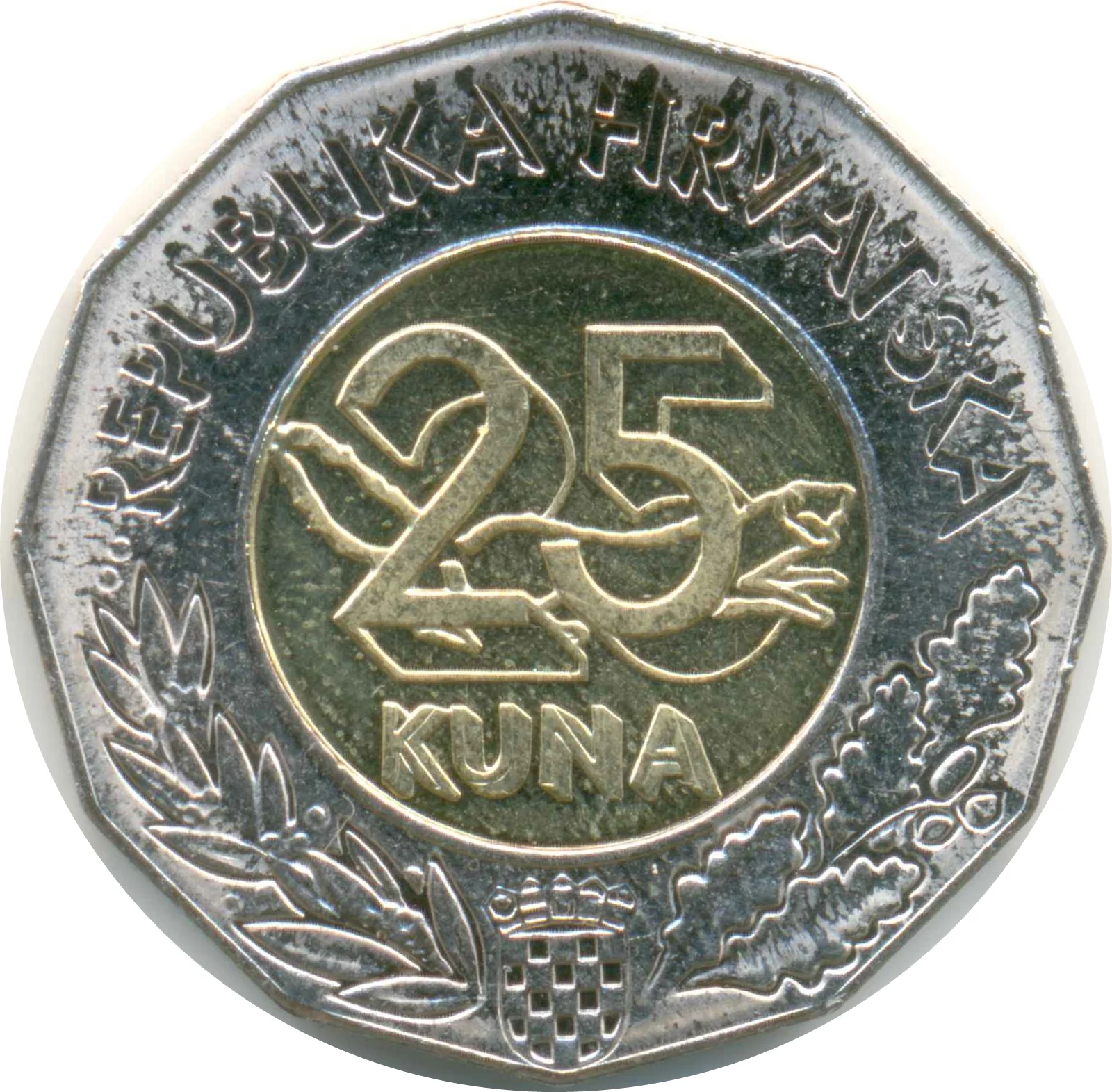
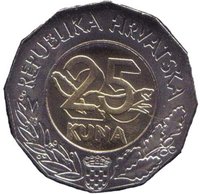
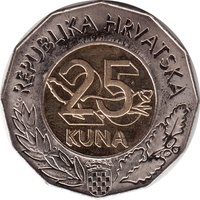
The brass center features the number "25" with a marten running right within its contours, and the word "KUNA" below. The outer ring displays the Croatian coat of arms flanked by laurel and oak branches, with "REPUBLIKA HRVATSKA" above.
Inscription:
REPUBLIKA HRVATSKA
25
KUNA
25
KUNA
Translation:
REPUBLIC OF CROATIA
25
KUNA
25
KUNA
Script: Latin
Language: Croatian
Engraver: Damir Mataušić
Reverse
Description:
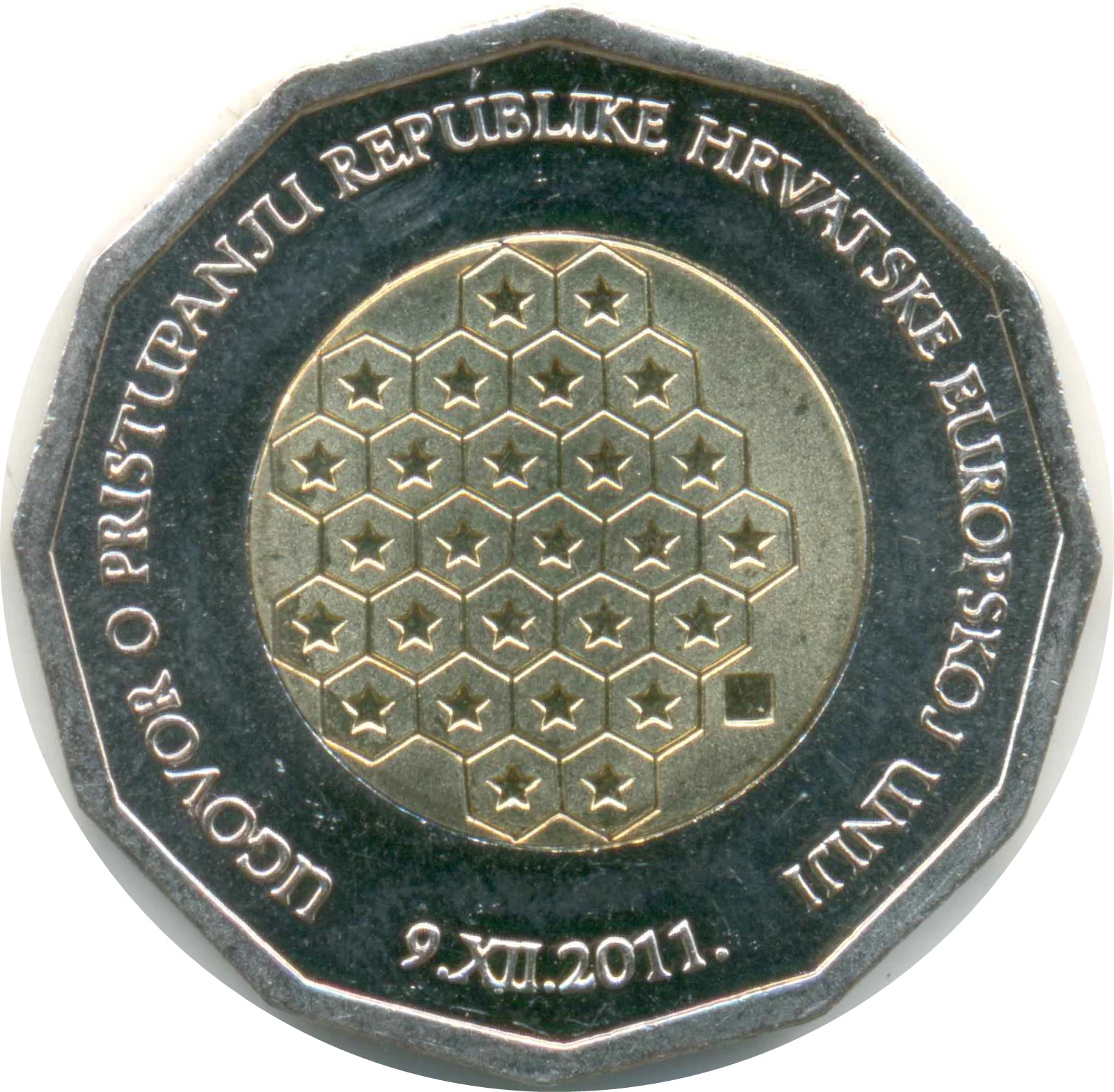
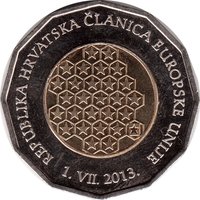
The brass center features a stylized EU honeycomb with twenty-seven starred cells for member states. Below, a square represents Croatia, poised to become the twenty-eighth star upon accession. The edge reads "UGOVOR O PRISTUPANJU REPUBLIKE HRVATSKE EUROPSKOJ UNIJI," and the lower ring bears the date "9.XII.2011."
Inscription:
UGOVOR O PRISTUPANJU REPUBLIKE HRVATSKE EUROPSKOJ UNIJI
9.XII.2011.
9.XII.2011.
Script: Latin
Engraver: Damir Mataušić
Edge
Plain
Mints
| Name | Mark |
|---|---|
| Croatian Mint | — |
Mintings
| Year | Mint Mark | Mintage | Quality | Collection |
|---|---|---|---|---|
| 2011 | — | 20,000 | ||
| 2011 | — | 2,000 | Proof |
Historical background
In 2011, Croatia's currency situation was defined by its long-standing use of the kuna (HRK) and the nation's strategic path toward European Union accession. The kuna, introduced in 1994 after the independence war, had established itself as a stable and fully convertible currency, pegged to a basket of currencies but effectively shadowing the euro. This stability was overseen by the Croatian National Bank (HNB), which maintained a managed float exchange rate regime, successfully shielding the economy from the wild volatility seen in some neighboring regions during the global financial crisis. However, this stability came with significant intervention costs for the HNB.
The dominant financial narrative of 2011 was Croatia's intense preparation for EU membership, scheduled for July 2013. A key requirement for eventual Eurozone adoption was participation in the European Exchange Rate Mechanism II (ERM II), which would require the kuna to maintain a stable exchange rate against the euro for a minimum of two years. Consequently, 2011 was a year of careful calibration, with monetary policy focused on maintaining kuna stability against the euro as a prerequisite for this next step. Public and political debate increasingly centered on the timeline for eventually replacing the kuna with the euro, though this was understood to be a post-accession project.
Despite institutional stability, underlying economic weaknesses posed challenges. The country was in the third year of a persistent recession, burdened by low growth, high public debt, and a large foreign trade deficit. These factors created downward pressures on the currency, which the HNB had to manage through foreign exchange reserves. Thus, the 2011 currency landscape was one of surface-level stability underpinned by strategic EU alignment, but also of underlying fragility as the economy struggled, highlighting the tension between monetary stability and broader fiscal and economic health.
The dominant financial narrative of 2011 was Croatia's intense preparation for EU membership, scheduled for July 2013. A key requirement for eventual Eurozone adoption was participation in the European Exchange Rate Mechanism II (ERM II), which would require the kuna to maintain a stable exchange rate against the euro for a minimum of two years. Consequently, 2011 was a year of careful calibration, with monetary policy focused on maintaining kuna stability against the euro as a prerequisite for this next step. Public and political debate increasingly centered on the timeline for eventually replacing the kuna with the euro, though this was understood to be a post-accession project.
Despite institutional stability, underlying economic weaknesses posed challenges. The country was in the third year of a persistent recession, burdened by low growth, high public debt, and a large foreign trade deficit. These factors created downward pressures on the currency, which the HNB had to manage through foreign exchange reserves. Thus, the 2011 currency landscape was one of surface-level stability underpinned by strategic EU alignment, but also of underlying fragility as the economy struggled, highlighting the tension between monetary stability and broader fiscal and economic health.
🌱 Fairly Common