

1 Koruna – Czechoslovakia
Context
Years: 1946–1947
Issuer: Czechoslovakia 
Issuing organization: Czechoslovak National Bank
Period:
(1945—1948)
Currency:
(1945—1953)
Demonetization: 31 May 1953
Total mintage: 100,550,000
Material
References
KM: #Click to copy to clipboard19
Numista: #3995
Obverse
Description:
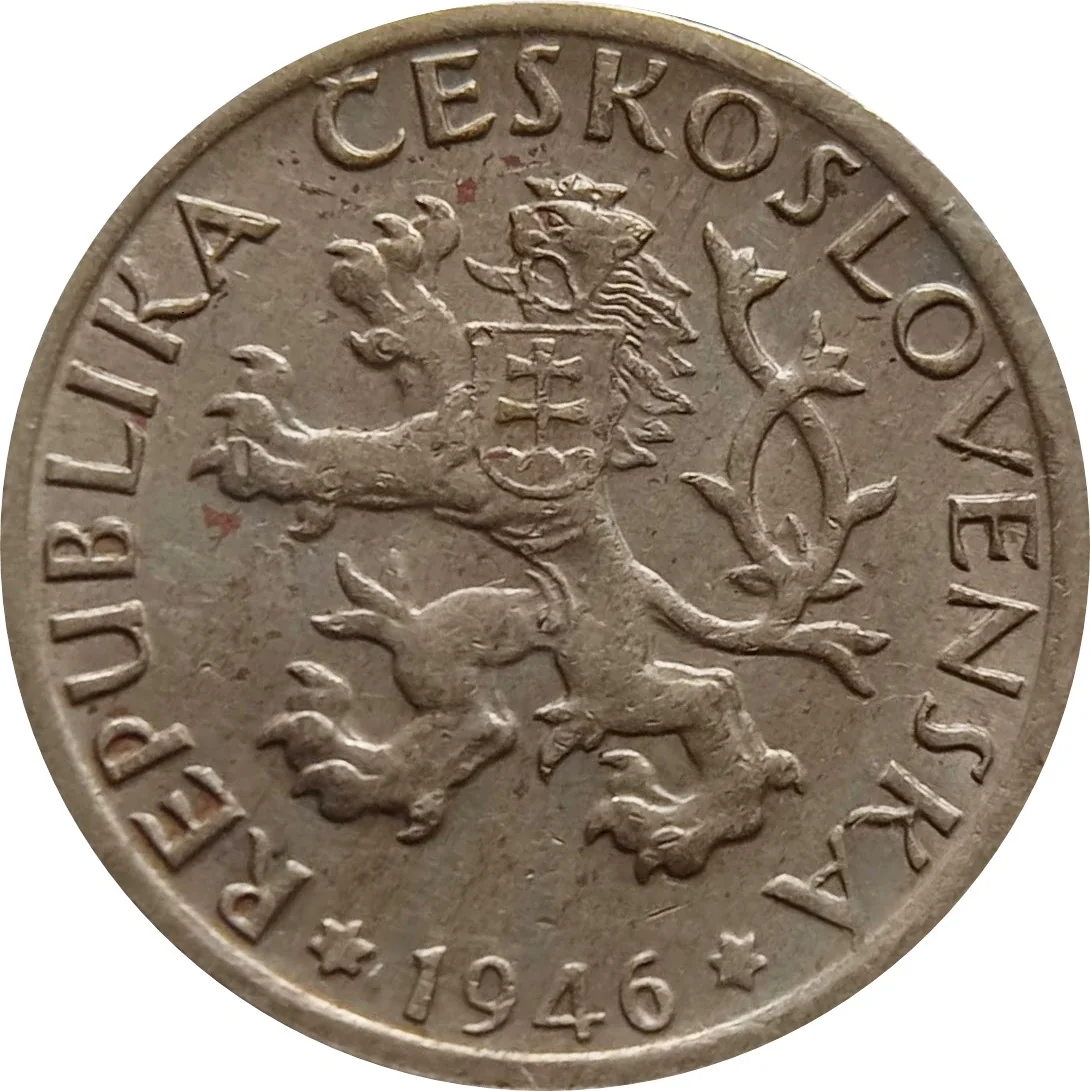
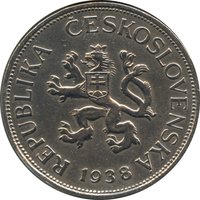
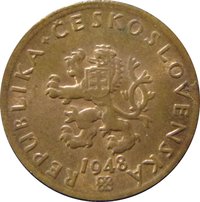
Czech lion with Slovak shield and date beneath.
Inscription:
REPUBLIKA ČESKOSLOVENSKÁ 1946
Translation:
REPUBLIC OF CZECHOSLOVAKIA 1946
Script: Latin
Language: Czech
Engraver: Otakar Španiel
Reverse
Description:
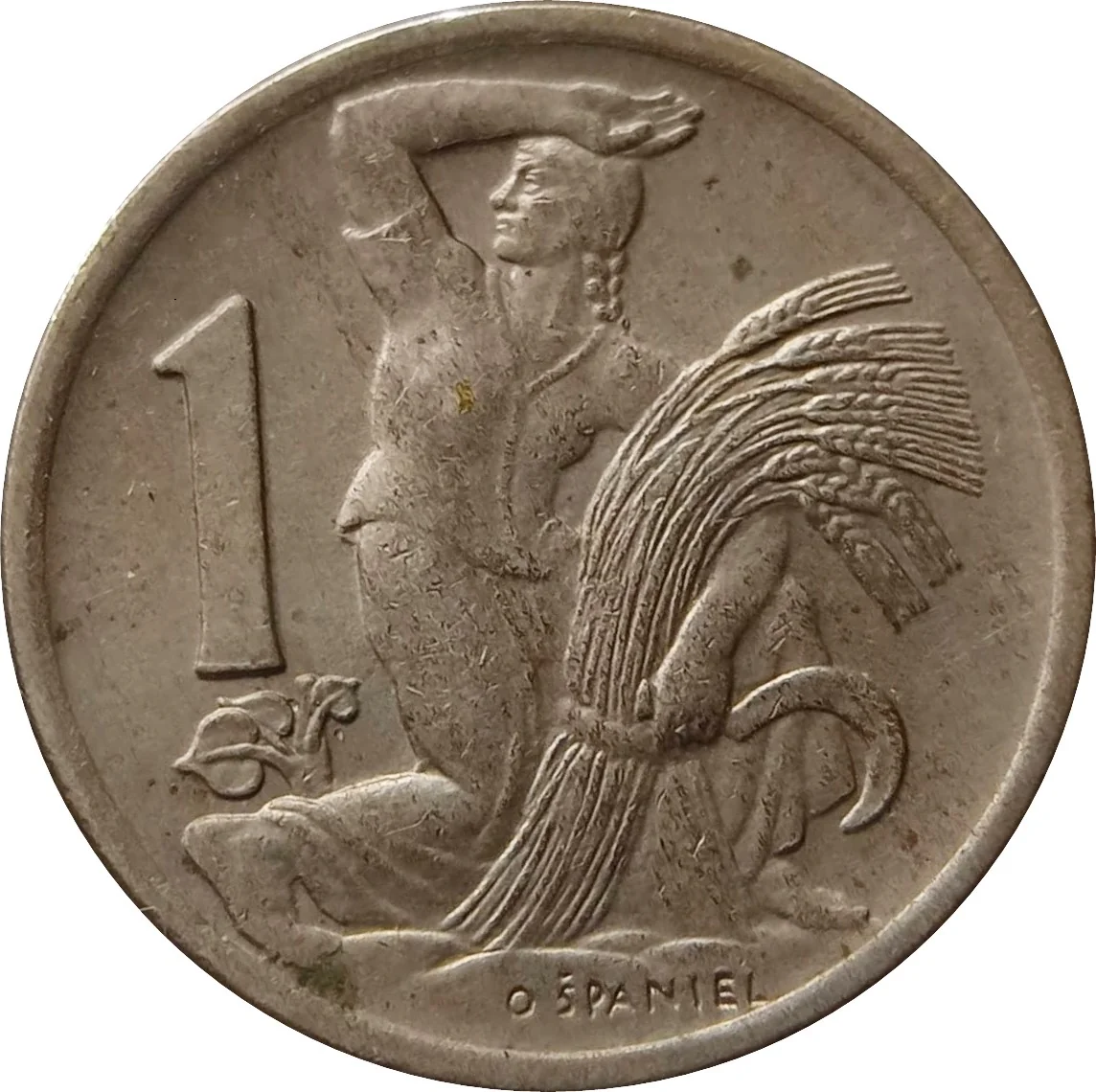
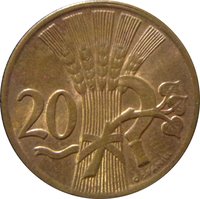
Woman with sheaf and sickle, denomination left.
Inscription:
1
O-ŠPANIEL
O-ŠPANIEL
Translation:
Oh, Spain
Script: Latin
Language: Spanish
Engraver: Otakar Španiel
Edge
Milled
Categories
| Agriculture |
| Symbols> Coat of Arms |
Mints
| Name | Mark |
|---|---|
| Kremnica | — |
Mintings
| Year | Mint Mark | Mintage | Quality | Collection |
|---|---|---|---|---|
| 1946 | — | 88,000,000 | ||
| 1947 | — | 12,550,000 |
Historical background
In the aftermath of World War II, Czechoslovakia in 1946 faced a severe and complex currency crisis. The economy was devastated, with widespread physical destruction, disrupted production, and a legacy of multiple currencies circulating from the occupation period, including the wartime Protectorate crown, Slovak crowns, and Reichsmarks. This monetary chaos, combined with a vast expansion of the money supply to finance the war and reconstruction, created intense inflationary pressures. A critical shortage of consumer goods meant that too much money was chasing too few products, leading to a thriving black market where prices were many times higher than official rates, severely eroding the purchasing power of ordinary citizens.
The Czechoslovak government, a broad National Front coalition, recognized that a fundamental monetary reform was the essential first step for economic recovery and the planned nationalization of key industries. Throughout 1946, intense preparations were made in secret for a radical currency confiscation and exchange. The goal was to sharply reduce the money supply, wipe out illicit wartime profits, and restore state control over the monetary system. The reform was also a political instrument, aimed at weakening the economic power of the former elite and speculators, thereby aligning with the socialist direction championed by the increasingly influential Communist Party within the government.
Thus, the currency situation in 1946 was one of tense anticipation and hidden planning. While the public grappled with the daily realities of inflation and scarcity, the state apparatus was designing what would become the dramatic Currency Reform of 1945 (implemented in stages from October 1945, with a major follow-up in 1953). The stage was being set for a profound financial reset that would not only stabilize the economy but also fundamentally reshape the distribution of wealth and advance the political transition toward a people's democracy, a process that would culminate in the Communist takeover in February 1948.
The Czechoslovak government, a broad National Front coalition, recognized that a fundamental monetary reform was the essential first step for economic recovery and the planned nationalization of key industries. Throughout 1946, intense preparations were made in secret for a radical currency confiscation and exchange. The goal was to sharply reduce the money supply, wipe out illicit wartime profits, and restore state control over the monetary system. The reform was also a political instrument, aimed at weakening the economic power of the former elite and speculators, thereby aligning with the socialist direction championed by the increasingly influential Communist Party within the government.
Thus, the currency situation in 1946 was one of tense anticipation and hidden planning. While the public grappled with the daily realities of inflation and scarcity, the state apparatus was designing what would become the dramatic Currency Reform of 1945 (implemented in stages from October 1945, with a major follow-up in 1953). The stage was being set for a profound financial reset that would not only stabilize the economy but also fundamentally reshape the distribution of wealth and advance the political transition toward a people's democracy, a process that would culminate in the Communist takeover in February 1948.
🌱 Very Common