

1 krugerrand – South Africa
Add to wishlist
South Africa
Context
Years: 2018–2025
Issuer: South Africa
Period:
(since 1961)
Currency:
(since 1967)
Total mintage: 114,000
Material
Diameter: 38.7 mm
Weight: 31.1 g
Silver Weight:: 31.07 g
Thickness: 2.84 mm
Shape: Round
Composition: 99.9% Silver
Standard: Silver ounce
Magnetic: No
Technique: Milled
Alignment: Medal alignment
flip
References
KM: #
Numista: #143754
Value
Bullion value: $79.39
Obverse
Description:
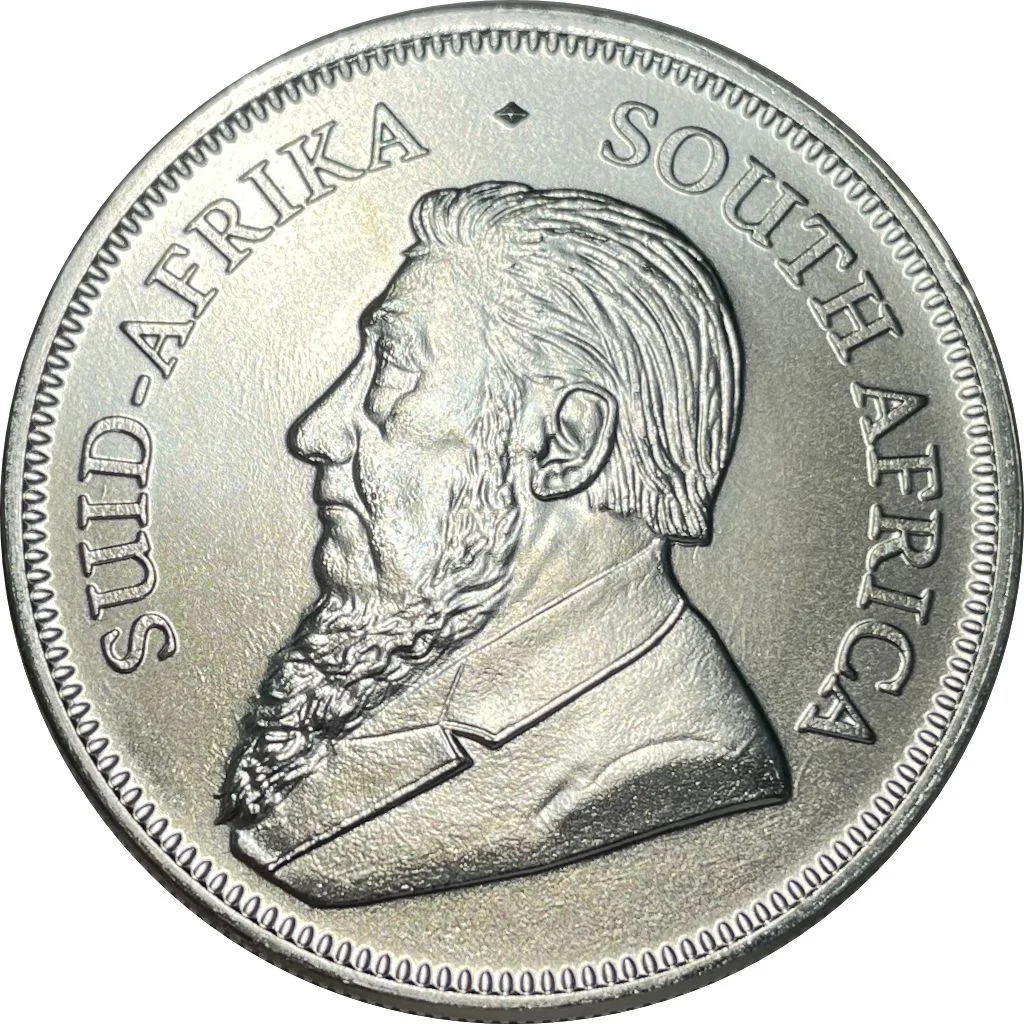
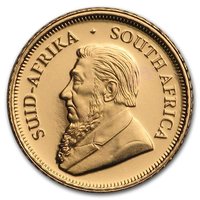
Paul Kruger effigy facing left, with "South Africa" in English and Afrikaans above.
Inscription:
SUID-AFRIKA⬩SOUTH AFRICA
Script: Latin
Designer: Otto Schultz
Reverse
Description:
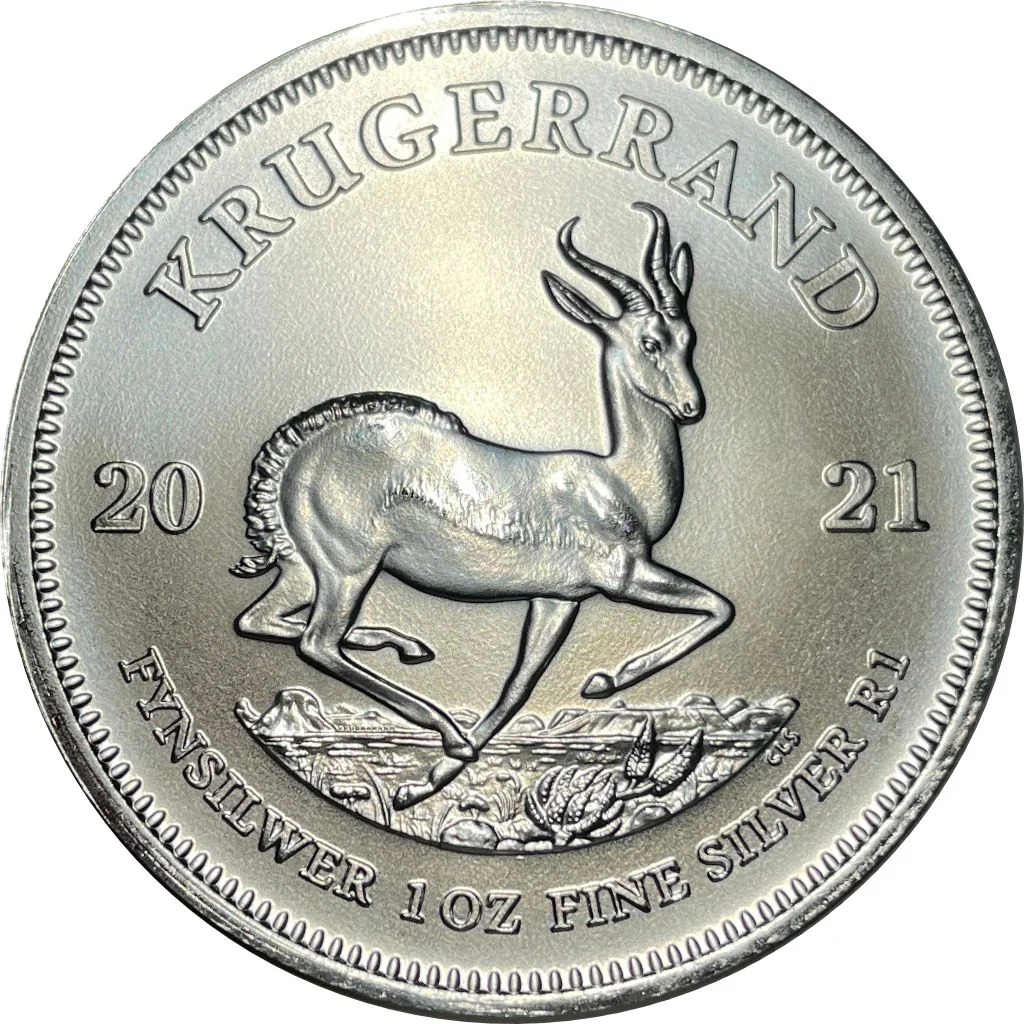
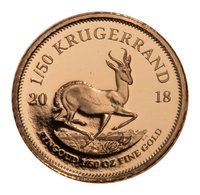
A pronking springbok on the savannah with "Krugerrand," its face value, date, and silver content.
Inscription:
KRUGERRAND
20 21
FYNSILWER 1 OZ FINE SILVER R1
CLS
20 21
FYNSILWER 1 OZ FINE SILVER R1
CLS
Script: Latin
Designer: Coert Laurens Steynberg
Edge
Reeded
Categories
| Animal> Cow |
| Person> Politician |
Mints
| Name | Mark |
|---|---|
| South African Mint | — |
Mintings
| Year | Mint Mark | Mintage | Quality | Collection |
|---|---|---|---|---|
| 2018 | — | — | ||
| 2018 | — | 15,000 | Proof | |
| 2018 | Great | — | ||
| 2019 | — | — | ||
| 2019 | — | 20,000 | Proof | |
| 2019 | Elephant | — | Proof | |
| 2019 | Lion | — | Proof | |
| 2019 | Spacecraft | — | Proof | |
| 2020 | — | — | ||
| 2020 | Leopard | — | Proof | |
| 2020 | Rhino | — | Proof | |
| 2020 | — | 20,000 | Proof | |
| 2021 | Elephant | — | Proof | |
| 2021 | Buffalo | — | BU | |
| 2021 | — | 20,000 | Proof | |
| 2021 | Buffalo | — | Proof | |
| 2021 | — | — | ||
| 2022 | — | 20,000 | Proof | |
| 2022 | Lion | — | Proof | |
| 2022 | Rhino | — | Proof | |
| 2022 | — | — | ||
| 2023 | — | — | ||
| 2023 | — | 11,000 | Proof | |
| 2023 | CPT | 1,000 | Proof | |
| 2024 | JHB | 1,000 | Proof | |
| 2024 | — | — | ||
| 2024 | — | 5,000 | Proof | |
| 2025 | JHB | 1,000 | Proof | |
| 2025 | SS | — | ||
| 2025 | — | — | Proof | |
| 2025 | — | — |
Historical background
In 2018, the South African Rand (ZAR) navigated a turbulent year characterized by significant volatility and depreciation, largely driven by domestic political and economic uncertainties. The currency began the year on a relatively strong note but faced intense pressure as investor confidence wavered. Key factors included the lingering effects of state capture allegations, persistent concerns over land reform policy, and disappointing economic growth data, which collectively fostered a climate of risk aversion among international investors. The Rand's value became a direct barometer of market sentiment towards the country's institutional stability and policy direction.
A major turning point occurred in the first quarter, with the currency suffering a sharp decline following the unexpected resignation of President Jacob Zuma in February and the subsequent ascent of Cyril Ramaphosa. While Ramaphoya's rise initially sparked a "Ramaphoria" rally on hopes of reform, the Rand quickly gave up these gains as the scale of the economic challenges and entrenched political divisions became apparent. External headwinds, notably a strengthening US Dollar and rising global trade tensions, further exacerbated the local currency's weakness, pushing it beyond R14/USD for sustained periods and breaching R15/USD at its lowest points in the year.
By year-end, the Rand had weakened considerably against major currencies, reflecting a sober reassessment of South Africa's near-term prospects. Although the threat of a sovereign credit rating downgrade to "junk" status by Moody's was staved off, the economy entered a technical recession, and fiscal concerns mounted around state-owned enterprises like Eskom. Thus, the 2018 currency situation underscored a fragile recovery hampered by slow implementation of structural reforms, highlighting the deep interconnection between political developments, economic policy, and investor confidence in determining the Rand's trajectory.
A major turning point occurred in the first quarter, with the currency suffering a sharp decline following the unexpected resignation of President Jacob Zuma in February and the subsequent ascent of Cyril Ramaphosa. While Ramaphoya's rise initially sparked a "Ramaphoria" rally on hopes of reform, the Rand quickly gave up these gains as the scale of the economic challenges and entrenched political divisions became apparent. External headwinds, notably a strengthening US Dollar and rising global trade tensions, further exacerbated the local currency's weakness, pushing it beyond R14/USD for sustained periods and breaching R15/USD at its lowest points in the year.
By year-end, the Rand had weakened considerably against major currencies, reflecting a sober reassessment of South Africa's near-term prospects. Although the threat of a sovereign credit rating downgrade to "junk" status by Moody's was staved off, the economy entered a technical recession, and fiscal concerns mounted around state-owned enterprises like Eskom. Thus, the 2018 currency situation underscored a fragile recovery hampered by slow implementation of structural reforms, highlighting the deep interconnection between political developments, economic policy, and investor confidence in determining the Rand's trajectory.

🌱 Very Common