

50 Øre – Norway
Norway
Context
Years: 1953–1957
Issuer: Norway 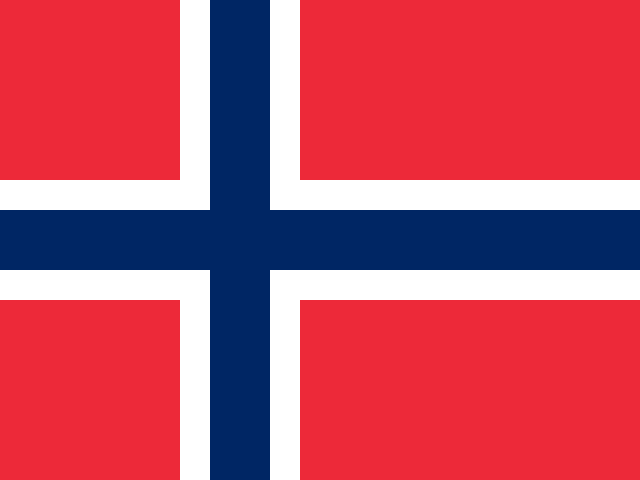
Ruler: Haakon VII
Currency:
(since 1875)
Demonetized: Yes
Total mintage: 7,960,000
Material
References
KM: #Click to copy to clipboard402
Numista: #1437
Value
Exchange value: 0.50 NOK = $0.05
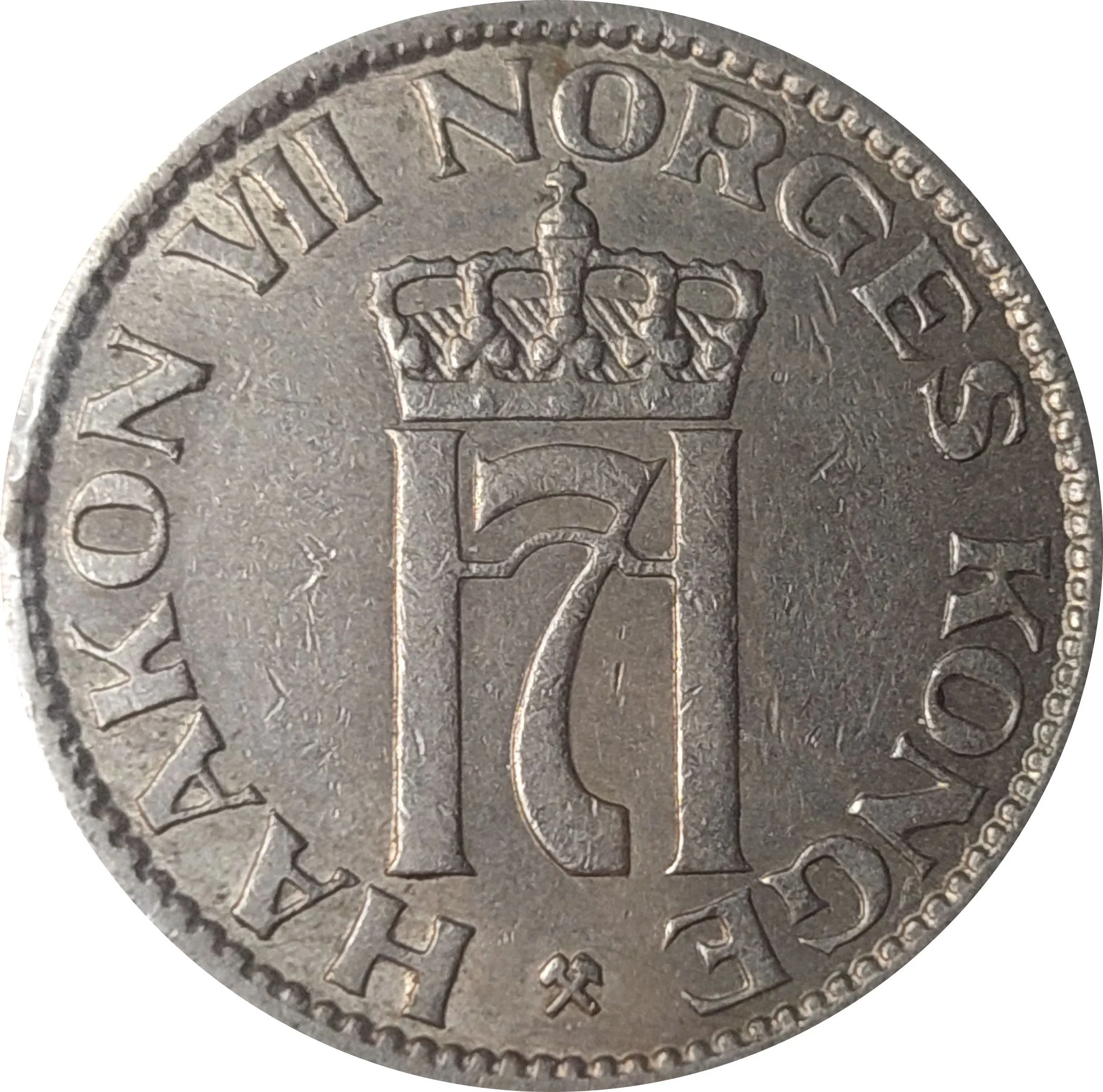
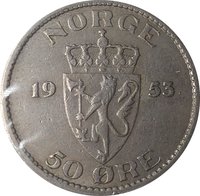
Obverse
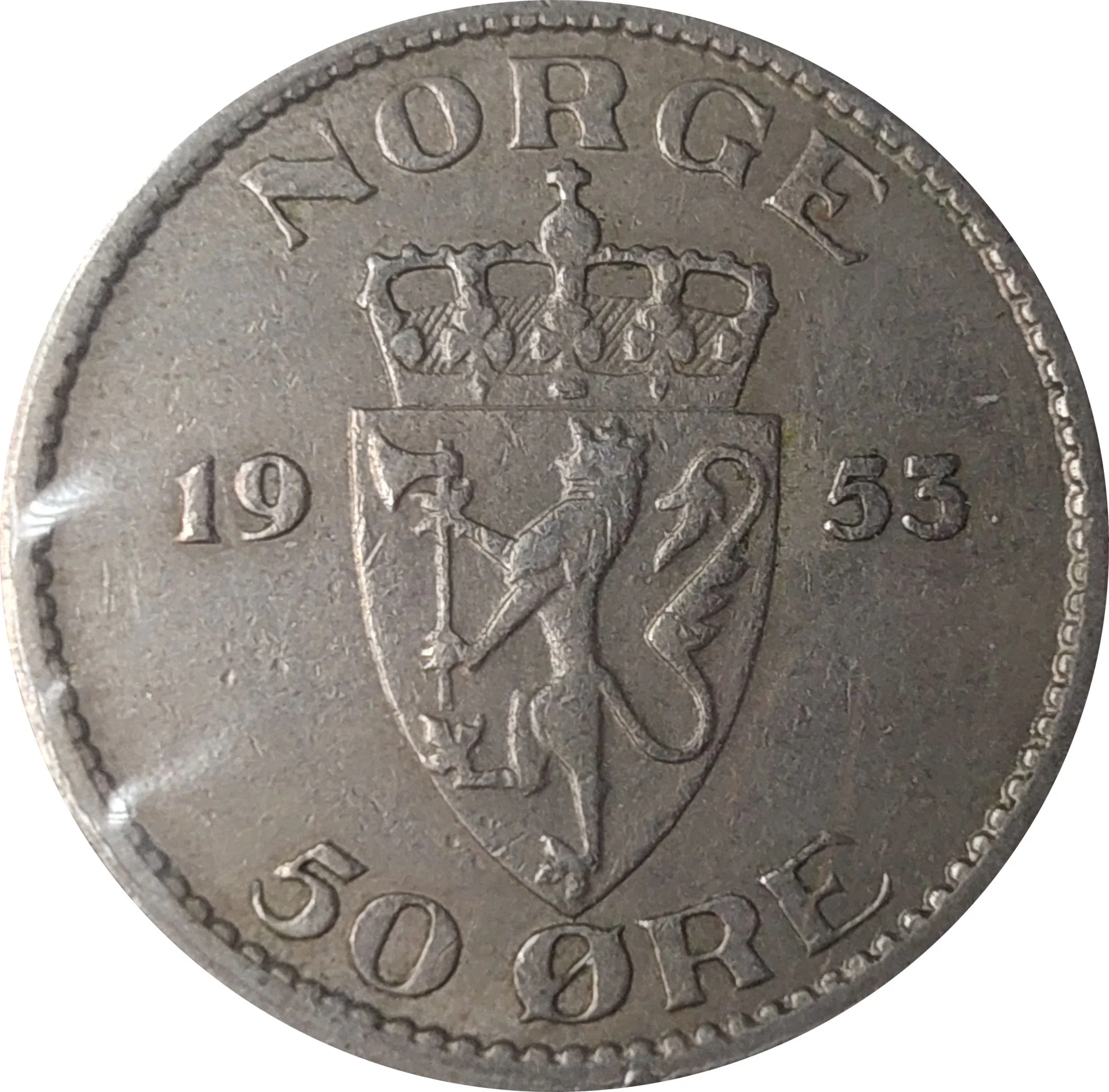
Reverse
Edge
Plain
Mints
| Name | Mark |
|---|---|
| Norwegian Mint | — |
Mintings
| Year | Mint Mark | Mintage | Quality | Collection |
|---|---|---|---|---|
| 1953 | — | 2,370,000 | ||
| 1954 | — | 230,000 | ||
| 1955 | — | 1,930,000 | ||
| 1956 | — | 1,630,000 | ||
| 1957 | — | 1,800,000 |
Historical background
In 1953, Norway's currency situation was defined by the Bretton Woods system, which pegged the Norwegian krone (NOK) to the US dollar at a fixed exchange rate of 1 USD = 7.142 NOK. This arrangement, established post-World War II, provided monetary stability but required Norway to maintain sufficient dollar and gold reserves to defend the peg. The system inherently limited independent monetary policy, as the Norges Bank (central bank) had to prioritize exchange rate stability, often adjusting interest rates to control capital flows and manage the balance of payments rather than focusing solely on domestic economic conditions.
Domestically, the economy was under a regime of strict financial regulation and credit controls. The legacy of wartime occupation and reconstruction, followed by the ambitious industrialization drives of the late 1940s and early 1950s, had led to persistent inflationary pressures and a high demand for investment capital. To manage this, authorities employed extensive rationing of credit through the central bank, directing loans to prioritized sectors like manufacturing, shipping, and housing, while limiting consumption and imports. This period was characterized by a "financial repression" environment, where interest rates were kept artificially low and access to foreign currency for imports was tightly controlled.
The year 1953 itself was not one of crisis but of managed adjustment within this constrained framework. The Korean War boom had subsided, easing some external price pressures, but the fundamental challenges of the fixed peg system remained. Discussions about potential exchange rate adjustments were ongoing in policy circles, foreshadowing the devaluation that would eventually occur in 1958 (to 1 USD = 7.143 NOK, a symbolic but minor change) and a more significant one in the 1960s. Thus, the currency situation in 1953 reflected a nation carefully navigating post-war reconstruction and growth within the rigid but stabilizing confines of the international Bretton Woods order.
Domestically, the economy was under a regime of strict financial regulation and credit controls. The legacy of wartime occupation and reconstruction, followed by the ambitious industrialization drives of the late 1940s and early 1950s, had led to persistent inflationary pressures and a high demand for investment capital. To manage this, authorities employed extensive rationing of credit through the central bank, directing loans to prioritized sectors like manufacturing, shipping, and housing, while limiting consumption and imports. This period was characterized by a "financial repression" environment, where interest rates were kept artificially low and access to foreign currency for imports was tightly controlled.
The year 1953 itself was not one of crisis but of managed adjustment within this constrained framework. The Korean War boom had subsided, easing some external price pressures, but the fundamental challenges of the fixed peg system remained. Discussions about potential exchange rate adjustments were ongoing in policy circles, foreshadowing the devaluation that would eventually occur in 1958 (to 1 USD = 7.143 NOK, a symbolic but minor change) and a more significant one in the 1960s. Thus, the currency situation in 1953 reflected a nation carefully navigating post-war reconstruction and growth within the rigid but stabilizing confines of the international Bretton Woods order.
🌱 Very Common