

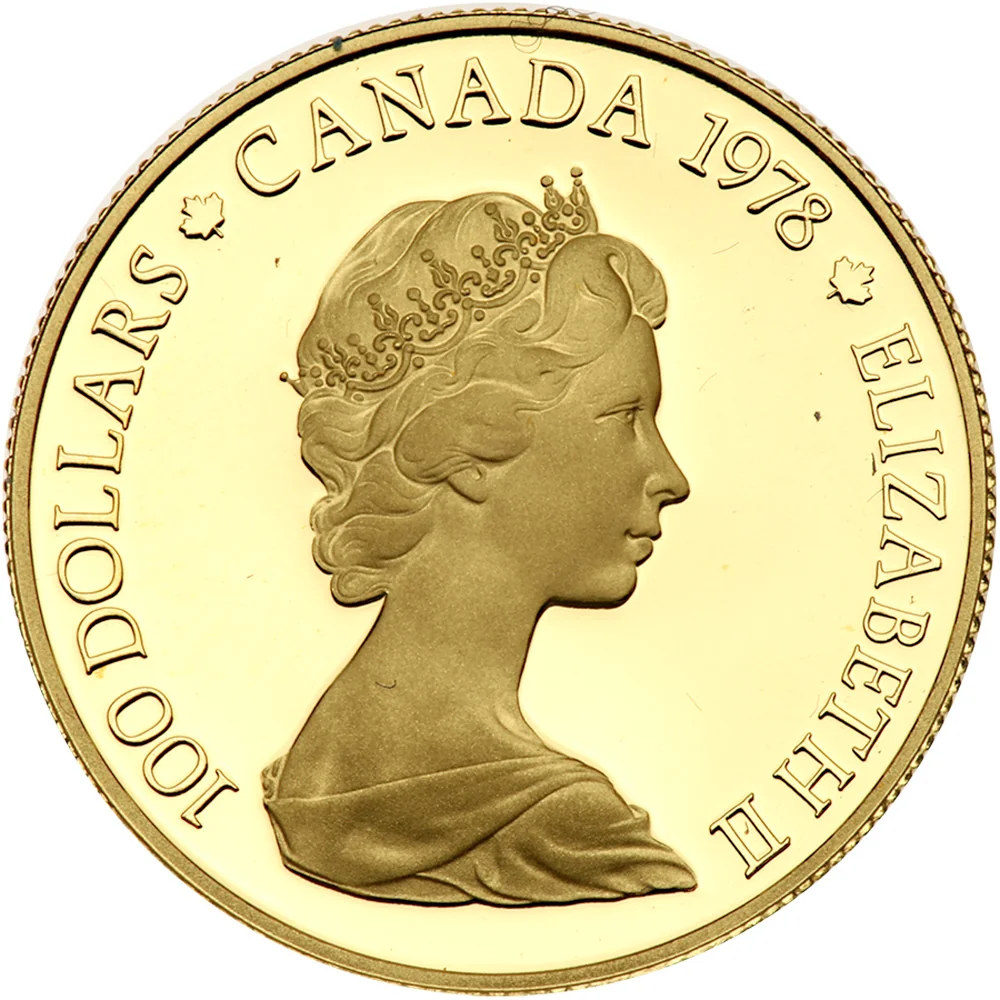

100 Dollars – Canada
Non-circulating coins
Commemoration: Canadian Unity
Canada
Context

Material

References
KM: #Click to copy to clipboard122
Numista: #39806
Value
Exchange value: 100 CAD = $73.13
Bullion value: $2593.97
Inflation-adjusted value: 481.43 CAD
Obverse
Description:
Bust of Queen Elizabeth II at age 37, wearing a tiara and facing right.
Inscription:
100 DOLLARS CANADA 1978 ELIZABETH II
Script: Latin
Designer: Arnold Machin
Reverse
Description:
Twelve geese in flight formation.
Inscription:
TOGETHER INTO THE FUTURE
ENSEMBLE VERS L'AVENIR
ENSEMBLE VERS L'AVENIR
Script: Latin
Engraver: Ago Aarand
Designer: R. Savage
Edge
Reeded
Mints
| Name | Mark |
|---|---|
| Royal Canadian Mint of Ottawa | — |
Mintings
| Year | Mint Mark | Mintage | Quality | Collection |
|---|---|---|---|---|
| 1978 | — | 200,000 | Proof |
Historical background
In 1978, Canada's currency situation was dominated by persistent inflation and a weakening Canadian dollar, set against a backdrop of global economic uncertainty. Domestically, inflation remained stubbornly high, hovering around 9%, despite the Bank of Canada maintaining a tight monetary policy with high interest rates. The Canadian dollar, which had traded near parity with the US dollar earlier in the decade, faced significant downward pressure, falling to approximately 84 US cents by year's end. This decline was fueled by a loss of investor confidence, concerns over the large federal budget deficit, and a general sense of economic malaise under Prime Minister Pierre Trudeau's government.
Internationally, the situation was exacerbated by a strong US dollar and volatile global currency markets. The US Federal Reserve, under Paul Volcker, was aggressively raising interest rates to combat its own inflation, which drew capital out of Canada and into higher-yielding US assets. Furthermore, Canada faced a growing current account deficit, as the cost of imported oil and manufactured goods rose. These factors combined to create a cycle where a falling dollar increased the cost of imports, thereby fueling further domestic inflation—a problematic feedback loop for policymakers.
The federal government's response in 1978 was marked by the introduction of a major austerity budget in April, which included spending cuts and tax increases in an attempt to curb the deficit and restore confidence. While the Bank of Canada continued its focus on price stability, the primary tools of direct currency intervention or capital controls were largely avoided. The year thus represented a challenging period of economic adjustment, where the currency's weakness was both a symptom of and a contributor to broader inflationary and competitiveness issues, setting the stage for the even more aggressive monetary policies that would follow in the early 1980s.
Internationally, the situation was exacerbated by a strong US dollar and volatile global currency markets. The US Federal Reserve, under Paul Volcker, was aggressively raising interest rates to combat its own inflation, which drew capital out of Canada and into higher-yielding US assets. Furthermore, Canada faced a growing current account deficit, as the cost of imported oil and manufactured goods rose. These factors combined to create a cycle where a falling dollar increased the cost of imports, thereby fueling further domestic inflation—a problematic feedback loop for policymakers.
The federal government's response in 1978 was marked by the introduction of a major austerity budget in April, which included spending cuts and tax increases in an attempt to curb the deficit and restore confidence. While the Bank of Canada continued its focus on price stability, the primary tools of direct currency intervention or capital controls were largely avoided. The year thus represented a challenging period of economic adjustment, where the currency's weakness was both a symptom of and a contributor to broader inflationary and competitiveness issues, setting the stage for the even more aggressive monetary policies that would follow in the early 1980s.

⭐ Rare