

5 Euro – Vatican City
Non-circulating coins
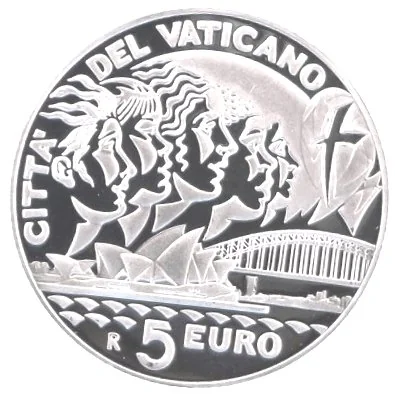
Commemoration: World Youth Day - Sydney
Vatican City
Context

Material
References
KM: #Click to copy to clipboard406
Numista: #39721
Value
Exchange value: 5 EUR = $5.91
Bullion value: $46.87
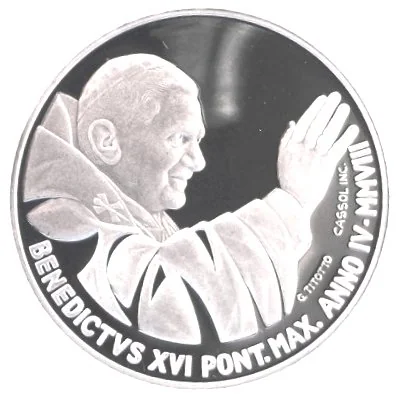
Obverse
Description:
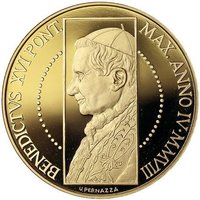
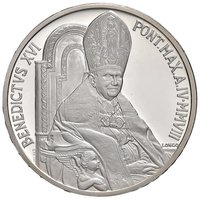
Pope Benedict XVI effigy.
Inscription:
BENEDICTVS XVI PONT.MAX. ANNO IV-MMVIII
G. TITOTTO CASSOL INC.
G. TITOTTO CASSOL INC.
Translation:
Benedict XVI Supreme Pontiff Year IV-2008
G. Titotto Cassol Engraver
G. Titotto Cassol Engraver
Script: Latin
Language: Latin
Engraver: Gabriella Titotto
Reverse
Edge
Lettering:COOPERATORES VERITATIS + MMVIII +
Legend:
COOPERATORES VERITATIS + MMVIII +
Mints
| Name | Mark |
|---|---|
| Rome | R |
Mintings
| Year | Mint Mark | Mintage | Quality | Collection |
|---|---|---|---|---|
| 2008 | R | 9,600 | Proof |
Historical background
In 2008, Vatican City’s currency situation was defined by its unique status as a sovereign city-state with an economy unlike any other nation. While it minted its own euro coins as a result of a 2000 monetary agreement with Italy (acting on behalf of the European Union), its practical economy did not function on a national scale. The Vatican’s limited issuance of euros—featuring the portrait of the reigning Pope—was primarily for collectors, souvenirs, and ceremonial purposes, rather than for domestic circulation to fund a public economy. Financially, the city-state’s operations were supported by museum revenues, postal sales, and donations, with the euro serving as the official legal tender for all transactions within its walls.
The year 2008 placed this arrangement under indirect strain due to the global financial crisis. While the Vatican’s budget was insulated from direct market speculation, its investments and the value of its substantial assets, managed by the Administration of the Patrimony of the Apostolic See (APSA), were impacted by the worldwide market downturn. Furthermore, the crisis affected the charitable giving and donations from the global Catholic faithful, which formed a crucial revenue stream. This financial pressure highlighted the vulnerability of the Holy See’s budget, even as its formal currency arrangement with the eurozone remained stable and unchanged.
Thus, the currency "situation" in 2008 was one of institutional stability in terms of the euro as the official currency, but underlying financial fragility due to the economic environment. The crisis underscored the dichotomy between the Vatican’s symbolic monetary sovereignty—exercised through its special-edition euro coins—and the real-world economic challenges of managing a non-commercial, donation-dependent institution during a period of severe global recession. This period would later contribute to increased internal calls for greater financial transparency and reform in the following decade.
The year 2008 placed this arrangement under indirect strain due to the global financial crisis. While the Vatican’s budget was insulated from direct market speculation, its investments and the value of its substantial assets, managed by the Administration of the Patrimony of the Apostolic See (APSA), were impacted by the worldwide market downturn. Furthermore, the crisis affected the charitable giving and donations from the global Catholic faithful, which formed a crucial revenue stream. This financial pressure highlighted the vulnerability of the Holy See’s budget, even as its formal currency arrangement with the eurozone remained stable and unchanged.
Thus, the currency "situation" in 2008 was one of institutional stability in terms of the euro as the official currency, but underlying financial fragility due to the economic environment. The crisis underscored the dichotomy between the Vatican’s symbolic monetary sovereignty—exercised through its special-edition euro coins—and the real-world economic challenges of managing a non-commercial, donation-dependent institution during a period of severe global recession. This period would later contribute to increased internal calls for greater financial transparency and reform in the following decade.
💎 Very Rare